Exploring the Human Condition
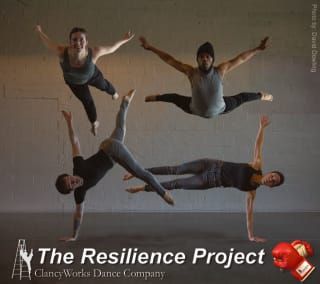
“The Resilience Project”
ClancyWorks Dance Company
Dance Place
Washington, DC
April 14, 2018
“The Resilience Project,” performed at Dance Place this past weekend by ClancyWorks Dance Company, investigated how an individual responds to and recovers from a blow. The show included additional performances from the Dance Place Repertory Class and The Ensemble from the University of Bedfordshire, and incorporated dancers with a variety of technical levels to offer a diversity of movement approaches, all relating to the theme of resilience. All the works integrated the concept of contact — whether it be between dancers or other objects — into established movements informed by familiar modern techniques. This explicit connection served as a representation of the everyday internal struggles we face due to the unsettling, chaotic world in which we live.
Dr. Adrienne Clancy, the founder and artistic director of ClancyWorks Dance Company, expressed her wish to illustrate the capacity of the human spirit to bounce back when things go wrong. She went on to explain how our current political and social environment functioned as a main inspiration for the performance. Her objective to expose this characteristic of the human condition was personalized by her mention of the struggles that artists and art-based institutions face in maintaining adequate funding, specifically citing recent threats to abolish the National Endowment of the Arts.
The company is well known for its inventive choreography and exploratory partner work. These strengths were prominent in “Stalked by Time,” a piece where two women exemplified a keen awareness of their partnership. The duet was abstract in movement quality, including various elements common to traditional modern technique, yet the work ventured from the normative through its progression. The foundation of the piece manifested in the ritualistic repetition of a distinct phrase, which the dancers reverted back to throughout the performance. By manipulating facing, timing, and proximity to each other, the dancers managed to recycle the phrase while maintaining interest, relating to a narrative that commented on the monotonous nature of daily routine. One of the performers (Nikki Morath) possessed a notably drawn out movement quality. As she lethargically shifted her weight from one side to the other, welcoming contact with the floor, she sustained a sense of internal initiation, despite the sedate speed of the movement. She and her partner Alex Alletto performed with conviction, exuding an effortless quality fully realized through their usage of natural momentum in their partnering.
The main work of the evening incorporated a variety of performance elements and storylines. Ironically, “Runnin’, Runnin’, Runnin’” began relatively stationary. The dancers relied heavily on gesture, remaining in a cluster set to one side of the stage. Projected images on the back wall shifted quickly and violently, including clips from the 2016 Presidential debate switching off to footage of melting ice caps within seconds. While the dancers did not directly interact with the projection, their movement seemed to be an implicit response to the chaos of conflicting images surrounding them. The motif of the defensive boxer became prominent in the piece. Dancers mimicked the stereotypically resilient athlete, bringing up their arms to protect their faces while swiping at the empty air in front of them, battling a palpable yet invisible foe. The boxing metaphor compared the struggles of every day individuals to that of a warrior. The dancers partnered with boxing equipment, which as structural props had the flexibility to be manipulated, immediately bouncing back to their original form. Devon Wallace, who Dr. Clancy credits for making an essential contribution to the choreographic process, performed an emotional solo full of bridled, fierce tension, employing his studio and street background to deliver a dynamic monologue of motion. The ending of the work was abrupt. The audio cut out, leaving the five dancers standing silently still, the prolonged projection engulfing their silhouetted forms. In general, the atmosphere of the finale made it seem that this dialogue was not fully resolved, but instead left to be continued.
The only work not choreographed by Dr. Clancy was performed by The Ensemble. The subject of the piece — borders that human beings fabricate — inspired movement that stemmed from one simple gesture: a hand shake. This gesture was used to advance more complex movement and hinted at the hypocrisy present in relationships. Dance Place's repertory class also performed a rich, lively number in which four partnerships took to the stage. While the continuous action throughout the piece seemed a bit overwhelming, the lighting design worked well to create a sense of order, grouping dancers and phrases together. In all, the evening of performance at Dance Place did not seek to resolve an issue, but instead made a complex observation concerning the human condition. While doing so, the dancers celebrated humanity’s resilient nature and explored this theme of pliability through the common thread of contact and partnering.
copyright © 2018 by Arielle Ostry



