Enfant no more
Mark Morris Dance Group
"Behemoth", "Looky", and "Socrates"
BAM Opera House
Brooklyn, New York
February 23, 2010
The Mark Morris Dance Company gave a brief season at BAM, with two works new to New York, "Looky" (2007), and the new ballet "Socrates", in addition to the 1990 "Behemoth". Morris, though always musical and inventive, has at times seemed deliberately quirky and overly cute, but this program was rich and moving. "Behemoth" showed his contrary side--this most musically astute of choreographers made a dance to silence, finding rhythm in coordinated moments and percussive footsteps. (Unfortunately, audience coughs added some dissonance.) For all the rhythm and coordination, "Behemoth" was generally dark and brooding (this is an observation, not a criticism). The various dancers, though performing the same steps, danced in isolation, often hunched over. Even the partnering seemed slightly ominous, as the dancers seemed variously ineffective comforters or sacrificial victims.
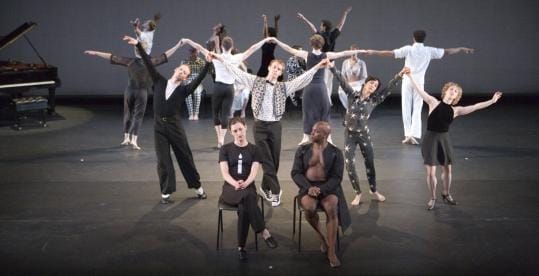
"Looky" was a witty and sardonic take on human behavior, with Morris, the champion of live music, choreographing to a player grand piano, whose ghostly keys tinkled cheerfully while his company mimed various scenes. Their casual, everyday behavior--sitting in chairs, walking around, looking at the sky--made the work seem lightweight, but it was the hidden ease of true artists. No one but a dancer could, by a subtle shift of a shoulder, turn into a poker playing cowboy, watched by a dance-hall boy and a tough little cowgirl.
"Socrates", a premier, to Eric Satie's simple and powerful cantata set to a French translation of extracts from Plato's Dialogues, is the kind of idea that would give a publicist the heebie--jeebies. What on earth would today's audience care about some dead philosopher? Fortunately, Morris is above such calculations, and "Socrates" is both glorious and haunting. The movements are deceptively simple, as the company moves from side to side, like a Greek frieze come to life. The three parts echo the divisions of the text, "Portrait of Socrates", "On the banks of the Illissus", and "Death of Socrates". Socrates is not the familiar elder sage; the limpid dances make it seem so wonderful to be young at the dawn of reason. Even the death isn't dark, just heartbreaking, as the English translation of Phaedo's matter-of-fact memories of Socrates' last moments are intoned by the tenor, the stylish Jean-Paul Fouchecourt. (As the hemlock started to work, I simply could not bear to read the text.) This was grief as ritual, echoing through the centuries, both universal and personal.
copyright © 2010 by Mary Cargill



