Elegance and Flair
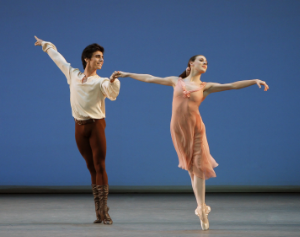
“Dances at a Gathering,” “Union Jack”
New York City Ballet
David H. Koch Theater
New York, NY
January 24, 2014
Mixing different styles, like flavors, can yield scintillating results, but you have to do it right. In pairing Robbins’s elegant “Dances at a Gathering” with Balanchine’s jolly “Union Jack” New York City Ballet accomplished just that. The expert performances of the two ballets contrasted, instead of clashed, and showcased the company’s artistic range. A little grace, a little fun, and NYCB’s got the perfect formula for a lot of happy viewers.
“Dances at a Gathering” has had to endure a series of weak performances lately, but this time thanks to skillful, if not altogether flawless, dancing it looked like the masterpiece that it is. From the outset the piece felt like a distillation of classical ballet to its beautiful basics. The dancers easily transitioned from lyricism to the character steps, which were performed with consistently correct form, yet never broke the continuity of the ballet’s style.
“Dances” works best when the performers’ individual coloring comes from more than the costumes, and the cast brought plenty of vivid shades. The brightest came from Megan Fairchild, who as the girl in apricot danced with such delightful ease and abandon that you almost overlooked her impressive delivery of the steps. Even the leap she did as the third girl in a diagonal of thrilling catches was full of joyful personality, a tricky feat when you finish upside down. Her energy also paired well with Antonio Carmena, who danced the boy in brick and looked his best beside her.
The other dancers each added their own nuanced pigments. Tiler Peck, in pink, and Tyler Angle, in purple, danced with such lovely elegance and surrender to Chopin’s music that each looked like the ballet was made for them. There were no excesses in their performance, yet plenty of moments made it memorable. Most remarkable was Peck’s series of partnered turns: each set looked as if it trickled with every piano note, pausing gently after a few rotations before speeding up synchronically with the music.
Zachary Catazaro, dancing for the first time the boy in blue, gave a smooth performance, and his partnering of Brittany Pollack, also in blue, looked particularly good. Although initially Joaquin De Luz, in brown, followed his inspired, dreamy entrance with strained jumps that looked like work, not dancing, that changed as the ballet progressed, and by his next appearance both his artistry and steps flowed with the music. A similar transformation happened to Adrian Danchig-Waring, in his debut as the boy in green, who quickly relaxed into his role and danced with youthful and lively refinement.
Sara Mearns, in mauve, looked like the principal of the company, even amidst this cast of mostly principals. She danced with artistry, but at times overdid it, and the emphasis she placed on her arms made them too dramatic for this elegant ballet. The approach might have worked had she been alone, but the strong style didn’t match Danchig-Waring, who in their duet was more restrained and appropriate.
The sole disappointment came from Maria Kowroski, whose girl in green looked rather gray. Her interaction with the three men lacked the independent air that can make this role fun and appealing and instead of looking flirtatious she came off as needy. When the scene was done and she was left alone on stage we did not share in her surprise by the predicament – it was no surprise they were uninterested.
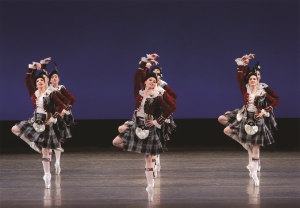
As colorful as “Dances” was, “Union Jack” looked comparably vibrant. From the first drum beats that begin the kaleidoscopic marches of the different regiments the dancers’ assertiveness primed you for this jovial British extravaganza (stiff upper lip definitely not included). The marching steps were perfectly accented to the accompanying beats while possessing an elegant balletic softness and control. Still, you knew the dancers weren’t giving you something completely serious.
The three first-timers in the ballet, Gonzalo Garcia, Andrew Veyette and Mearns, handled their roles like old hands. Garcia and Veyette danced the leads of Lennox and Dress MacLeod with dignity and élan, and executed the footwork well enough to satisfy any country dance fans in the audience. Mearns’ power-charged performance was well-suited for the MacDonald of Sleat, but alas, this portion of the ballet suffered from lack of uniformity from the corps. Of the ballet’s veterans, Abi Stafford stood out as the lead of the Green Montgomerie. She made each movement look bold and expansive and made it seem like she was coolly breaking decorum, adding flair to the dance.
The Costermonger Pas de Deux often has an entr’acte feel in “Union Jack,” but Jenifer Ringer and Amar Ramasar turned it into the highlight. Ringer, dancing weeks away from her scheduled retirement from the company, brought all the joys and lessons of her career to the stage. She was so engaging and natural that it made you think “one more year!” Ramasar was equally impressive as the Pearly King, his teasing and flirting and cheeky return for a second bow after the variation was entertainment at its best, at a music-hall or ballet theater.
The Royal Navy part of the ballet lightened the mood even further. The sailor dances looked effortless, proud and carefree. Teresa Reichlen added variety as the leader of Wrens by looking like a sassy fashion model, rounding off a well put-together evening.
copyright © 2014 by Marianne Adams



