East and West Together
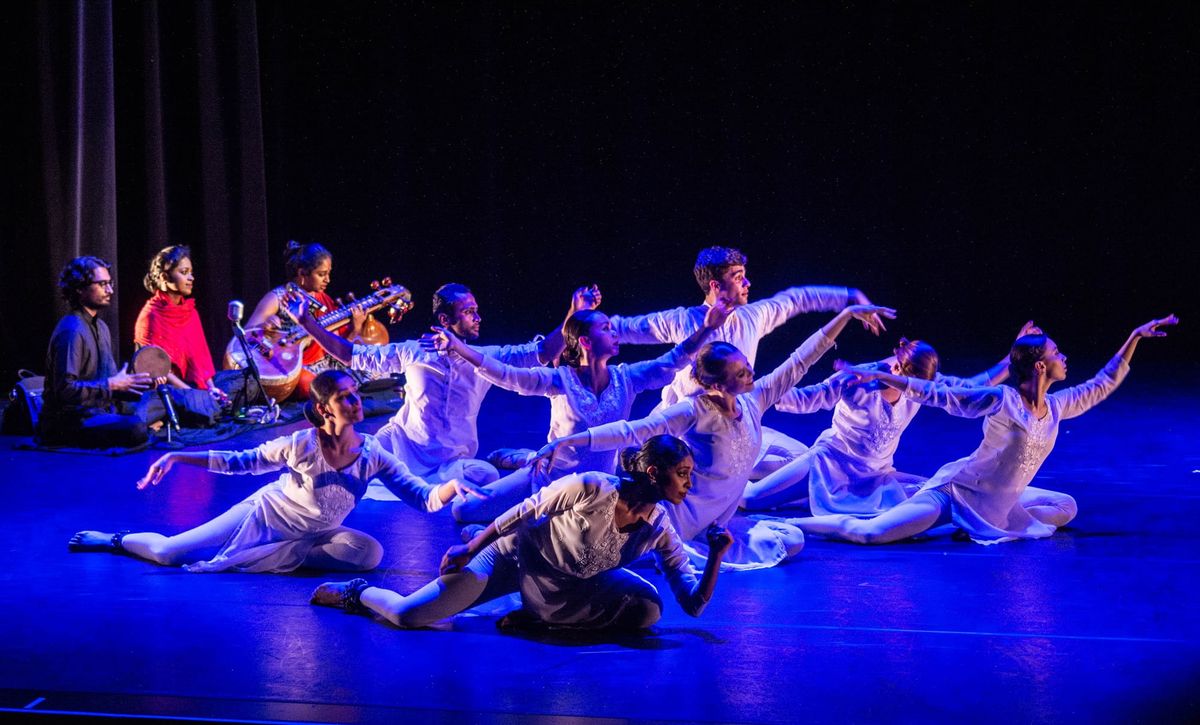
“Rajastra: The King’s Cloth” “Hamsa” “”Jangala”
Oakland Ballet Company
Odell Johnson Performing Arts Center Oakland, CA
June 1, 2019
Making the most out of whatever resources are available to you probably is not the least of a successful artistic director’s skills. Graham Lustig, the heart and brain behind the blossoming Oakland Ballet Company, certainly has what it takes. The company’s last season program was smartly planned, admirably danced and well received by the sizable matinee audience at Laney College’s Theater.
The three works, two of them world premieres, were collaboratively planned and realized by Lustig and Nadhi Thekkek, Artistic Director of Nava Dance Theatre. For the second time, the two choreographers were drawn together by the similarity they perceived between classical ballet and Bharata Natyam. Lustig’s welcoming introduction explained the parallels to the mixed audience: the vertical spine, the pliés and the expressive arms. He even spelled out some of the mudras.
The program opened with choreography by Thekkek and Shruti Abhishek and a quintet of Nava dancers plus five Indian musicians. Hans Christian Andersen’s “The Emperor’s New Clothes” had inspired the clearly conceived and charmingly realized “Rajastra: The King’s Cloth.” Shruti Abhishek danced the vain ruler with a puffed up chest, percussive stomps and folded hands on her back. The quartet of weavers who tricked him with the promise of a fine suit of clothes impressed with nicely calibrated unisons and changes in formations. As the giggling mischievous girls they reminded me of Krishna’s gopi friends.
Collaboratively choreographed by Lustig and Thekkek, and danced by both Bharatanatyam and ballet dancers, “Hamsa” (Swan) juxtaposed poetry by Mary Oliver and Rabindranth Tagore. Ananya Ashhokwas composed and performed the score with the musicians. Dressed in white kurtas, the ten dancers became stylistically almost indistinguishable. The dancing was graceful but also robust. Performers might have individual trajectories coalescing into kaleidoscopic pictures or sculptural formations. Some might be rolling on the floor while others whipped through space. Textures remained transparent and loose as dancers disappeared and re-emerged two by two that evolved into quartets, trios and ensemble numbers Oakland dancer Landes Dixon stood out with his fine turns and elevation. “Hamsa” was delightful, musically convincing and a lot of fun to watch.
After intermission Oakland Ballet — currently fourteen members strong -- reprised the 2018 local premiere of Lustig’s “Jangala”, a retelling of how young Mowgli (Brandon Perez) grew among monkeys and eventually returned to the human world. Lustig’s score “by various Indian composers” featured classical, folk and pop music. Some of the ensemble sections probably could have been scaled a little bit more tightly but the characterization of both man and beast and the colorful production (scenic design by Howard Siskowitz) delighted both kids and adults. Story ballets are so rare, so Lustig’s is a welcome addition to the repertoire.
Structured into scenes that flowed into each other, the story is clearly told with Perez (technically strong with a lot charm) growing up by imitating his wolf cub siblings (Terra Liu and Nina Pearlmen). A roly-poly Baboo (a jolly Lawrence Chen) and a sleek Baghera (Dixon) teach him the laws of the jungle. That trio was as funny as it was tender.
The lawless monkey dance, which looked and sounded like a mix of Bangra and Bollywood, performed with much gusto, filled the stage with more energy than anything that preceded. Lovely touch came from Mowgli’s mother who, somewhat unsuccessfully tried to teach him a “civilized” way of eating. Probably not exactly true to Kipling but convincingly re-imagined, was Samantha Bell who danced the fierce Shere Khan in point shoes. Fletching her teeth and splaying her claws, she leapt over a cowering Mowgli. However, when her raging feline didn’t catch the prey, she tried turning herself into an alluring pussycat. No dice, it didn't take.
copyright © Rita Felciano 2019



