Drunk or Sober
"Company B", "Phantasmagoria", "Promethean Fire"
Paul Taylor Dance Company
New York City Center
New York, New York
March 2, 2011
A mix up meant that I missed the beginning of Paul Taylor's evergreen "Company B" and had to watch it on the monitor. Though I couldn't see the details the cast gave their interpretations, it was an interesting exercise, and made Taylor's use of unexpected pauses and shadows to shade the chipper and exuberant music much more vivid than the live performance. But even on the monitor, Annmaria Mazzini's "Rum and Coca-Cola" sizzled.
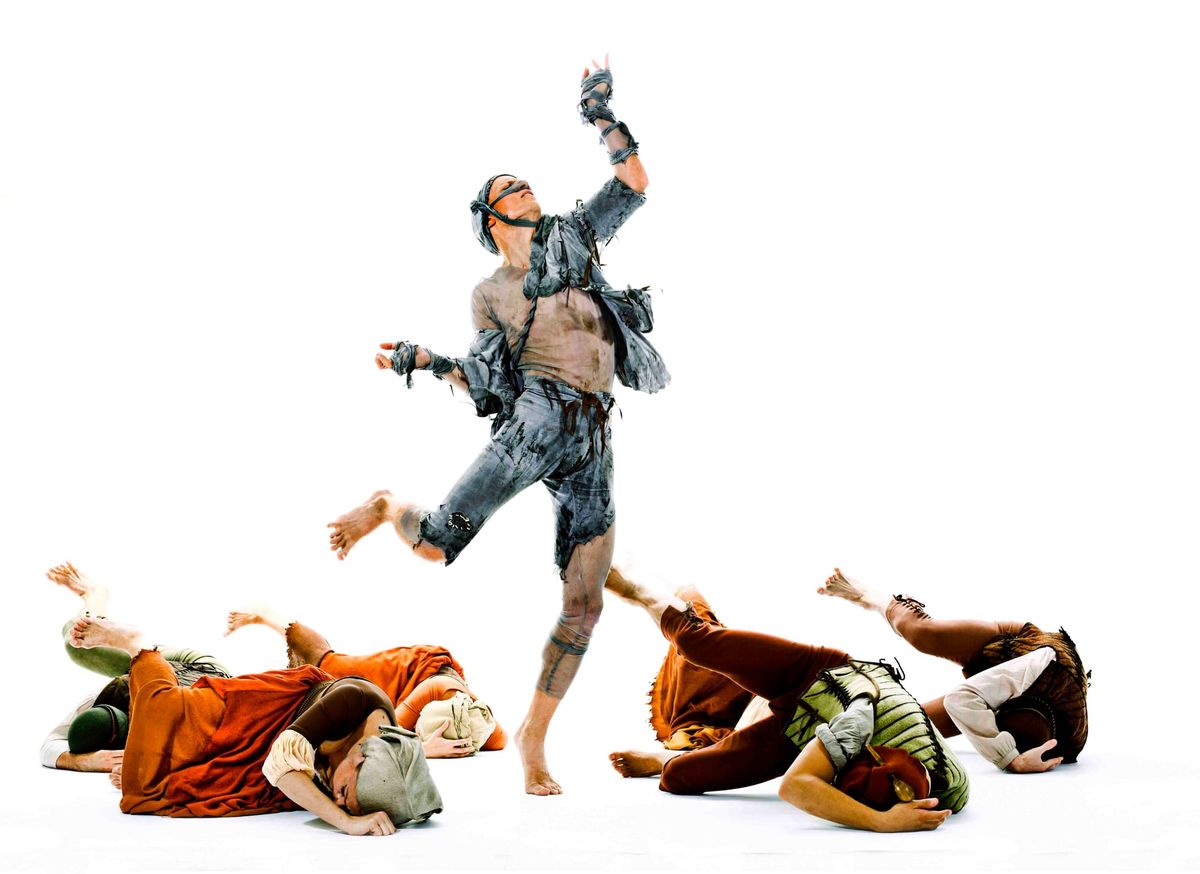
There is a little bit of everything in Taylor's new "Phantasmagoria", set to Renaissance music by Anonymous. This is Taylor being obviously jokey, rather than sly or witty, attributes also in his arsenal. He quotes Lewis Carroll "Life, what is it but a dream?", which seems a bit defensive, and the piece does look at times like out-takes from unrelated unused jokes from earlier works. It involves a group of Breugel peasants (whose male cohort sport over-sized cod pieces), an Orientalist Adam and Eve (complete with a snake used in various X-rated contortions), a prissy but easily distracted Mother Superior, and Irish step-dancer, a group of Isadora dancers, a drunk, and an attact of St. Vitus and his dances. It makes less sense than this summary implies.
But with Taylor as the choreographer, the individual vignettes are musical and vivid. Annmaria Mazzini as the outcast peasant, railing against some unknown fate, hinted at a more serious work, and she, with Amy Young and Laura Halzack, managed to be elegant and soft in the middle of sending up Isadora's Greek-inspired wardrobe. Michelle Fleet as a dead-pan Irish step dancer ending up on point now and then was very funny. However, drunks in dance, even when choreographed by Taylor, are embarrassing, and giving Robert Kleinendorst a pot-belly didn't help.
"Promethean Fire", from 2002, uses no gimmicks other than imaginative lighting (by Jennifer Tipton), and is a profound and moving work. It is set to Leopold Stokowski'sorchestration of Bach music, and the costumes, black leotards, set against a black background highlight the faces, arms and feet of the dancers, giving the work a magical, superhuman feel, as if the extremities were moving on their own, in a noble kaleidoscope of shifting shapes. There is a sense of gravity in the forms, perhaps of tragedy, as the bodies fall in a heap. The heart of the ballet is a pas de deux by two dancers rising out of that heap, Mazzini and Michael Trusnovec, a technical and musical tour de force. There are flashes of anger or rebellion, but it ends in a majestic calm, riding the crest of the soaring score. For me, Taylor trumps drunk Taylor but drunk or sober, Taylor is a great choreographer.
copyright © 2011 by Mary Cargill



