Dresden in New York
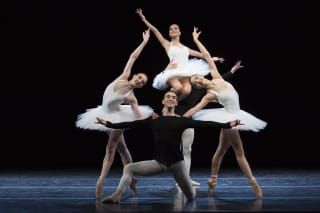
"5", Ganz leise kommt die Nacht / The Night Falls Quietly", "On the Nature of Daylight", "Vertigo Maze"
Dresden Semperoper Ballett
The Joyce Theater
New York, NY
November 1, 2017
The Dresden Semperoper Ballet, founded in 1823, boasts a roster of sixty dancers, and a repertory which, during the 2017-2018 season, encompasses everything from Petipa's "Sleeping Beauty" to Justin Peck's "Heatscape". Its inaugural season at The Joyce included eleven dancers from all ranks of the company (among them only one principal), four ballets, all ten years old or less and all U.S. local or world premieres, with three by choreographers, though not well known in New York, with serious Anglo-American ballet bona fides. David Dawson is a graduate of the Royal Ballet School, while Joseph Hernandez is a product of New York's own School of American Ballet. Stijn Celis, with his roots in continental Europe, may be familiar to locals from his work with the now defunct Cedar Lake Ballet. All in all a generous sample of an unfamiliar troupe.
Dawson's "5" which opened the program is a quintet, three women and two men, detached from the choreographer's version of "Giselle" where it was originally the wedding pas de cinq, an indication of how far Dawson has gone in re-imaging the ballet. So too, the music, by Adophe Adam, but reconceived by the conductor and composed David Coleman, so that it sounded not like "Giselle" but like the more upbeat pages of "Le Diable à quatre"; the "Giselle" that didn't sound like "Giselle" was certainly disconcerting, even distracting, upending aural expectations as it did – whether intentionally or not. The women's costumes, too, combined old and newer; flat white tutus, part "Etudes", part "Discrete Thrill of Exactitude", part ballet blanc. Dawson's desire to create a dialog between old and new is obvious. Only in the actual dancing does the blend look superficial and unfinished: a big frog-like jump, or a head to toe shimmy interrupted a classical phrase only to disappear as quickly as it had come. Gina Scott, Alice Mariana, Zarina Stahnke, Julian Amir Lacey and Michael Tucker were not phased by the non-stop stamina required of them, but were hemmed in by the small stage. "5" needs more space than it had to make a fully accurate impression, but a series of tours à la seconde got a rousing reception; straight forward, unapologetic balletic virtuosity is a rarity on The Joyce stage.
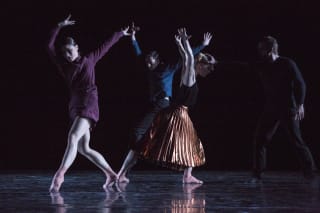
"Ganz leise kommt die Nacht / The Night Falls Quietly" is all but a Gesamt- kunstwerk with costumes and lighting by its choreographer, Joseph Hernandez (born 1988). The music by Bohren & Der Club of Gore, called in the program "an unholy mix" of jazz, rock and death metal. In practice, it sounded like lugubrious, inoffensive mood music, a sound track to a quartet for two couples who check each other out, test each other out, and without any explicit justification, ends with a long duet; the other couple just disappears. The star of the piece was Aidan Gibson's copper lamé pleated skirt, a wake up call in an evening of dark hues, white and off-white. Gibson was also the only dancer who could mold time to her needs, letting a full stretch expand and contract luxuriantly without loosing sight of the phrase as a whole. What any of this has to do with the statement in the program note the "the early 1990s demands nostalgia ... the last time ... that things appeared normal", is up for grabs. Perhaps the choreographer is looking back, longingly, to his childhood but ""Ganz leise kommt die Nacht" etc. doesn't make his case.
David Dawson returned with a pas de deux "On the Nature of Daylight" to the Max Richter score of the same name. It too was accompanied by a program note here about pure love, soul mates, and love lost, like two ships that meet prow to prow but, in the end, pass in the night. What one saw was mostly an adagio in which Alice Mariani was slung, spun and dragged around the stage by Julian Amir Lacey, before the two parted ways six minutes on.
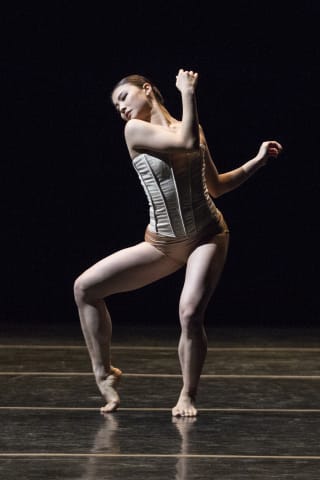
Only at The Joyce, after a trio of chamber-sized, works could an octet register like a cast of thousands. "Vertigo Maze" by Stijn Celis, set to Bach's "Chaconne for Solo Violin and Four Voices" (beautiful even when recorded, as was all the music), made the stage space crackle in three dimensions. And all it took was one set of bodies set at a ninety degree angle to the other. Is this the choreographer making concrete the push and pull between freedom and restriction (yes, that's paraphrasing a program note). There as also a goodly amount of flowing arms, flattened bodies like Paul Taylor in his Grecian vase mode, and more spinning and slinging. The tension of opposing groups often gave way to something much less compelling.
The evening as a whole was not as compelling as one might have wished. Program notes and stage action did not necessarily illuminate each other while giving the impression that dance needed the written word in order to be fully understood. Even when audible, dance rhythms never connected with the music viscerally. Most disappointing was that one saw human bodies in motion, able to do anything asked of them, rather than human beings, soaring beyond the steps and dancing.
copyright ©2017 by Carol Pardo



