Dorrance Dance
“Lessons in Tradition,” “Harlequin and Pantalone,” “Jump Monk,’ “SOUNDspace”
Dorrance Dance
New York City Center
New York, NY
March 28, 2019
It would be hard to imagine a more joyful choice for a celebration than Dorrance Dance, which opened New York City Center’s seventy-fifth anniversary season Thursday evening. Michelle Dorrance’s tap concerts seem made to lift the spirits. Much of this has to do with Dorrance, herself, a whirlwind of motion who appears to delight in every move she makes. But she is far more than a virtuoso tapper. She is also an innovative choreographer and imaginative artistic director who attracts outstanding dance talent. Each of her fourteen company members is a virtuoso in is or her own right. Dorrance also collaborates with important guest artists, in this case Bill Irwin and Kate Davis, who joined forces with her on Thursday.
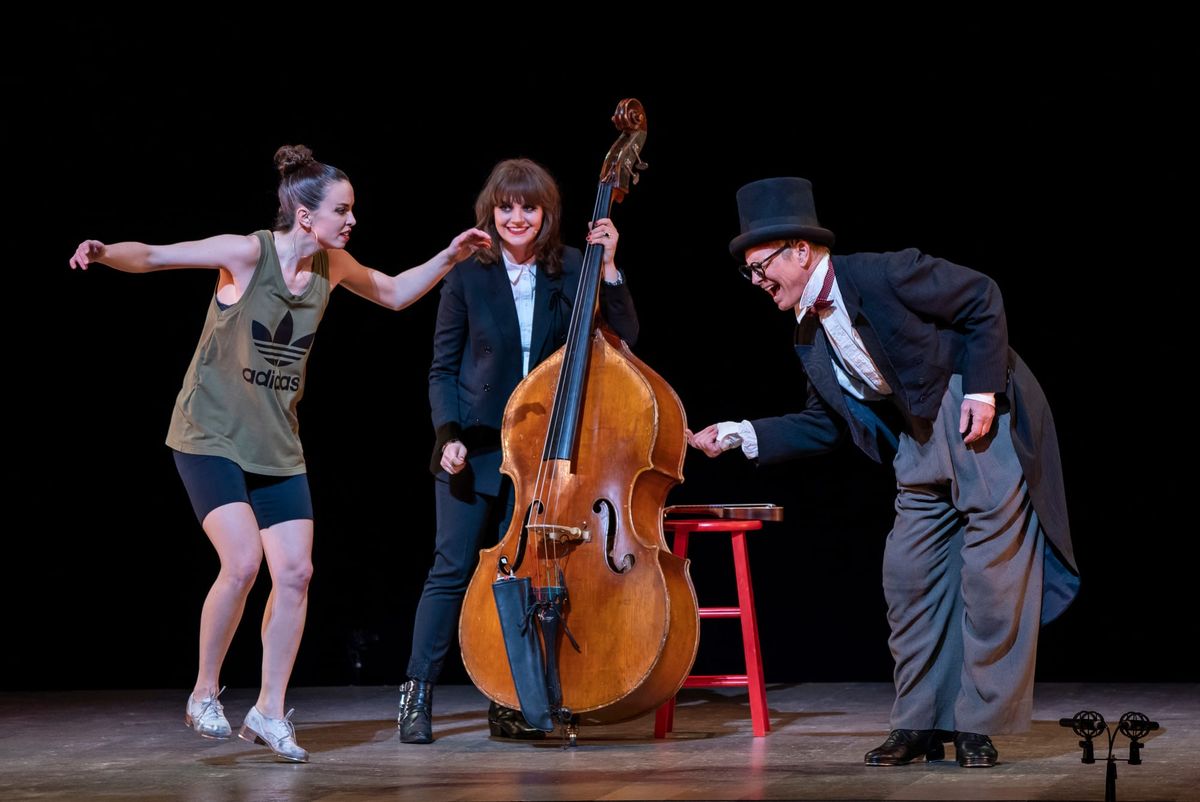
The three of them opened the program with a piece called “Lessons in Tradition,” choreographed by Dorrance and Irwin. Davis is a young singer and jazz bassist, who recently premiered an album entitled “Trophy,” which she created and fully produced, herself. Irwin has been a presence on the New York stage for decades, performing acclaimed leading roles in Broadway plays such as “Waiting for Godot” and “Whose Afraid of Virginia Woolf.” But he is best known for his clown productions, usually performed with colleagues.
Irwin’s sly humor was on display Thursday as he attempted to explain the difference between tap and soft shoe. He claimed to hate the sound of tap, so noisy, while demonstrating the supposed superiority of soft shoe. He also did not approve of Dorrance’s initial costume; she was wearing shorts while he was dressed in formal, though dilapidated, top hat and tails. The spoof continued as Dorrance made a second appearance in her own top hat and tails and Irwin donned tap shoes to join her. After extravagantly slipping and sliding about on the unaccustomed metal taps, Irwin finally got himself together, although at one point he had to call for oxygen when the dancing got a bit rambunctious. Meanwhile, all this silliness was accompanied by Davis, singing songs like “Tea for Two” and “Up a Lazy River” in a silken voice that made me want to hear her in a concert of her own.
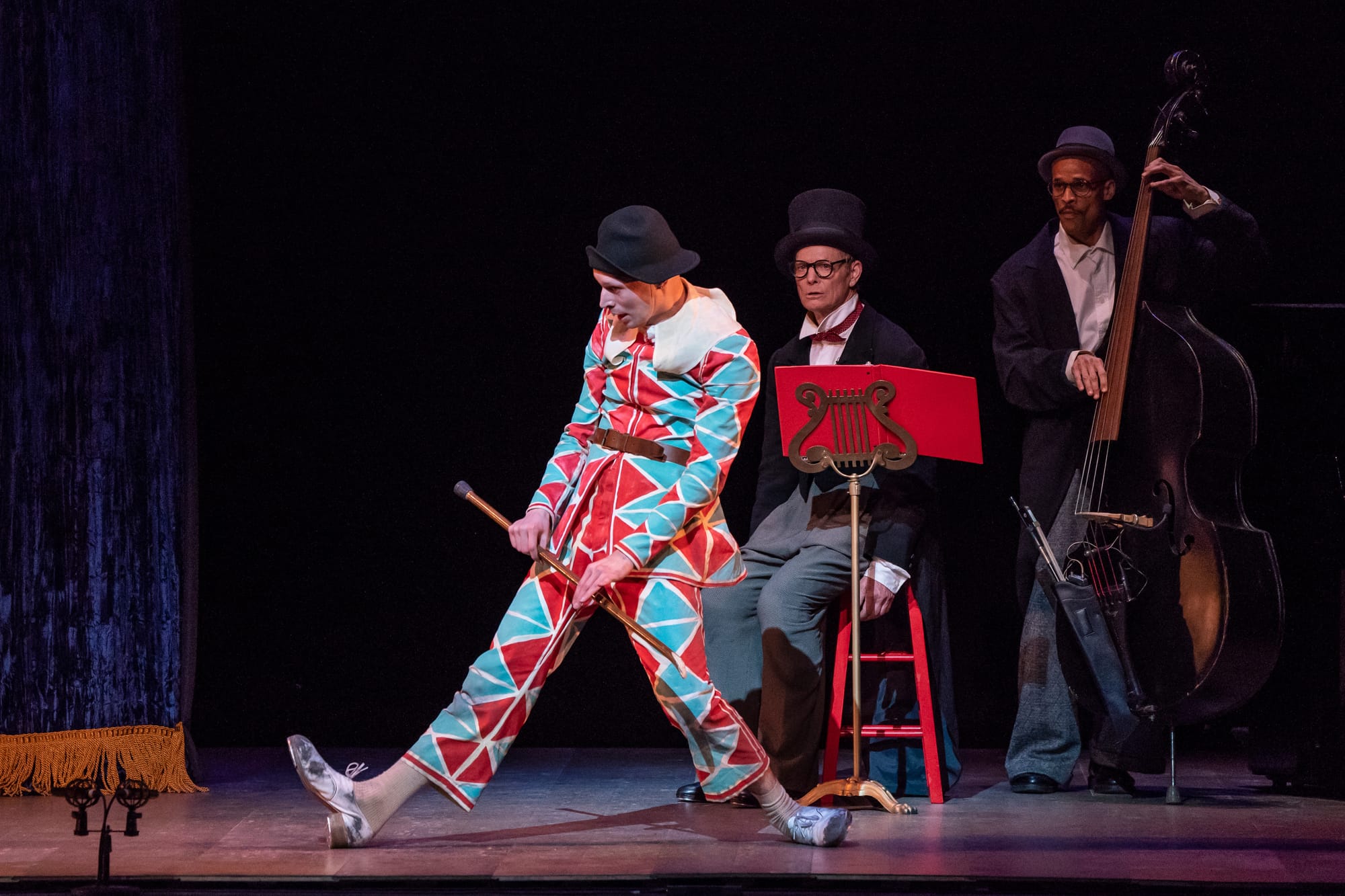
Irwin choreographed, wrote, and narrated the second work on the program, entitled “Harlequin and Pantalone,” which was a world premiere commissioned by City Center. Irwin told a story of commedia characters in which Harlequin, who is dedicated to dance, steals the cane of his master Pantalone. This infuriates Pantalone, who places a curse on Harlequin that prevents him from dancing. However, with the encouragement of narrator Irwin, Harlequin overcomes the curse and dances again. Irwin created a tour de force for dancer Warren Craft as Harlequin, who appeared in tandem as both Harlequin and Pantalone, and whose unusual style ranges from spasmodic, to loose, to astonishing in speed. Craft improvised a good deal of his individual dances, but Irwin set the action to make the most of it.
The other two works on the program made a fascinating contrast in styles and aims. The first, “Jump Monk” was choreographed by tap master Brenda Bufalino in 1997. The second, Dorrance’s “SOUNDspace,” was choreographed in 2013 as a site-specific work for St. Mark’s church in the Bowery, here seamlessly transferred to a proscenium stage. “Jump Monk” was set to music of Charles Mingus accompanied by Donovan Dorrance, piano; Aaron Marcellus, vocals; Gregory Richardson, bass; and Nicholas Van Young, percussion. Donovan Dorrance and Richardson also were the composers and accompaniment for “Harlequin and Pantalone.”
“Jump Monk” (Mingus’ salute to Thelonious Monk) was all about shifting rhythms in relation to the music, with the emphasis on ensemble dancing. Ten dancers started in horizontal lines that broke up then reformed in constantly changing patterns. All this was carried on in the most precise synchronized movement that was immensely impressive. Bufalino also contributed an audio recorded “Interlude” that served as a prelude to “Monk Jump.” It was called “My Minds on Mingus,” which was a meditation on, and homage to, the composer.
“SOUNDspace,” was also set for ten dancers, but it had an entirely different feel and momentum. Most important, it was a cappella, with no music per se, but rather a score made by the complex and varied rhythms, counter rhythms, and syncopation of the tapping. The work started in darkness with only the sound of tapping heard. Gradually the lights came up to semi-darkness, and we saw three dancers each standing on a box-like platform, slowly tapping rhythms that played off each other so that they sounded like coded conversations. Then a group of dancers tapped horizontally across the front of the stage, followed by another whose legs were spotlighted while the rest of their bodies remained in darkness. These dancers wore white shoes to emphasize their feet and moved, like the previous group, horizontally across the stage, this time in variations of a simple heel/toe step that became increasingly complicated.
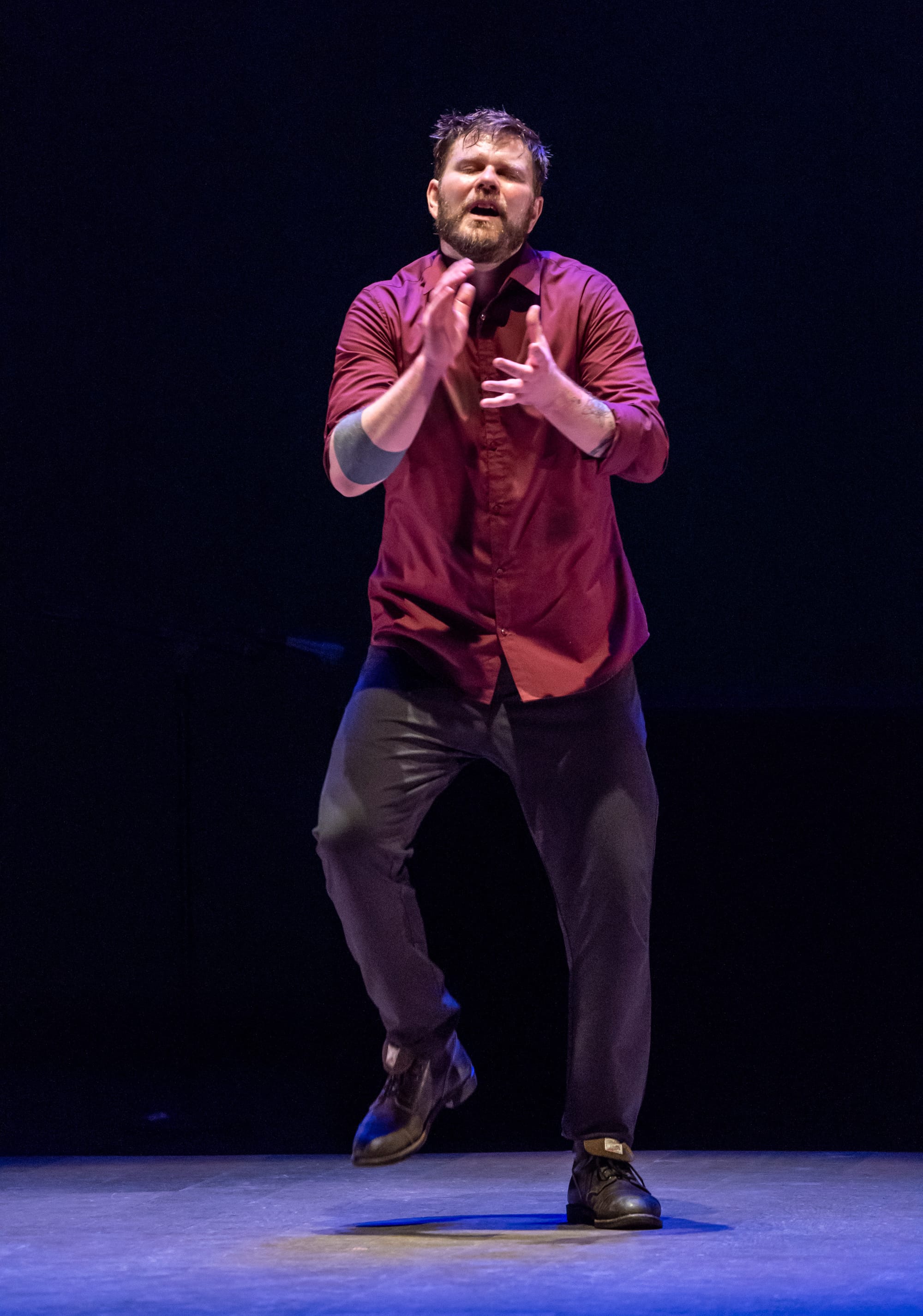
Solos followed, including one for Dorrance, who dazzled while looking nonchalant, as if she were dancing just for fun. There was a bit for Craft with his signature Petrouchka-like floppiness that belied the precision of his tapping. At another point Van Young reappeared, this time as a dancer/musician. His solo consisted of making his entire body into a percussive instrument, tapping in soft shoe while slapping, pounding snapping, and clapping various parts of his body. Who knew a human being could become an entire orchestra. The work came to an end in a flurry of movement and sound by the entire group.
Dorrance has said that tap dance is music, and “SOUNDspace” proves her point. But if tap is music, it is music made visible, and Dorrance Dance makes music visible in a particularly compelling way.
copyright © 2019 by Gay Morris



