Divas in Tulle
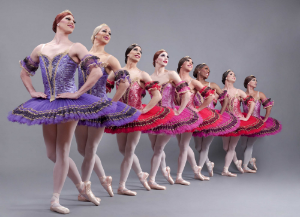
"ChopEniana,” “Patterns in Space,” “Esmeralda,” “Dying Swan,” “Don Quixote”
Les Ballets Trockadero de Monte Carlo
The Joyce Theater
New York, NY
December 18, 2014
The “ladies” of Les Ballets Trockadero de Monte Carlo once again dazzled the audience with their clever humor and admirable technique, and from the pre-performance announcement that a dancer, a certain Ms. Notgoodenoff, will not be performing to the last note of the Hava Nagila that they spontaneously broke into while still in their “Don Quixote” costumes to end the night, Program B of the company’s 40th Anniversary season was a real treat of dance and entertainment.
The audience may have laughed throughout the evening, but the Trocks “ladies” take their dancing very seriously. You knew it from the moment the curtain went up for the opening ballet, “ChopEniana,” to reveal the very focused glorious ensemble of broad-shouldered, hairy-chested, toe-shoe donning men in abundant tulle and aggressively caked-on make-up. As Fredric Chopin’s music lulled on, the divas of the corps sat with upturned Mary Magdalene eyes, as the soloists took turns dancing with such abandon that sometimes they neglected the proximity of the others, much to one dancer’s annoyance and injury.
The corps was as supporting and critical of the leads as you might expect in a ballet company. Two of the “ladies” counted on their fingers and then enthusiastically applauded a series of relevés in arabesque of one soloist, while two other corps members chose to take a little siesta on stage during another starlet’s boring dance. One of them unfortunately suffered from a sleepwalking affliction that took her, with her arms outstretched, into the wings and back, to be woken only by a fall into the orchestra pit.
Proving that they can present classical and modern works with equal gusto, the company next performed “Patterns in Space” in which they poked fun at Merce Cunningham’s use of odd musical accompaniments. The two “musicians” sat at the bottom of stage left and produced impressively diverse sounds through all sorts of means such as by popping bubble wrap, breathing into paper bags, gargling water, and taking turns mooing and bleating to accompany the three dancers in bright unitards who moved up and down the stage with jumps, and did leg kicks, pliés and good old push-ups.
A lovely pas de six from “Esmeralda” followed, with Nina Immobilashvili (Alberto Pretto) being nearly immobilized by her love and longing for a never seen officer who refused to marry her. She continuously reached for him to one side of the stage during her adagio with Araf Legupski (Laszlo Major), who danced the role of Esmeralda’s friend, Pierre Grengoire, and when she seemed no less distraught in her variation after a very deftly executed pas de quatre by the disheveled foursome that completed the cast of the pas de six, Legupski resourcefully offered her medicine to relieve her suffering. Alas, the drug may have been too strong: poor Esmeralda started hallucinating very much as Giselle does in that eponymous ballet, giving the audience what could well be described as the mad scene on Xanax.
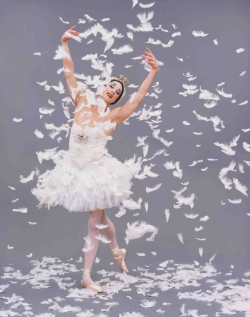
As was promised before the evening began, Ida Nevasayneva (Paul Ghiselin) graciously agreed to perform the “Dying Swan” – her signature role, and by now a Trocks classic – as the off-the-program treat which followed. As she fluttered on stage she proved that she wasn’t just a grande danseuse, she was a feathered sensation. Plumage flew as abundantly as the giggles and applause, and the diva soaked it all in, choking up from the adoration, and assuring the audience during the bow that she was, in fact, okay, despite the death scene with her gesture of “who me? Oh, I am just fine!”
A tweaked and truncated version of “Don Quixote” closed the evening. In it the actual characters of Don Quixote and Sancho Panza have been eliminated “due to economic reasons” according to the program, but audience members were invited to imagine them “wandering about aimlessly and getting in everyone’s way, which in most versions is all they do anyway.” As a result adjustments had to be made, of course, and in this version Kitri and Basil are brought together by a homeless fortuneteller who turns into a rather large cupid in a tunic with gold underpants and was danced, with more embellishment than any of the costumes, by Maya Thichenthighya (Ihaia Miller).
“Don Quixote” brought to the forefront the impressive dancing prowess of the Trocks that sometimes gets lost amidst the humor. Yakaterina Verbosovich (Chase Johnsey) as Kitri could rival many professional female dancers with both her technique and charm, and her chemistry with Vyacheslav Legupski (Paolo Cervellera) as Basil, as well as their speed in the grand pas de deux, were almost too good for laughter. The humor was still there though, and in her variation the speed of one double turn in attitude caused her fan to fly out of her hand, only to be replaced by a small spare she had stashed in her costume. To end the night, Verbosovich walked on very casually, much in the manner of Natalia Osipova, for her fouettés, effortlessly knocking off all 32 of them.
With that, the two-hour program may have been over, but the Trocks couldn’t leave it on the semi-serious note of impressive technique. For an encore the dancers, still in their “Don Quixote” costumes, burst into dance to Hava Nagila, grapevining their feet to the rhythm for a lasting holiday season impression.
copyright © 2014 by Marianne Adams



