Different Worlds
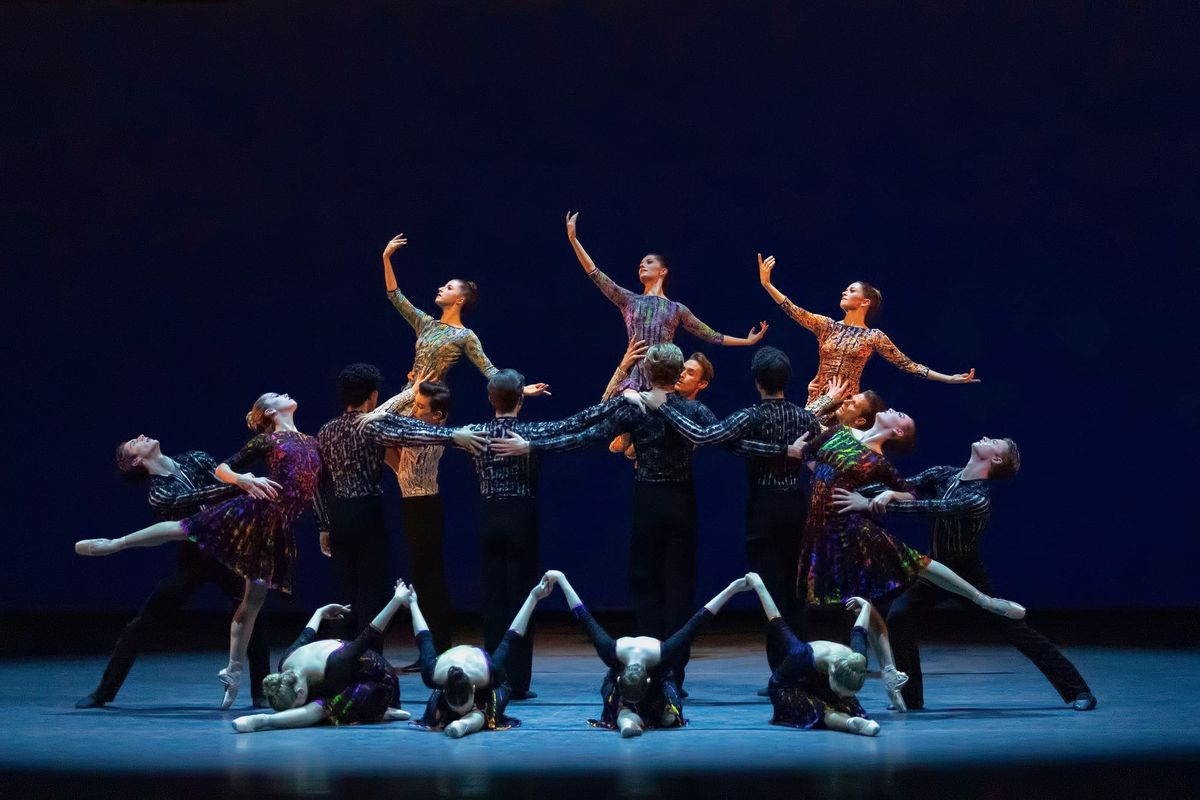
"Rotunda", "Concerto for Two Pianos", "Odesa"
New York City Ballet
David H. Koch Theater
Lincoln Center
New York, New York
February 1, 2024
Tiler Peck’s new ballet “Concerto for Two Pianos” premiered in a program featuring ballets created in the twenty-first century; rather optimistically NYCB calls the program “New Combinations”. It also included Justin Peck’s 2020 “Rotunda” and Alexei Ratmansky’s 2017 “Odesa” (the updated spelling for “Odessa”). All three were abstract, all three explored different worlds, and all three very danced with flair.
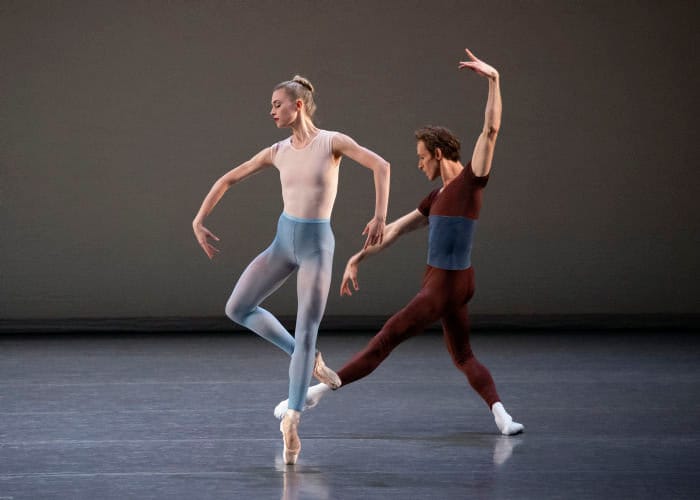
“Rotunda” though, is a typical Justin Peck work, full of Jerome Robbins’ energetic juveniles and set, like several other Peck works, in what appears to be a dance rehearsal room with a group of dancers who huddled every time the scene changed; each huddle ended with a breakout session for one or more dancers. The music by Nico Muhly, a frequent Peck collaborator, was commissioned for the ballet, and meandered a bit through some minimalist phrases. The choreography was a bit choppy, with frequent changes of direction and a few too many “gosh I’m cute” shrugs. In between, there were some fine performances. Miriam Miller and Adrian Danchig-Waring danced a willowy pas de deux which showed off her lyrical line and noble carriage. It really didn’t develop, though, and they walked off in different directions with a sort of a “well, whatever” strut.
Morgan Fairchild, replacing Sara Mearns, had a more intense pas de deux with Gilbert Bolden III. She is usually paired with a smaller partner, and his height and dignity protected and emphasized her petite charm. They danced to a slower, quieter section; Bolden is an understated dramatic dancer, using his eyes to focus on his partner. He can tear into steps with the best of them, but can also show a powerful stillness and they did seem to have a real conversation before wandering off separately.
Daniel Ulbricht can also tear into steps, but he debuted in the Gonzalo Garcia role of the slightly isolated, contemplative man. He gave the final solo a delicate lightness and underlying melancholy. The work, though, for all the fine moments, has a slightly sterile air, as if nothing beyond the rehearsal room existed. The audience is invited to watch these buddies do their jobs, but in the end, the dancers turn their backs on us.
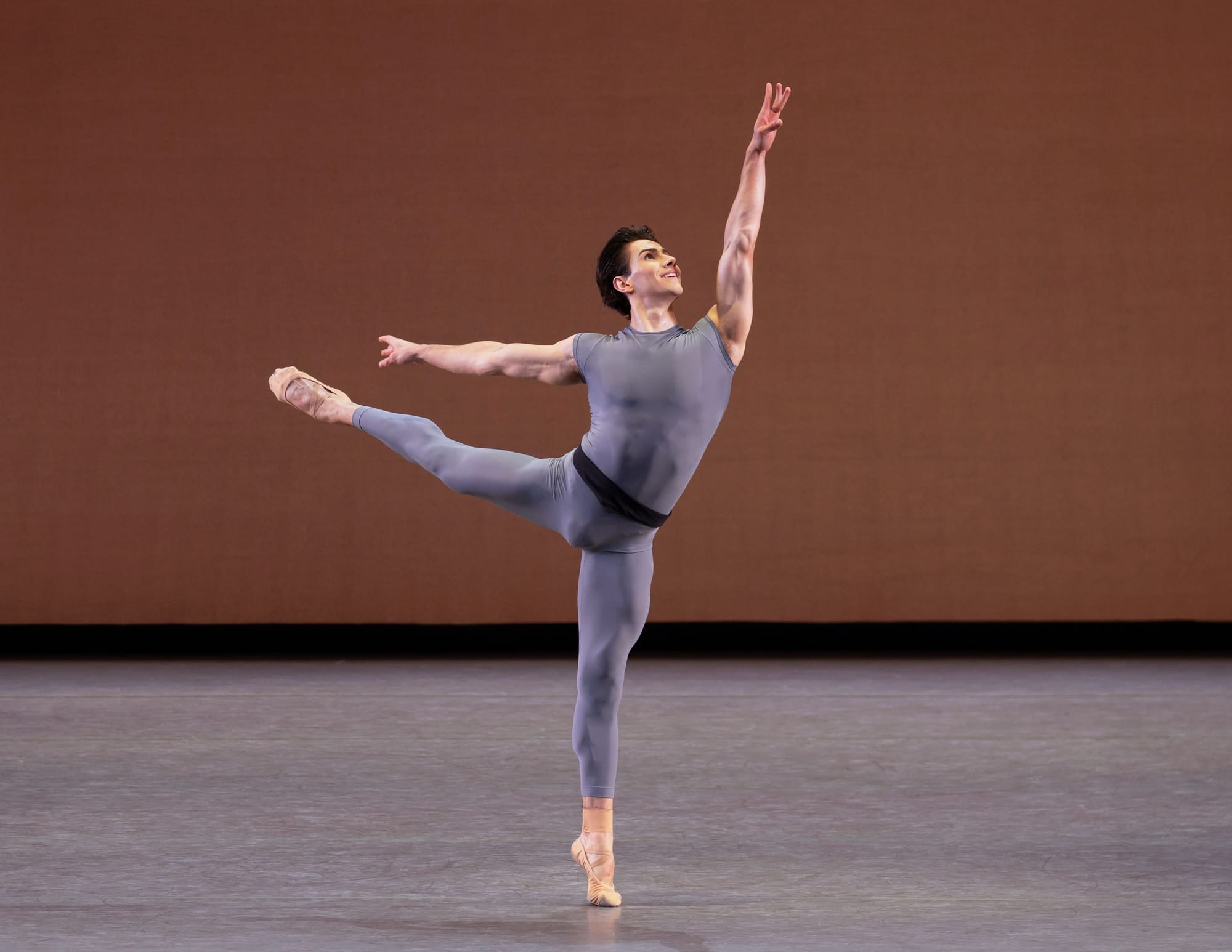
Tiler Peck’s new work is about dancers, too, but is more exuberant and outgoing. She set her work to Francis Poulenc’s 1932 “Concerto for Two Pianos”, a full-blooded explosion of sound, which she handled confidently. The costumes are by Zac Posen, with lovely and fluid short flared skirts and elegant bodices in shades of blue (and one red one) for the women, rather drab grey body suits for the male soloists, and slightly more formal dark blue ones for the male corps. The work is to some extent a concerto for Roman Mejia, as he leads the cast with bounding leaps and spins, pausing now and then to flex his muscles, Popeye with a twinkle. Peck moved her large cast (five soloists and seven corps couples) effectively, as the corps rushed on and off, alternating with the various soloists.
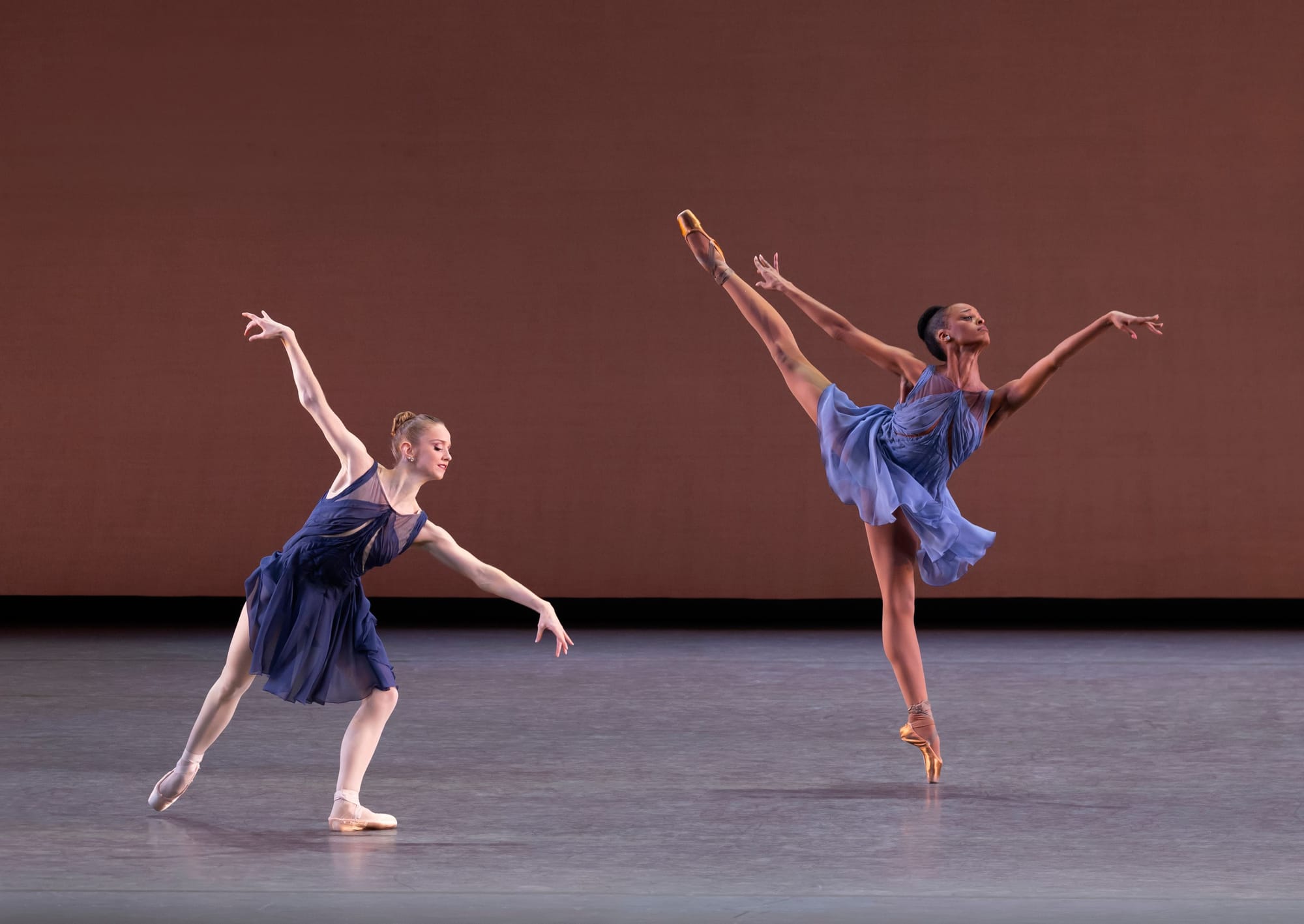
These included Mira Nadon (glamorous in red) and Chun Wai Chan, who had an ecstatic, leggy pas de deux, and some perky dancing for Emma von Enck and India Bradley. Unfortunately, Tiler Peck didn’t differentiate between these two different dancers, and the fast, precise, elegant steps which von Enck tossed off with cheerful aplomb emphasized Bradley’s rather wayward line and flat hands.
There were some intriguing combinations; one which particularly struck me was a quiet moment when the male corps entered one after another on the darkened stage, and merged to lift Nadon, making her look like an airy, floating bubble; they could have been male Bayadères, emerging from the mists. At times, though, the work was episodic and the interesting and memorable moments that did not always connect; at one point Nadon and Chan had a brief lyrical interlude backed by Mejia, von Enck, and Bradley dancing their own thing in the shadows behind them and then both groups left without any connection. Peck’s choreography was exciting and musical and Mejia proved yet again that he is a truly amazing and generous dancer but I missed an emotional background.
The dancers of Ratmansky’s 2017 “Odesa”do connect, if not always happily. The ballet is choreographed to Leonid Desyatnikov’s “Sketches to Sunset”, a reworking of his music for the 1990 Russian film “Sunset”, based on short stories by Isaac Babel about a group of Jewish gangsters during the Russian Revolution. Ratmansky didn’t retell those stories, but the dark, slinky atmosphere of his ballet hints at them, reinforced by the louche costumes by Keso Dekker. The music, full of plaintive tango and klezmer echoes, evokes a smoky nightclub, full of desperate and despairing customers. Ratmansky has three couples (Megan Fairchild with Daniel Ulbricht, Indiana Woodward with Anthony Huxley—both debuts, and Unity Phelan with Adrian Danchig-Waring in his debut) who may or may not be in love.
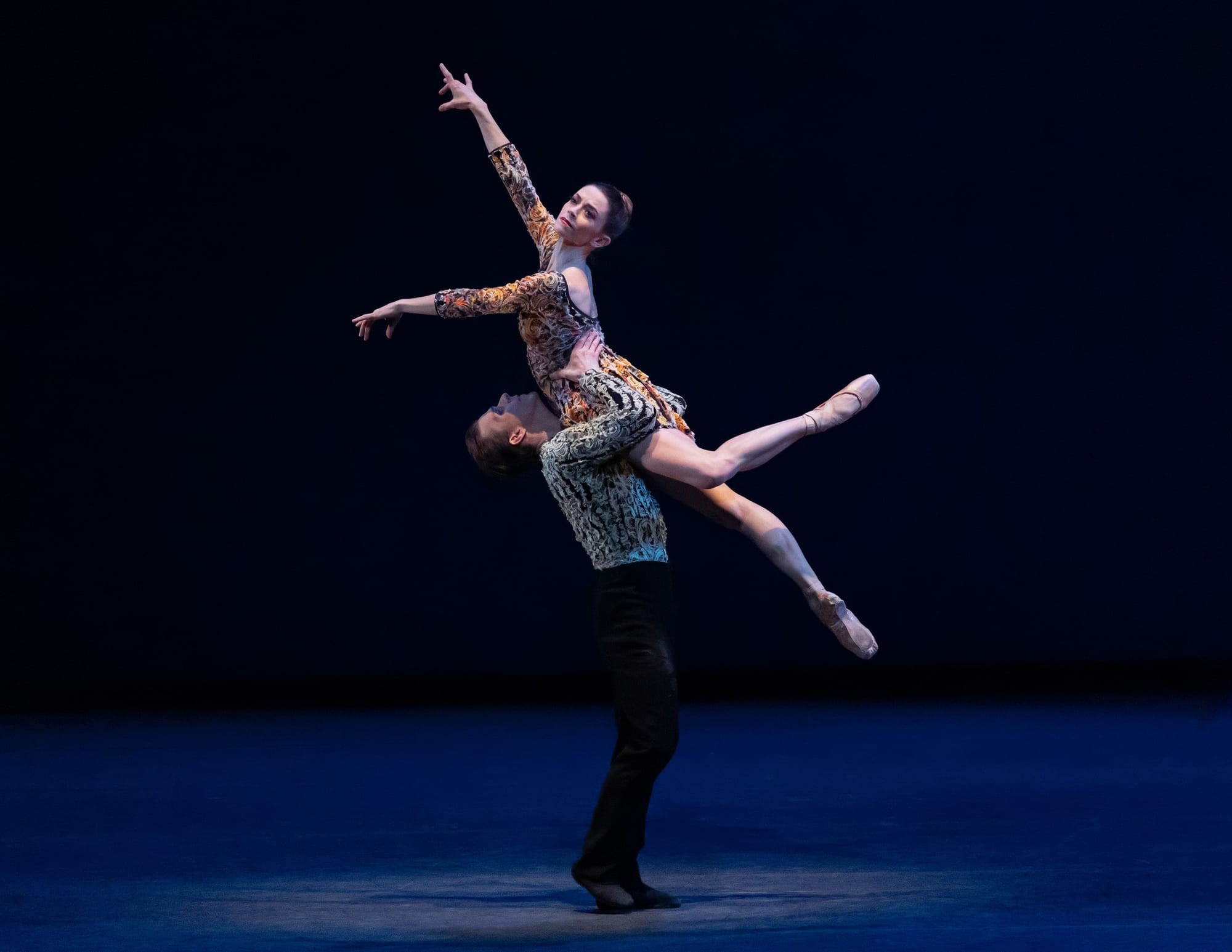
Woodward and Huxley danced a vivid Apache Dance, an early twentieth-century nightclub staple from the Paris underground, originally portraying a prostitute and her pimp. There were hints of violence but it was neither glorified nor condemned—the couple was just surviving the only way they could. Fairchild and Ulbricht had a more complicated relationship, and it seemed to evolve into a dream, or rather a nightmare, as they were separated by groups of men. Fairchild danced with a sensual fragility, waking up with a snap and hitting out at some enemy, who may or may not have been Ulbricht.
Phelan and Danchig-Waring’s third couple were less distinct; Phelan’s cool, calm elegance seemed detached from the ballet’s gritty world, though she and Danchig-Waring may have been a bored, well-to-do couple looking for excitement in all the wrong places—the ballet is oblique, darkly fascinating and changeable. The sculptural finale, with the three women lifted high, seems to speak, not of hope for a brighter future but of a resigned endurance; it has none of Justin Peck’s often facile cheerfulness, and for me, shows a much richer world.
© 2024 Mary Cargill



