Different Worlds
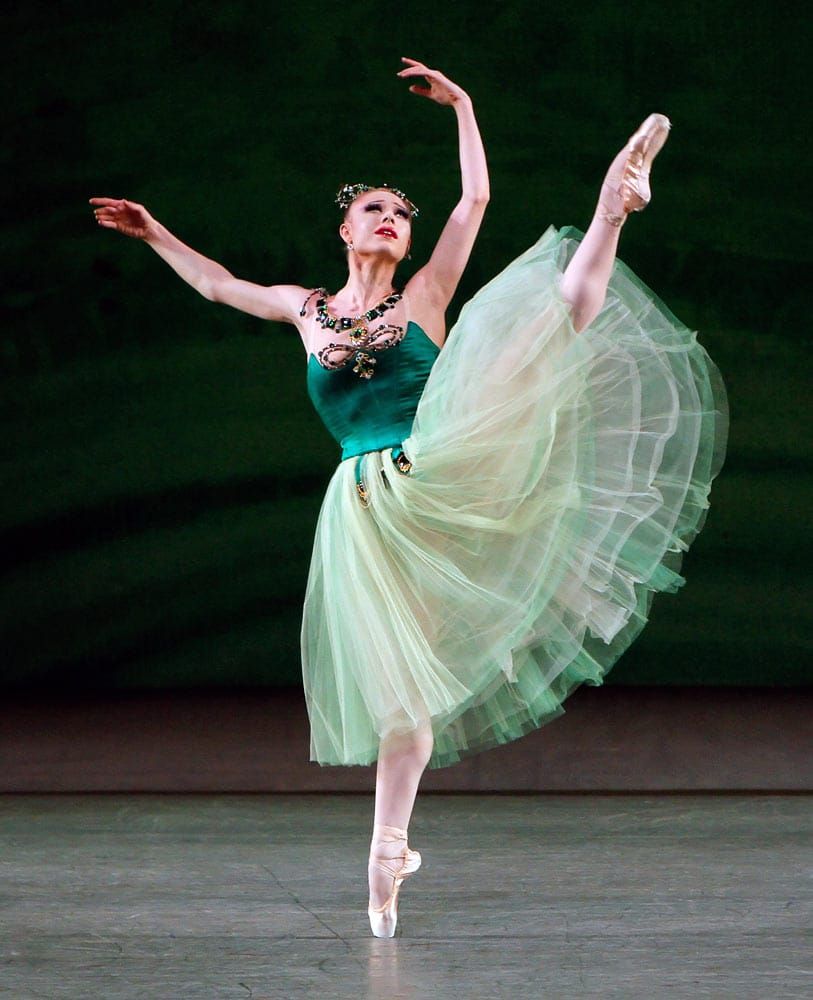
“Jewels
New York City Ballet
New York State Theater
New York, NY
January 2, 2008
The evergreen Nutcracker was finally put to rest for another year, as NYCB opened the dance part of the Winter season with the even more evergreen Jewels. Green is the operative work for “Emeralds”, in the redesign (or re-redesign) by Peter Harvey; the slightly oppressive mass of green with its strings of gaudy baubles gives the impression that the miraculous choreography is taking place in some aquatic bead store’s bargain basement. But the choreography, with its sense of melancholy urgency and courtly mystery, would probably cast its spell set in a parking lot.
Ashley Bouder danced the Verdy role; it is a somewhat surprising choice, since her high-energy pop would seem more suited to “Rubies”, but she is a remarkable dancer, and found her way, floating her arms through what seemed to be a shimmering, heavier air than mere humans breathe. There was no sense of wispiness about her haunting, indefinite, but so nuanced, mime. She seemed to be a memory, calling to her cavalier (the courtly Stephen Hanna), but not quite connecting; this underlying feeling of farewell, of some undefined tragedy, was amplified in the pas de deux, where her backbends seemed to hover between worlds.
Sara Mearns, in a more traditional piece of casting, danced the Mimi Paul role. She used her long arms and extraordinary tapered fingers to suggest an Ondine, casting a spell. She gave the deceptively simple walking pas de deux an air of hypnotic mystery; she really looked as if she weren’t touching the ground.
There is a lot of ground to touch in “Rubies”, traditionally the most popular of the triptych. It is certainly the most obvious, two youngsters having a ball. This “Rubies”, with Megan Fairchild and Benjamin Millepied, was unusually subdued, and while it was nice not to endure the frantic cuteness some recent “Rubies” have exuded, it really should be a happy work, and true happiness isn’t expressed by grinning now and then at the audience; the best “Rubies” has a couple who really seem to enjoy dancing together, and who let the audience share in their joy.
Teresa Reichlin danced the tall girl. She is a dancer of prodigious gifts and amazing technical facility, but tends to fade a bit in the projection department. This reticence worked in “Rubies”, since the choreography can really sell itself, and her coolness, combined with the sizzling steps, made for an intriguing contrast.
“Diamonds” has its contrasts, too, the intensely private pas de deux combined with the seemingly endless (unless danced by the Kirov corps) hearty finale. Wendy Whelan and Philip Neal were the lead couple. Whelan is also an apparently unusual choice for the regal and cool “Diamonds”, but she is a unique dancer, who can find her own way into a variety of roles. She danced the pas de deux as if she were steel surrounded by mist, looking through and beyond the fourth wall. She made it an elegy of almost epic strength, and it was a true honor to see an artist in full command of her art. Neal was her sympathetic and supportive partner, and broke through in his solo with some wonderfully controlled turns.
“Diamonds”, though, is more than the pas de deux, and the corps saw the welcome return of Dena Abergel, one of the few in the corps who seemed to luxuriate in the movements, and who seemed to believe that “Diamonds” is about a world beyond the stage
copyright © 2008 by Mary Cargill



