Diaghilev, Huh?
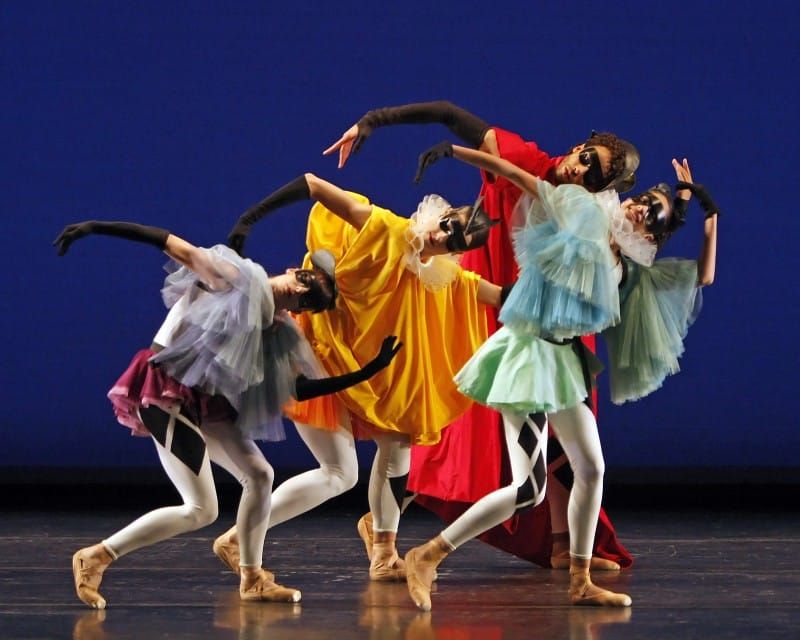
"Commedia", "One", "Monotones II", "Shutters Shut", "Fool's Paradise"
Morphoses/The Wheeldon Company
City Center
New York, NY
October 4, 2008
In his affable, charming opening remarks Morphoses director Christopher Wheeldon explained that the opening ballet Commediawas made to honor the 100th anniversary of Diaghilev's monumental debut in Paris. This bold (or rash depending on your point of view) statement set very high standards, since Diaghilev was a master of program construction, and a bloodhound of genius when it came to discovering talent. Judged by these standards, Morphoses is no Ballet Russe; the programming, like last year, lacks variety, and the choreography, with some exceptions (mainly due to Sir Frederick Ashton), was generally not memorable.
Commedia was set to Stravinsky's Pulchinella Suite, and the costumes were obviously inspired by the Commedia characters, though in a very general way, since there were no distinct characters either in the costuming or in the choreography. This was probably the most generically bland evocation of the commedia dell'arte characters ballet has produced, and was particularly disappointing as a tribute to Diaghilev, who used those figures so brilliantly in several ballets. Wheeldon substituted quirkiness for characterization, and didn't really develop any ideas. He had his dancers all wear black gloves for the opening scenes, flicking their hands spasmodically (a long way from Ashton's brilliant use of the gloved hands in his Stravinsky ballet); the dancers were gloveless in the final scenes, for no apparent reason. The problem wasn't just that the dancers were all dressed alike, it was that they all danced alike, with the same herky-jerky fidgety steps. It was a bit like watching the Commedia dell-Arte take an aerobics class.
The second act was made up of three short pieces; the heart of the programming, as Wheeldon explained in his opening comments, was Ashton's Monotones II, the ballet that has critics pouring through dictionaries for synonyms for "limpid". Other than "perfect", I haven't come up with a better word. Wheeldon also said he thought he would experiment with New York City Ballet dancers, to see what they could do with Ashton. They made it look difficult, basically, but if its silver thread got tangled up now and then, it still glowed. Wendy Whelan danced the part originated by Vyvyan Lorrayne, a dancer of liquid extensions. Whelan has never had the flexibility that Lorrayne had, and did not look entirely comfortable. But she is a dancer of subtle musicality and imagination, and there were some sublime moments. Tyler Angle danced with an innate nobility, but both he and Adrian Danchig-Waring tended to overemphasize the delicate changes in direction of their torsos, as if speaking a foreign language very carefully and the rigorous but effortless precision which creates such a magical effect was not always there.
The scheduled performance of Ashton's magical pas de deux from The Dream was canceled, and another pas de deux One by Annabelle Lopez Ochoa, danced by Drew Jacoby and Rubinald Pronk, was substituted. This was heavily influenced by Forsythe, with the harsh lighting, black costumes, and sullen demeanor of so many recent works. The music, by Jacob Ter Vedhuis, had a voice speaking breathy French apparently recorded in an auto-body shop on a busy day, saying, to judge by the choreography, "I hate you" over and over again.
The final pas de deux, Shutters Shut by Lightfoot León (a pseudonym for the Netherlands Dans Theatre dancers Paul Lightfoot and Sol León) also used the spoken word as their music, in this case a recording of a poem by Gertrude Stein. The words had a distinct rhythm and worked as a surprisingly solid floor for the dancers, Christine Thomassen and Andreas Heise. The choreography played off Stein's inspired nonsense and the short, sharp, rhythmical gestures of the dancers were a perfect counterpart to the verses. It had a whimsical charm that fortunately did not go on too long.
The final work, Wheeldon's Fool's Paradise, unfortunately, did go on too long. It uses some striking images, with bright pieces of confetti sprinking down in the dark, but this has little emotional effect. The music, by Joby Talbot, is based on a score he wrote to accompany a silent film, and film music generally needs a story or at least an emotional thread. Wheeldon just has his very fine dancers come out, practice their arabesques, stretch a bit, and now and then lift each other. True emotion doesn't come from the odd hug, or complicated lifts, it comes, as Ashton shows so clearly, from the music, and from steps that flow so apparently naturally from it.
copywright © 2008 by Mary Cargill



