Details, Details
"Traditions"
"Square Dance", "Prodigal Son", "The Four Seasons"
New York City Ballet
New York State Theater
New York, NY
January 29, 2008
The marketing department has apparently decided there is more than one Tradition to be celebrated in the Balanchine and Robbins program, but the tradition of great choreography coherently danced is the most important tradition of all, and fortunately this program had that to offer. The inevitable tradition of dancers retiring was also, quietly, celebrated, as Nikolaj Hübbe gave his final performance in “Square Dance”, proving yet again that dancing is not just about bounding high and leaping energetically. There are many dancers, some in the corps, who can jump higher and land cleaner than Hübbe at this stage, but no one can run on to a stage and generate such excitement just by looking at his partner and offering her his hand.
The remarkable solo, so oddly placed, (it seems like an intermission for grownups in the middle of recess) was an understated and powerful meditation on some mysterious power, fate perhaps, pulling him on. This undercurrent of unease also appears in the pas de deux, with the music’s gentle tension. Hübbe’s partner, Megan Fairchild, didn’t quite get the mysterious character of the pas de deux, but she shone in the sparkling finale, with its sharp, glorious footwork. The corps, too, maintained the pristine rigor the choreography call for, and it was a bracing performance, dominated by Hübbe’s generous, detailed, and magnificent dancing.
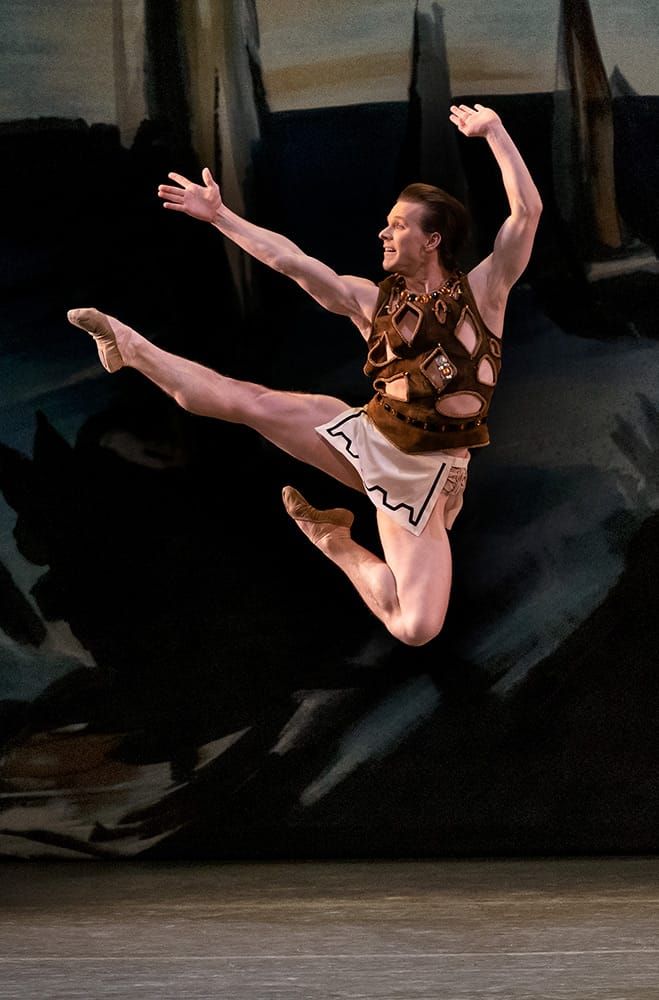
Details are especially important in “Prodigal Son”, a fascinatingly dated Expressionistic rethinking of the Biblical parable. There is little actual dancing, other than the opening leaps, and the fine new prodigal, Daniel Ulbricht, made them perhaps more spectacular than the ballet needs; he should be rebelling against something, pushing away and out to the wide world, not hovering up in the air to the audience’s gasps like the jaw-dropping technician that he is. He also tried almost too hard to made the Prodigal an individual; the ballet isn’t a realistic story, but an abstraction—one of Brecht’s Everymen, not a Biblical Stanley Kowalski. But his youthful looks and general impetuousness, combined with his honest sincerity, made this a powerful performance.
Teresa Reichlin was his Siren, and she caught much of the cold, inevitable mystery. The Siren is more than a girl on the make, she is the embodiment of an unknown and fascinating danger. Reichlin kept her anonymity throughout the pas de deux; I think with experience, she will be able to make more of the snaky hand gesture, allowing it to move on its own, and hovering ever so slightly over her head a moment longer, to let the oddness register with the audience.
The supporting cast varied in quality; the two sisters, Dena Abergel and Pauline Golbin, both seasoned and valuable corps dancers, brought warmth and dignity to their roles. The Father, Jonathan Stafford, needed more weight to give the seemingly unsympathetic role enough dramatic depth. Adam Hendrickson, as one of the false friends, had much of the ominous menace, but Antonio Carmena was simply too charming, even without his engaging smile.
Carmena was much more at home as the high-flying Pan in the final section of Jerome Robbins’ salute to Russian ballet clichés, “The Four Seasons”, to Verdi’s lilting, infectious, danceable music. Some of Robbins’ jokes are a little too obvious, like the shivering snowflakes of the opening “Winter” section, but Sterling Hyltin as head snowflake danced with a delicate but commanding musicality. Sara Mearns danced “Spring”. It was choreographed for Kyra Nichols and has her strength and her phrasing stamped all over it. Mearns gave a burnished performance, though she didn’t have Nichols’ ability to get to a pose slightly before the music and hold it, giving the illusion of extending the music. Her cohort, Jared Angle, danced his jaunty little solo very well, but he didn’t really look like he was enjoying himself until it was over. The four boys, though, in what may be a takeoff on the four little swans dancing around that famous lake, were elegantly and exuberantly froggy.
Joy is the very essence of “Fall”, with its marvelously 19th century Bacchanal. Ashley Bouder and Benjamin Millepied joined the frolicking Carmena. Bouder is an astounding dancer, who is able, without any exaggeration (no self-indulgent head-whacking for her) to get more juice out of academic purity than almost any dancer around. She does, though, seem to be too aware of the audience, and her dancing lacked some of the devil-take-the-hindmost improvisational feel that can drag the audience to the edge of its seat. Millepied seemed miscast, a bit lightweight to give enough contrast to Carmena, and though he threw in some Sovietized tricks, he looked like he felt uncomfortable wearing that silly headband. A few years ago, Hübbe danced “Fall”, and was able, without all the flashy jumps, to bring the stage alive with his back to the audience, summoning all the bacchantes with a magnificent and powerful gesture, a detail, among so many other details, that can turn steps into dancing.
copyright © 2008 by Mary Cargill



