Delicious Variety
“Wash/A Variety Show”
Vicky Shick
West End Theatre
New York, NY
May 12, 2018
I remember when a “variety show” was a jumble of generally mediocre acts crammed together in a program that tried to provide a little something for everyone. Vicky Shick’s wryly titled “Wash/A Variety Show” offers quite an alternative – a mash-up of marvelous solos and duets, lightly connected by an interlocked cast and Shick’s magical touch. Shick filled the cozy West End Theater with personality and wit, in the 40th edition of David Parker and Jeffrey Kazin’s “Soaking WET” dance series, now in its 15th year in the space.
Shick’s female-dominated casts sometimes seem homogenous, but usually that suits the work, and its sense of flow. The “Variety Show,” though, reveled in diversity among the women, as well as the addition of the estimable Jon Kinzel, who was also co-credited (with Shick) for sound and design. The work offered more than variety; it felt like a mini-society, where the shifting relationships depended on the uniqueness of each member.
As we entered the house, an inflated parachute filled the performance space, blown by a hidden fan, and the billowing circle echoed the half-moon shape of the WET stage. As the lights dimmed, a film was projected on the belly of the parachute, the story of an afternoon in the life of a dancer, Marilyn Maywald Yahel, sitting by a New York window, with the skyline and traffic in view. Her shape and the lines of the room and the view were soft and distorted by the parachute screen, and we were like eavesdroppers on a character who stretched and moved, snacked and looked outside, transforming from civilian to dancer and back again. When the inflating fan stopped, the parachute deflated onto a sculptured base (by Seline Baumgartner,) and the screen – and story – disappeared.
Months after her solo in the opening film, a now notably pregnant Marilyn Maywald Yahel danced a live solo with a wooden stool, a safety net for balance as she shifted her own rounded belly into silhouetted twists, or framed her face in the empty space between the stool legs. Yahel’s character was the first introduced in this variety show; but each of the others had their own story and style.
After a brief opening scene in which all the dancers took a pre-show bow (an unexpected frame for the start of the performance,) Omagbitse Omagbemi and Jennifer Lafferty danced in an uncoupled duet, two soloists on stage simultaneously. Omagbemi’s elegant body moved sensually, with swiveling hips and long stretches, while Lafferty’s body was more angled and floor-bound; what the two had most in common was the deliberate, controlled pace, and the clarity that is Shick’s.
Omagbemi was partnered later in a duet with Kinzel, and their mutual strength created a powerhouse of movement. As Omagbemi jumped into Kinzel’s waiting arms, she was a hook to his eye, her powerful bent legs grabbing his torso, each balancing and holding the other. In Omagbemi's duet with Gabrielle Revlock, they leaned and fell toward each other, almost birdlike, as their feet sharply pulled up, flipping against each other.
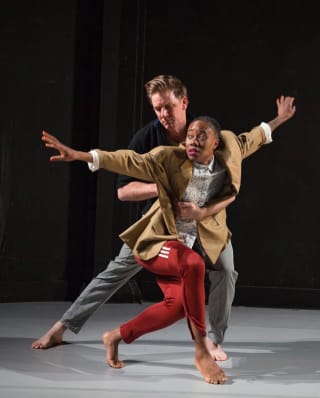
Each performer had a solo turn, and each had a unique personality and movement type. Kinzel’s solo was to a drumbeat, and as he leaned toward the walls, he was machine-like, his winding arms and angled legs pumping the air. Lafferty twitched her body in a shiver, and her lightly sparkling pants shimmered as she quivered, her arms jabbing in clean curves, like shifting parentheses.
Periodically prancing around other duets and soloists, stately Donna Costello lifted her knees and bounded around the curved stage. She framed the others, then disappeared, re-emerging to prance and encircle again. In her solo, oozing around a table (where she perched on her belly,) her body shifted angles. Her table solo melted into dark background to become the frame, and she the observer, for another duet: Shick’s with her partner, Meg Harper.
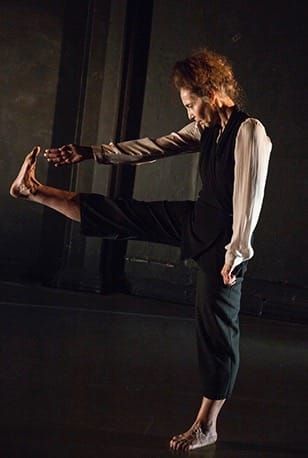
Shick’s presence is quiet but monumental; she can’t be ignored. The specificity of her movements made each moment count, as her hips collapsed in quick shifts, or arms spiraled, as if to launch her up and away. She wore a David Byrne-like wide-shouldered jacket, and her duet with Harper included subtle shifts and poses, as they mirrored and supported each other. Shick slid her shoulders out of the jacket and slid it on Harper’s shoulders. That coat continued to make the rounds, sliding onto Omagbemi (whose shoulders could fully inhabit it,) and the other wending soloists. Like a shared rhythm or melody, the coat drew them together.
The final, darkly lit duet was Kinzel’s with Lafferty, as they curled together along the floor, their limbs intertwining. A barely heard Beach Boys “Don’t Worry Baby” played in the background; and Lafferty, who was the final solo image, stretched her legs out, gently sidling off the stage into the dark.
Just as they’d begun, the performers lined up for their final bow. This variety show offered space enough for each of these dancers’ uniqueness, and Shick’s weave connected them all.
copyright © 2018 by Martha Sherman



