Debuts in "Jewels"
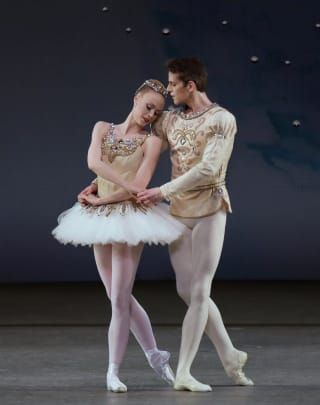
“Jewels”
New York City Ballet
David Koch Theater
New York, New York
September 23, 2018
New York City Ballet presented performances of George Balanchine’s “Jewels” over the past week, with a young cast taking major roles in the “Emeralds” section on Sunday. Each of the three ballets that makes up “Jewels” shows a different aspect of Balanchine’s major stylistic interests. “Diamonds” looks to his Russian heritage, “Rubies” to his American experience, and “Emeralds” to a neo-romantic mode that was most evident in his European years of the 1930s.
“Emeralds,” at least recently, has proved problematic for NYCB dancers, and Sunday was no exception. The ballet has often been considered French, perhaps because the central ballerina role was originally made for Violette Verdy. When the Paris Opera Ballet danced “Emeralds” at last year’s Lincoln Center Festival the company reinforced the idea of French inspiration. The two central ballerina solos are all about épaulement and port de bras, aspects of technique that are not much emphasized at NYCB. The arms of the Paris Opera dancers floated effortlessly, every gesture and turn of the shoulders delicately expressive, the women chic without being cold. Their interpretation was a revelation. The ballet was suddenly brought to life in a way that it seldom is in the home company.
Lauren King and Megan LeCrone, both NYCB soloists, took the two ballerina roles on Sunday. Although neither had any technical difficulties with the choreography, neither conveyed anything of the work’s mood, which is touched with mystery. “Emeralds” is like a fête champêtre, which is invaded by a sense of unease as it nears its end. Neither King nor LeCrone have the supple backs and fluid arms the dances call for, or the delicate femininity. They are both forthright dancers, not given to comunicating the elusive perfume of another time and place.
The surprise of the day was Daniel Applebaum, a corps member, who partnered King. He is usually a cheerful, dependable presence in any number of NYCB works, but here he became a man in a dream. Every gesture, from offering his hand to his partner, to turning his head to gaze at her, was full of wonder. His dancing, too, had a soft pliancy coupled with pristine placement that was exactly right for the role.
Andrew Scordato, partnering LeCrone, was far less comfortable, perhaps because the two were not suited physically. She appeared to loom over him, which did neither of them much good. The trio, danced by Kristen Segin, Harrison Ball and Sarah Villwock was far more successful, light and effervescent, as it should be.
The leads in “Rubies” and “Diamonds” were mostly danced by experienced principals, and their confidence showed. Lauren Lovette was adorable as the ballerina in “Rubies,” unaffected, lightly teasing and appearing to be having a very good time. Gonzalo Garcia was her partner. He matched her in energy, although it would take a genius to make some of Balanchine’s “jazzy” movements look current rather than like fifty-year-old slang. Claire Kretzschmar, a corps member, danced the “Rubies” “tall girl” soloist role for the first time this season. It is a part often taken by Teresa Reichlen, who gives it a flirtatious glamour. Kretzschmar is warmer and softer. Her performance, although less finely etched than Reichlen’s (not surprising in a young dancer), nevertheless offered a personal interpretation that was interesting and bodes well for the future.
Reichlen this time was given the ballerina role in “Diamonds,” partnered by Russell Janzen. She danced with her usual cool assurance and he partnered well, but there was no emotional connection between them. It was a far cry from the kind of performance given by Sara Mearns and Tyler Angle who often take these roles. They imbue their dancing with a passion that is given added tension by being confined within the regal formality of a classical pas de deux. Reichlen and Janzen were more like strangers in an arranged marriage.
The New York City Ballet fall season continues through October 14 with varied programs.
copyright © 2018 by Gay Morris



