Debuts Galore
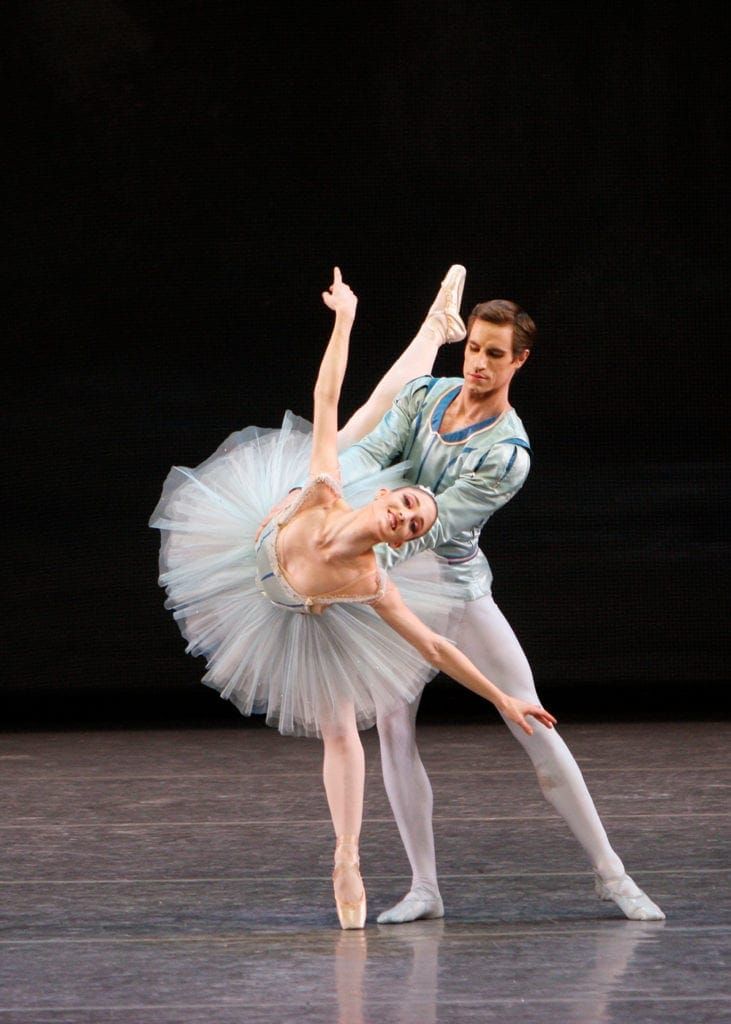
"Raymonda Variations", "The Steadfast Tin Soldier", "Le Tombeau de Couperin", "Symphony in C"
New York City Ballet
David H. Koch Theater
New York, NY
May 10, evening, 2014
The marketing department could come up with nothing more imaginative than "All Balanchine", but that didn't matter to the audience, which turned out despite the lack of an advertising hook. Though there really was a hook, beautiful ballets danced very well, which seemed to be enough. The whipped cream music of Alexander Glazounov's "Raymonda" flowed under the guest conductor Alexandre Myrat's direction; it really is some of the most delicious, danceable music ever written. The original ballet, though, didn't have much of a story; it seems as if Petipa just needed an excuse to pour out beautiful variations. In his several ballets based on the "Raymonda" score, Balanchine completely ignored the story, but kept the flavor, and in both this ballet and "Cortège Hongrois" the ballerinas do Hungarian-inflected movements. (In the original story Raymonda was a French noblewoman dancing one of her many solos to honor the Hungarian King Andrei, who was visiting the happy couple on his way home from the Crusades, or something like that; it was a good excuse for a party.) Though Balanchine's "Raymonda Variations" has no narrative, he did take much of the structure of Petipa's solos, adding his own flourishes, and the dancers should echo the courtly origins, even though the main couple, Ashley Bouder and Andrew Veyette, must wear Karinska's beautifully cut but washed-out turquoise costumes.
The five soloists (surely related to the five fairies in Petipa's "Sleeping Beauty" Prologue) were all making debuts. Many got through the difficult hops and jumps with willpower rather than poetry, but Emilie Gerrity had a carefree windswept feel to the second solo and Ashly Isaacs, in her variation, had a willowy delicacy and beautiful control. The corps, too, flew through their constantly shifting formations with a gentle lilt combined with breakneck speed.
Bouder danced her two solos with a rich and subtle musicality, never exaggerating the shapes (she has a perfect 90 degree arabesque), and a radiant confidence. She has always been a technical powerhouse, and has recently added more lyrical roles, such as "Emeralds" and "Serenade". But she didn't quite have the transcendent nobility that the role can have, and her dances with Veyette seemed more about friendship than the exalted connection of two souls that the pas de deux should show. Veyette, too, had few technical issues, and his beats are elegant. But his upper body seemed at times a bit rushed and disconnected. But as pure dancing, it was a fine performance.
Anthony Huxley made his debut as the loyal soldier to Megan Fairchild's doll in "The Steadfast Tin Soldier". Based on a Hans Christian Andersen tale, this is one of Balanchine's few narrative works, and it can, if overplayed, be a bit coy. Fairchild and Huxley, despite their crisp, stylized dancing, were not in the least coy, and I found myself hoping that maybe, just maybe, this time she wouldn't open the window to let the fatal breeze in. Fairchild danced her opening solo without a smile, but she let her body express her inner humanity, pausing just a bit at the top of her moves to let the music flow, which gave her dancing a quiet, whispered sadness. Once the soldier presented his heart, she could smile, and her dancing became a bit softer and warmer; it was a perfectly calibrated performance. Huxley didn't over-emphasize the prancing cuteness of his steps, and matched Fairchild's half-doll/half-human quality.
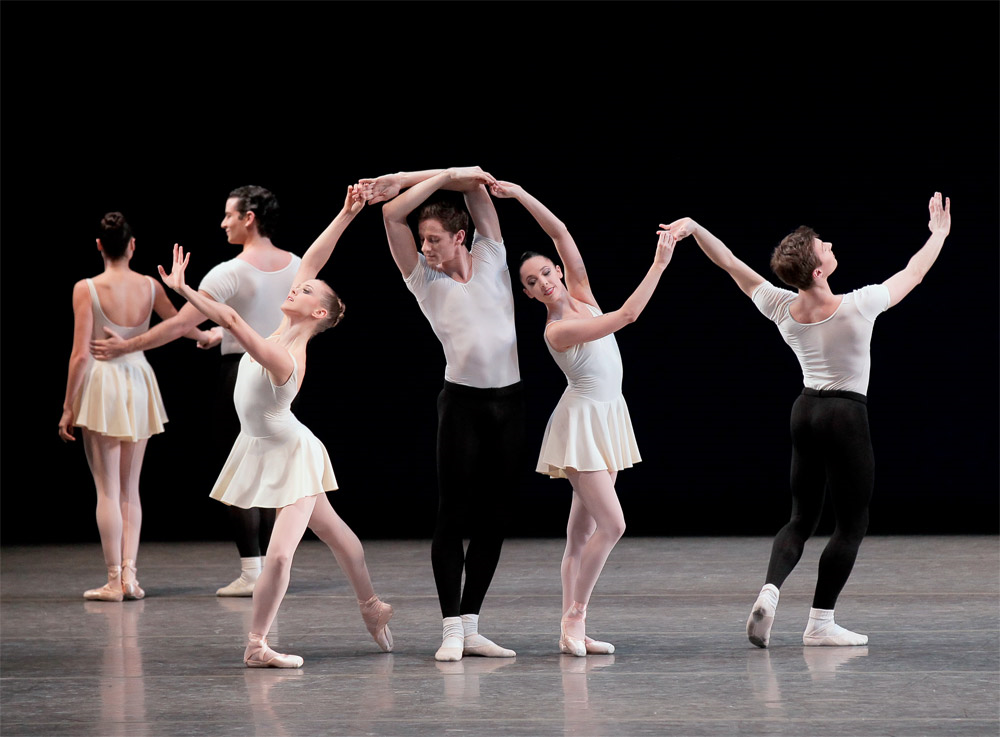
"Tombeau de Couperin", Balanchine's 1975 all-corps ballet to Ravel, is based on courtly dances, and the extremely well-rehearsed dancers kept their eyes on their partners, creating a feeling of community. Though the dances have formal outlines and complex geometrical patterns, the costumes are spare, black and white workout clothes. This contrast creates the feeling of ghostly courtiers dancing in a long-destroyed knot garden, and the piece has a haunting beauty.
There are ghosts in Balanchine's "Symphony in C" as well, as Petipa haunts it as thoroughly as he haunts "Raymonda Variations". Tiler Peck, with impeccable musicality, made her debut in the first movement, that gracious summation of radiant femininity (a riff on the final acts of so many Petipa works). She was scheduled to dance with Chase Finlay, but Zachary Catazaro was a last minute substitute; who knows how much rehearsal they had. But Peck sailed through it as if she had been dancing it for years; she has the ability to give dimension to her every move, to play with the timing without distorting the music, and to move with an easy and magnificent grace. Even the new costumes, with the unfortunate greyish triangle on the front bodice, couldn't dim her dancing. Catazaro and the other men weren't as fortunate, since their black velvet doublets are sprinkled with crystals, making them look like they are all suffering from a case of radio-active dandruff. There is a noble reticence to his dancing, though, which shone through the garish costumes.
The second movement, with Sara Mearns and Jared Angle, is, for me, closer to the spirit of "Swan Lake" than most full-length versions I have seen, and Mearns makes is one long sigh of longing and farewell, helped immeasurably by Angle's unobtrusive partnering, as she seemed to float through those arching lifts. Mearns is a vibrantly dramatic dancer, but the feelings poured from her dancing and there was no melodrama. There is something about the way the light catches her face that makes her look as if she is looking out beyond the stage to another world, and she danced like a throbbing pearl.
The third movement, with Erica Pereira and Antonio Carmena, was more stage-bound, though Carmena's joyful persona sparkled. Pereira looked a bit lost, as if she were worried about catching up with the music, and her upper body was a bit shapeless. The fourth movement is often overlooked and Lauren King, with Sean Suozzi, did not manage the difficult leg-outstretched turns. But she danced as if she loved being on the stage, with a quiet confidence that made her dancing sing. For me this joy is more important than some technical checklist, and she deserved her crown.
copyright © 2014 by Mary Cargill



