Dark Times
"Divertimento from 'Le Baiser de la Fée'", "When We Fell", "Chiaroscuro", "Odesa"
New York City Ballet
David H. Koch Theater
Lincoln Center
New York, New York
May 24 matinee, 2025
The program, officially called Eclectic NYCB, showed works from four very different choreographers (Balanchine, Kyle Abraham, Lynne Taylor-Corbett, and Alexei Ratmansky), but each piece used an element of darkness, either as a theme or a background, or both. The result, thanks to some interesting choreography and some extraordinary dancing, was thrilling.
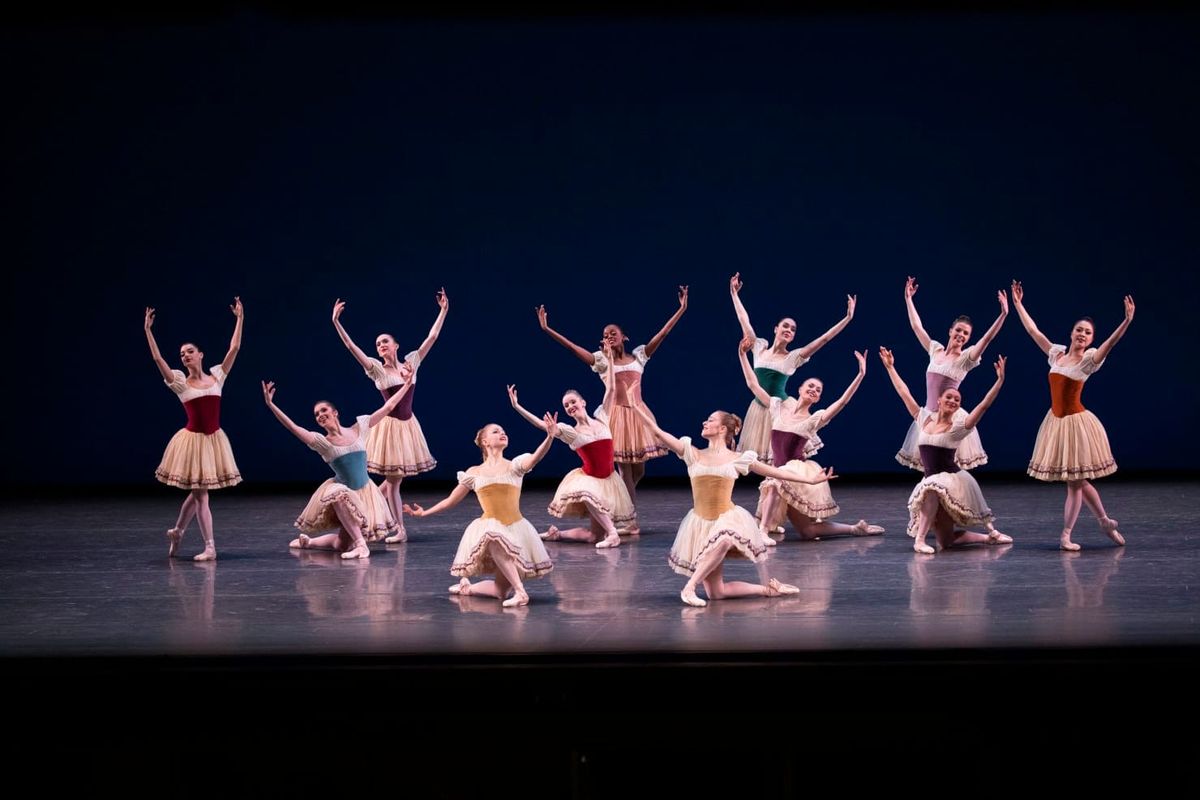
Balanchine’s “Divertimento from ‘Le Baiser de la Fée’” uses selections from Stravinsky’s one-act ballet, based on Hans Christian Andersen’s “The Ice Maiden”. Balanchine’s version has no story, but does explore some of the themes, especially the idea of an artist cursed by fate (the fairy and her kiss) to isolation and loneliness. The first part of the ballet is a cheerful village celebration with ten female corps led with a stylish energy and mirror image accuracy by Lauren Collett and Mary Elizabeth Sell, who were joined by Megan Fairchild. She had a brief soft, lyrical dance, opening up her arms with youthful confidence and was soon joined by Joseph Gordon. Their pas de deux had a youthful hesitation, as they kept at arm’s length, barely touching each other, but clearly enraptured, as the delicate floating lifts showed.
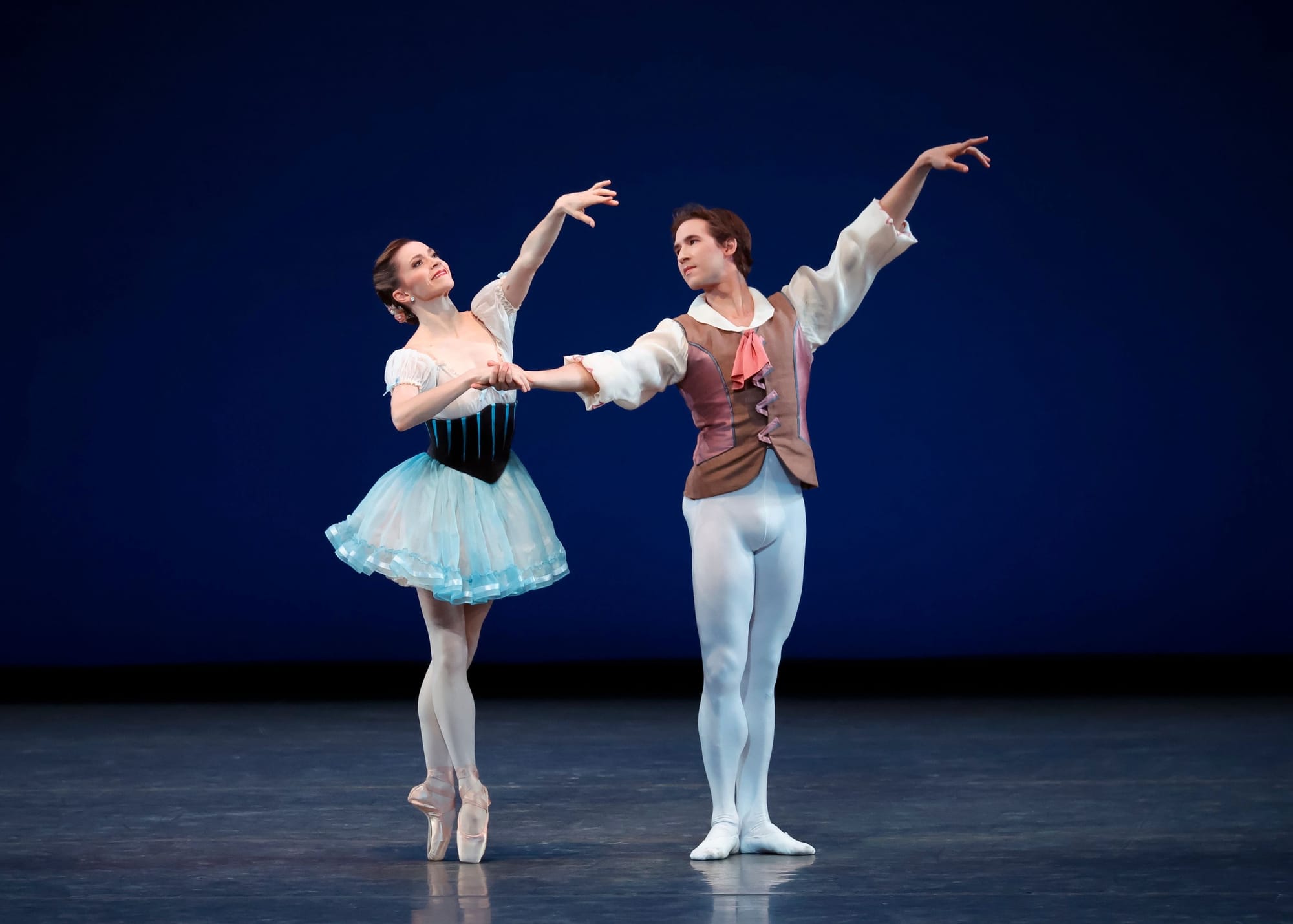
Gordon’s solo, though, indicated that this happiness could not last, as he seemed to be swept in several directions, turning this way and that, unable, it seemed, to stop moving. His run around the stage, with the jumps to bended knee sweeping his hand before him as if searching for something had a haunting sadness which made Fairchild’s subsequent sparking solo, full of little jumps and hops on point, dancing as if happiness were trilling inside her, all the more poignant.
The couple did get a brief moment together for some speedy turns, immaculately done, before the music and the stage darkened and the corps pulled them apart until they were on separate sides of the stage, seemingly pulled backwards into the wings alone. It is a dark and haunting finale, unexpected yet somehow inevitable.
Kyle Abraham’s “When We Fell’ originated in a dark time; it was choreographed during the lockdown, and filmed in the Koch Theater’s lobby and stage, using the large marble Elie Nadelman sculptures as a partial background and was released as a black and white film during the period the theaters were closed. The 2025 ballet reworked the choreography for a live performance. The dark background was intersected by a long narrow mirror reflecting the dancers’ metallic bodystockings, perhaps reflecting the watching images in isolation aspect of the original film.
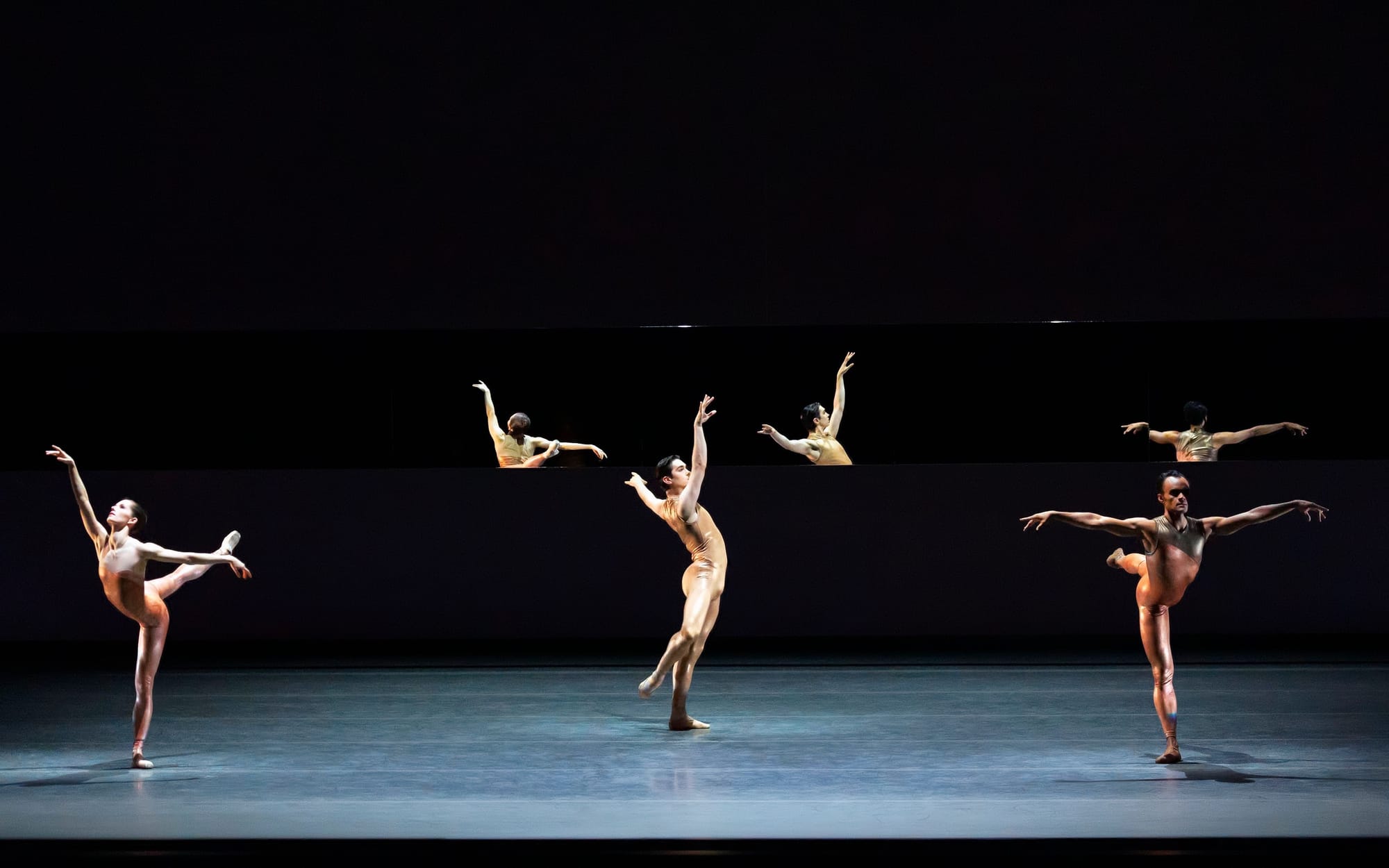
The music, three piano pieces by Morton Feldman, Jason Moran, and Nico Muhly, reinforced the quiet, isolated feel of the piece, as the eight dancers entered and exited. The movements had many of Abraham’s signature head rolls, rippling torsos, and snaky arms mixed with standard ballet steps, but the movements were often calm and statuesque, giving an impassive, impersonal feel to the work. Taylor Stanley oozed through his dances with his usual loose limbed precision, and KJ Takahashi had some impressive beats and spins. The women, India Bradley (who got to show off some extravagant extensions), Unity Phelan, and Indiana Woodward balanced and turned with an impassive precision. Jules Mabie, David Gabriel, and Sebastián Villarini-Vélez joined them, partnering with great control, though the general anonymous air made this work feel a bit sterile.
There is nothing anonymous about “Chiaroscuro”, which broadcasts its heart. It was choreographed in 1994 for Jock Soto and built around his strong presence. Andrew Veyette, in his retirement season, danced the lead. The subtitle “The play of light and shadow”, is a bit misleading—there isn’t much light in the piece, which is danced against a black background, decorated with vaguely baroque panels by Michael Zansky. The stately music is by the baroque composer Francesco Geminiani.
Veyette, on his knees with arms outstretched, opened the ballet; he was soon joined by the other six dancers (Ashley Laracey, Olivia MacKinnon, Brittany Pollack, Preston Chamblee, and Daniel Ulbricht). The women seemed to be memories from his past, MacKinnon a youthful episode, Pollack a more fraught relationship, and Laracey, with her air of being lit from within, his ideal vision. Ulbricht could be his younger self, energetic and hopeful, while Chamblee, whose moves often echoed those of Veyette, his observant doppelgänger.
He got to observe some rather generic choreography, generously and rapturously performed. Laracey’s lyrical glow as she wrapped herself around Veyette with her long, elegant legs and beautifully shaped arms was warm and protective. Ulbricht’s impeccable pirouettes were both effortless and musical; he seems to defy age. Veyette’s final solo, though a bit overwrought (he had to roll on the floor) was performed with a powerful and moving restraint, as he repeated his opening gesture.
Ratmansky’s “Odesa”, like the opening ballet, was descended from a literary work, in this case, Isaac Babel’s “Odessa Tales", short stories about Jewish gangsters in pre-Revolutionary Odessa (the music, by Leonid Desyatnikov, comes from the film “Sunset”, based on those stories). The music includes a mixture of klezmer-like sounds (it has a haunting clarinet wail) and tango rhythms. Unlike “The Ice Maiden”, it is certainly not a fairy tale, and Ratmansky’s choreography has a dark and swirling undercurrent of danger, a sour and hopeless mood.
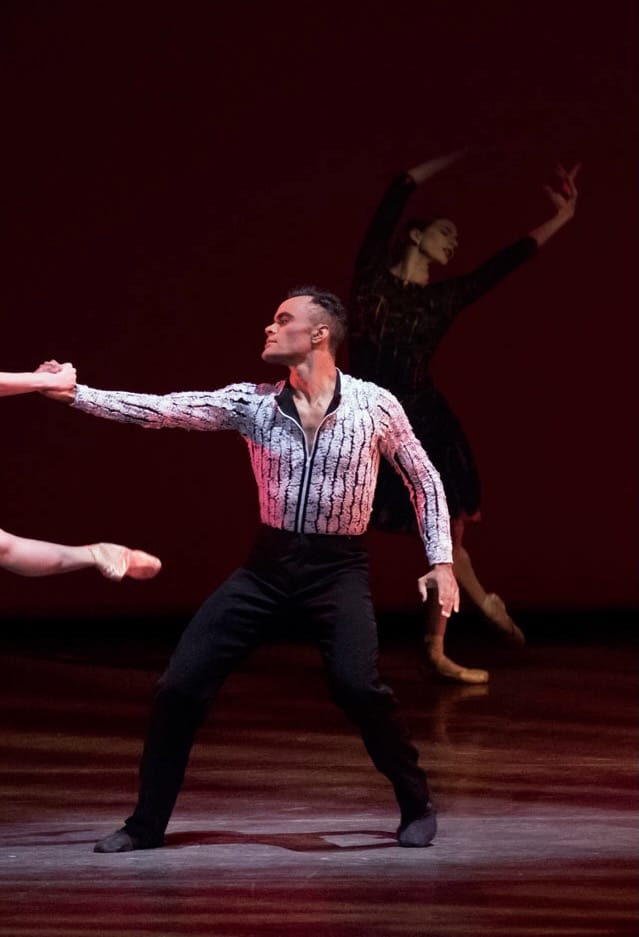
It focuses on three distinct couples, Alexa Maxwell with Daniel Ulbricht, Emma Von Enck with Taylor Stanley, and Unity Phelan with Peter Walker, accompanied by a large corps. The men, in their rather louche outfits with tight shirts and trousers, had an ominous presence. Ulbricht, hunched over, used his hands like claws, only to be pushed away by Maxwell, who used her subtle dramatic power to create her own story of a woman trapped and helpless who tried to fight back. Von Enck and Stanley performed the stylized danse apache; she was too beaten down to struggle. Phelan danced the tango role originated by Sara Mearns; she gave it an elegiac air, nothing like Mearns gripping drama, but she made her final revolutions in the pool of light seem like a mournful benediction for those lost people. It was a glorious gleam of light after all the darkness.
© 2025 Mary Cargill



