Dark, Strange and Familiar
"Kindertotenlieder”
Gisèle Vienne and artists
New York Live Arts
New York, NY
October 29, 2014
Contrary to its title, Gisèle Vienne’s “Kindertotenlieder” does not mourn the death of children, nor does it use any of Gustav Mahler’s famous songs from the opus of the same name. Instead, it taps into something deeper and darker, presenting nearly every instantiation of the violent and disturbing triggers of human anxiety, through a creative integration of movement with music, sound, speech, and puppetry. Seven years since its world debut in 2007, the U.S. premiere of the work had the audience oscillating between sympathy and dread, but despite its disturbing qualities remained eerily captivating.
In creating the piece in collaboration with Dennis Cooper and KTL (Stephen O’Malley and Peter Rehberg), Vienne was influenced in part by “Kindertotenlieder” poems by Friedrich Rückert that underlie Mahler’s music and deal with grief over children’s deaths, but her principal source of inspiration was the concept of the “uncanny” as presented by Sigmund Freud: a blurring of lines between reality and fiction, the strange and the familiar, and the disruption of the viewer’s psychological state through the resulting dissonance.
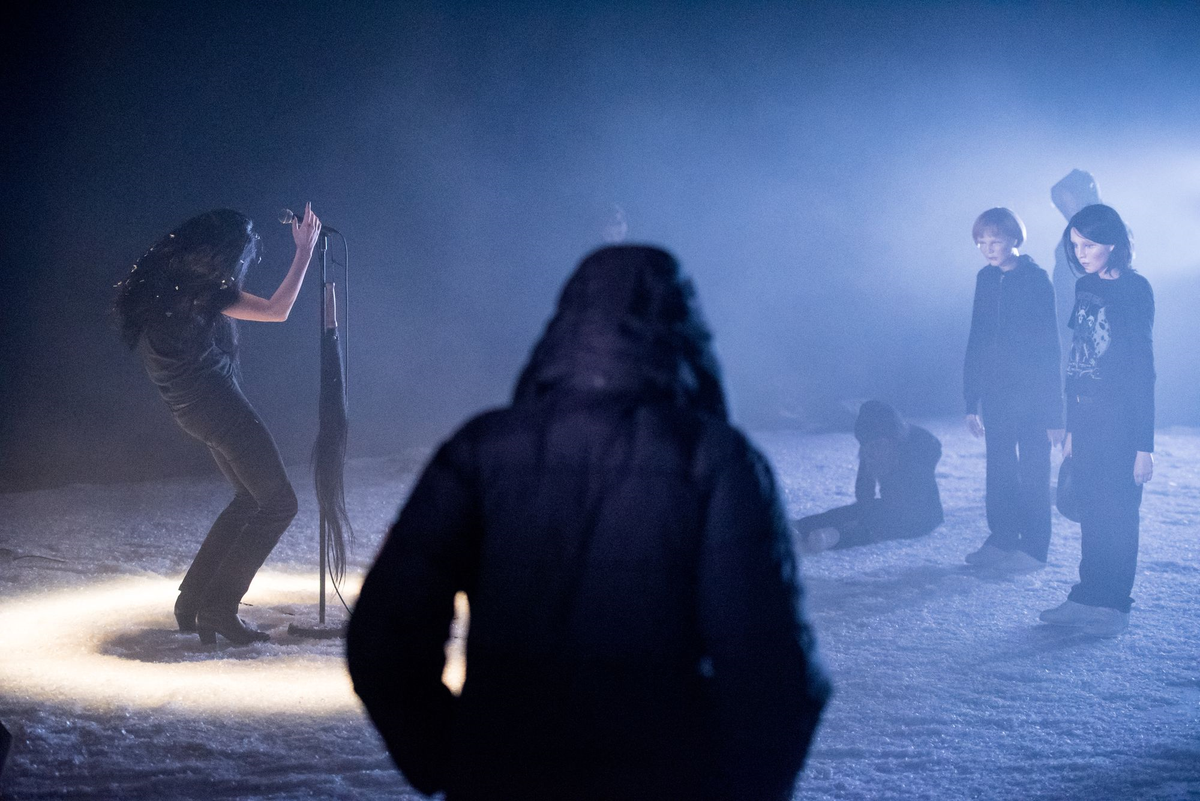
To explore the Freudian concept, Vienne presents an eerie stage resembling a winter night populated with human figures, constantly shifting the audience’s perception of which were real people, which were human-sized dolls, and which were uncanny imitations of human beings. These shifts between the human representations, all dressed in similar clothing, would be disturbing enough, but Vienne adds to that by cycling through an almost exhaustive set of graphically presented grotesque and distressing acts, such as murder, rape, suicide, physical abuse, and more. Whatever your trigger points are for viscerally rejecting the imagery, even if only staged, Vienne is bound to hit them, but through the overall presentation, and largely through the unique choreography, the effect is disconcerting, but not altogether horrifying.
Death serves as the thematic matrix of the work, and during the piece each performer appears “dead” somewhere along the timeline, only to become reanimated again. Whether the characters were ever meant to be alive or dead is not quite clear, but the loose plotline of the work emerges as a dialogue of a teenage boy with a dead friend’s ghost, which provides some grounding for what occurs, and suggests that the many crimes were retellings of the same events as perceived by different actors.
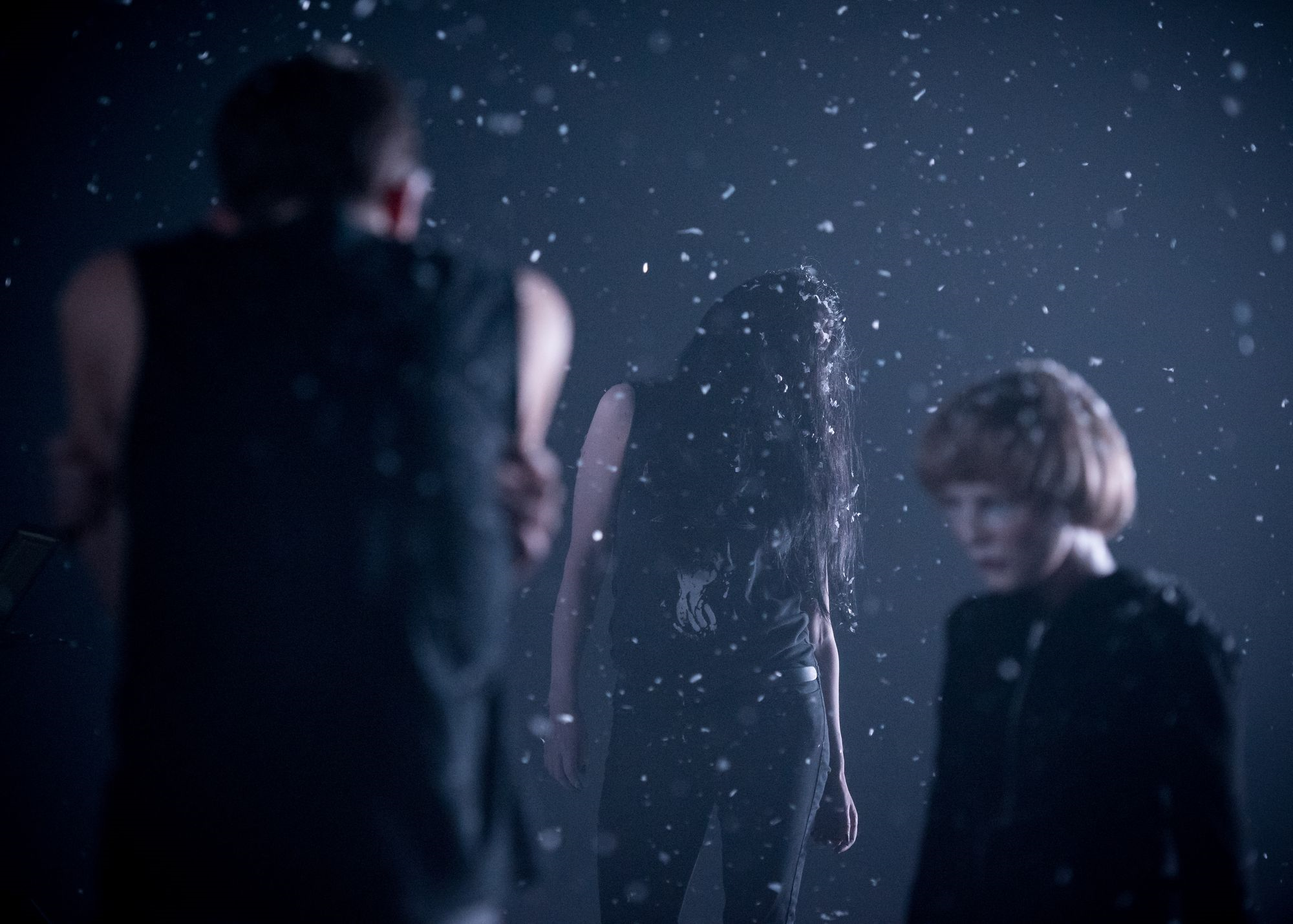
The performance began with an animal form slowly emerging from a coffin and moving across the snow-covered stage to a series of different chilling sentences (“When I grow up I want to chug-a-lug a zillion beers, then behead your wife and kids”) uttered by a disembodied, androgynous and eerily calm voice that appeared periodically throughout the performance. Then the figure removed its mask, revealing a woman. As she gradually proceeded down the stage towards two sitting robotic representations of children and began to mimic their movements, the voice seemed to be a conversation between the youths, but soon enough another performer moved, the voice now belonging to him, as he stood nervously fidgeting and adjusting himself. The violence followed shortly, with the man kicking and killing one of the “children” and dragging the body off stage, opening the door to brutal scenes which were periodically offset by the creative and sometimes dreamy choreography.
Throughout the piece, Vienne and her collaborating choreographer, Trisha Bauman, didn’t use any traditional dance steps, nor did the movements in the work happen across the horizontal plane – in their performance the dancers often remained standing in one place. Nonetheless, there was plenty of variety: sometimes the performers moved in fluid, rhythmical motions, other times so slowly it appeared they were gliding across the stage, sometimes they moved like puppets resembling Bunraku theater dolls, yet at other points the motions were distinctly robotic, not unlike those of some of the robot toys present on stage.
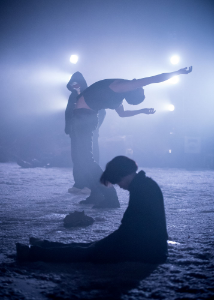
The choreography often had calming qualities and frequently became the focal point in the work following a violent act. After one disturbing sequence showing a fight among three men on the side of the stage where one of the performers was repeatedly kicked while in a fetal position on the floor, a man came to the middle of the stage and began swaying and folding forward only to open his arms in a body wave leaning back, repeating this oscillation, bending further and further back each time. The contradiction of his movement resembled the cowering from the foreign and the open embrace of the familiar, and the harmony of the repetitive choreography had an almost hypnotic quality.
Other parts of the work’s movement architecture were more robotic and doll-like. A female character that looked like a rock singer past her prime often resembled a broken mannequin or a marionette. She leaned forward and back as if playing an imaginary guitar near an upright microphone, her body often sagging, as though handled by an inexperienced puppeteer. Her movements, at times human at times not, provided a confusing but elegant symmetry with the music and her role contributed to a ceremonial quality in the work with the many dolls and characters positioned to face her and the eerie solace she provided from the disturbing imagery.
Despite the many graphic scenes, Vienne did not glorify brutality but instead made the stage a space to confront the more acute representations of what we find reprehensible but which we encounter on a daily basis through news reports and entertainment. Thus the scenes were morally foreign, but also familiar. The engagement with these depictions was designed to ultimately lead to a form of catharsis, and the many death scenes sought to present an experience of what philosopher Georges Bataille called “pure loss” – a form of complete expenditure that does not yield any return to the individual but which he viewed as necessary in all societies and ultimately resulting in harmony.
Whether the work accomplished its many ambitious goals perhaps depends on the susceptibility of the viewer, but even if it failed, it presented an opportunity to view unsettling imagery in a unique way. There was a mystical quality to the disturbing nature of the work that somehow rendered it beautiful and gave it a certain incomprehensible elegance.
copyright © 2014 by Marianne Adams



