Dark Secrets
"Caravaggio Meets Hopper", "Threshold", "Butterflies and Demons", "Zjawa", "Suspended Women"
Buglisi Dance Theatre
The Joyce Theater
New York, New York
February 6, 2013
Jacqulyn Buglisi and her dancers are celebrating their twentieth season with old and new works; this evening ranged from 1991 ("Threshold") to two new premiers, one by Buglisi ("Butterflies and Demons") and one by the young Katarzyna Skarpetowska ("Zjawa"). The general mood was dark, with only flashes of gentleness and humor, with a powerful and imaginative theatricality and stunning dancing. The opening work, "Caravaggio Meets Hopper", choreographed by Buglisi in 2007 to a combination of Nina Rota, Jelly Roll Morton, and John Corigliano, had flashes of irony, hints of violence, and a gently moving ending. The backdrop was a giant set of louvers which was echoed by the masks the dancers sported. They were all in various degrees of office attire, sitting in chairs and moving as if pulled by strings--it looked like a casual Friday the 13th.
The scene then switched to a domestic interlude, as guests Charles Askegard and Martine van Hamel, clearly an older married couple, struggled to communicate. Buglisi can evoke such clear images with just a few concentrated gestures; Askegardwith his newspaper, slumped in his chair, and van Hamel reaching towards him with suppressed desire. They reminisce, dance together, and then walk off in different directions, a life-time of sorrow and missed opportunities distilled into a few everyday movements.
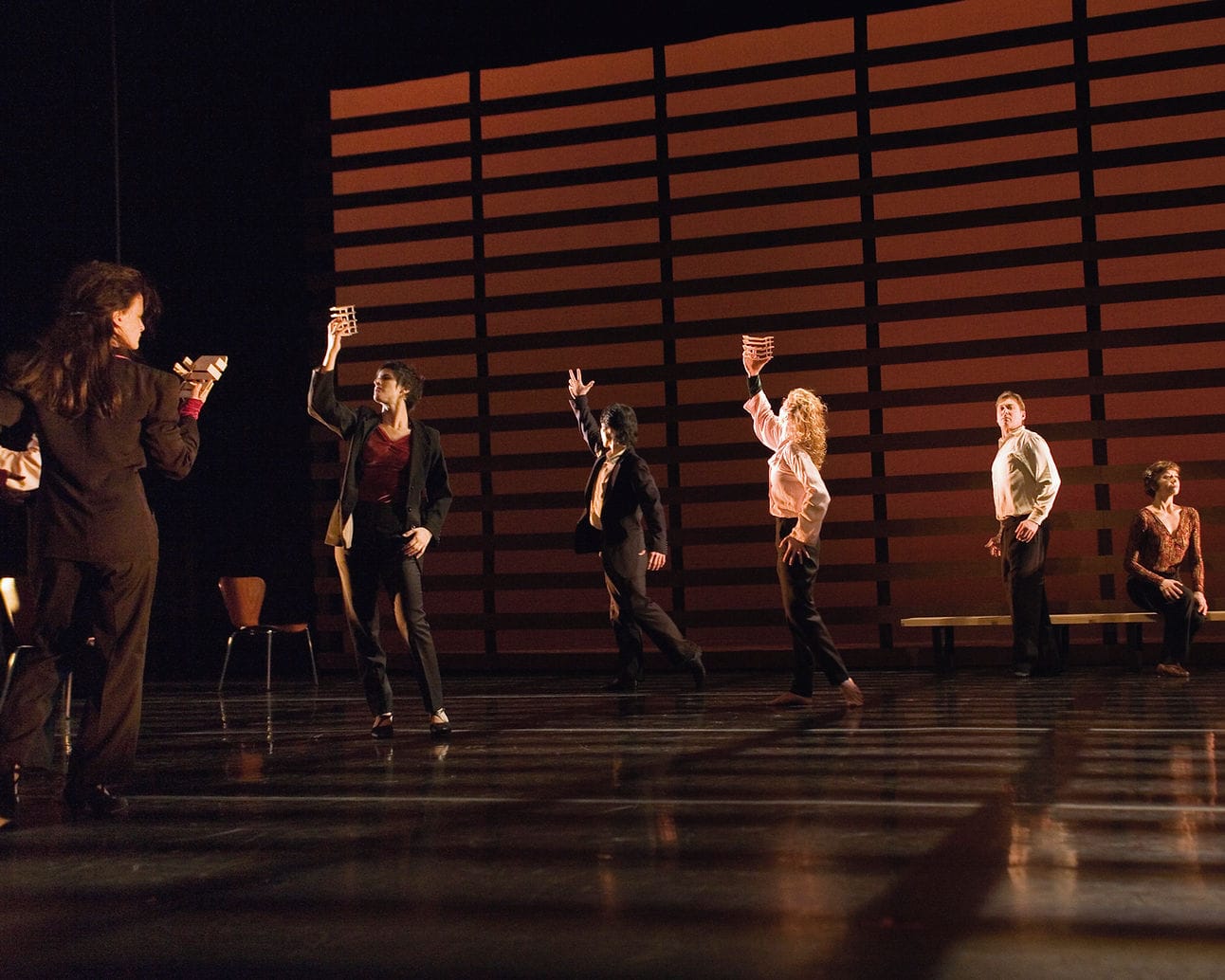
There were other couples, one with hints of violence, and another with a yearning innocence, but the Askegard/van Hamel was the most distinctive. Terese Capucilli seemed to explode with loneliness, as she stood among a group of men whose backs were turned, listening to the hyper-romantic dialog from the ending of "Casablanca"--she would never have Paris. The work was not completely bleak, as Askegard and van Hamel returned, he to quietly touch her shoulder. The gesture merged into a gentle tango, as finally they sat down in middle-aged contentment. This was a powerful, subtle, and moving work.
"Threshold", choreographed in 1991 by Buglisi to Arvo Pärt, is equally theatrical but more oblique. The program note is a quotation by Rilke about beauty, angels and terror, but assuming that one of the two dancers is the angel and one is beauty/terror may be taking things a bit too literally. The work opens with a women (Virginie Victoire Mécène) on the floor covered by a white cloth, from which she struggles to emerge. Once she breaks free, a man, Kevin Predmore, emerges with a vaguely threatening attitude, and carries her around the stage. The actual movement was hypnotic, concentrated, and unforgettable, using the female's fragile power and the male's menace to create stunning images.
"Butterflies and Demons", a premier by Buglisi to music by Daniuel Bernard Roumain, also came with an explanatory note, one possibly too clear, as the piece was inspired by the Coalition Against Trafficking in Women and dedicated to a female relative of Buglisi, who was kidnapped and murdered. The work for 12 male and female dancers wasn't literal--that would have been too hard to watch, nor did it fall into the trap of making the men into one-dimensional ogres, though they did their share of carrying the girls off. It seemed more of a timeless lament for all the victims, both male and female.
Katarzyna Skarpetowska's "Zjawa", to music by John Zorn, also had an explanatory note, explaining that it was based on a 19th century Polish romantic poem about a phantom at the bottom of a lake. The choreographer adds that her work "draws on the eternal themes of destruction, loyalty and sacrifice, faith and hope." Needless to say, this was difficult to convey in a solo, even when performed as powerfully as Carrie Ellmore-Tallitsch did. She danced in a long white dress against a dark stage; she didn't look like a 19th century romantic creature; her stylized curled hair and odd heavy movements gave her the feel of an archaic Greek statue performing some ancient and mysterious ritual. She had an odd gate, walking backwards heels down first, which gave her a dense, floating quality which was quite hypnotic. The piece had a pure, stark beauty.
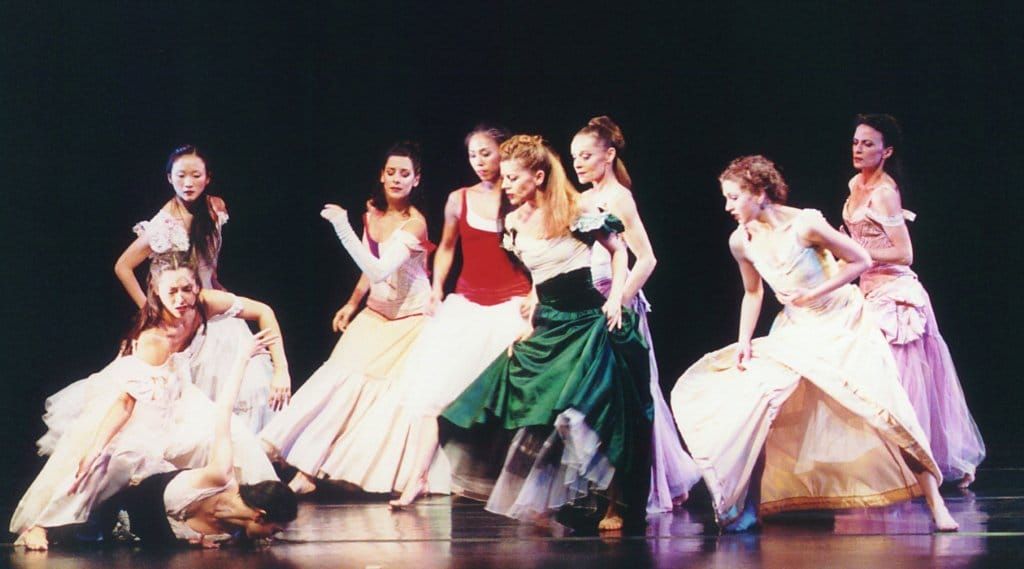
And so did Buglisi's 2000 piece "Suspended Women", to Maurice Ravel. This opened with a line of women in long dresses from a range of periods. There were repeated gestures of reaching up and falling to the ground, as one and then another of the group came forward, and then blended back in. This constantly shifting collection was interrupted by a group of men, who occasionally lifted one of the women and carried her off stage. This was obviously a "woman's ballet", led by Terese Capucilli as the most determined of the group to break free, but there was a slight ambiguity as well; some of the women were happy to be in couples. Again Buglisi made small, ordinary gestures resonate. The men returned at the end, offering their jackets to some of the women. Several put them on, but Capucilli firmly but without harshness, rejected the offer, standing alone. A quiet, but determined triumph.
copyright © 2013 by Mary Cargill



