Dancing on Federal Land
"Ritmo" "Ambiguous Dance" "Laughing Frame" "We are all Dragons in Drag" “Tableaux 2017” “Divine Conversations”
San Francisco International Arts Festival
Fort Mason Center
San Francisco, CA
May 31-June 3, 2018
This year’s San Francisco International Arts Festival offered a line-up similar to the one it has since 2013. That means Circus, Comedy, Music, Performance, Theater and Video, the vast majority from the Bay Area. Given the “international” in the name, the Festival disappoints almost every year. For a time, it was, apparently, difficult to get visas for foreign artists but those issues, according to Executive Director Andrew Wood, appear to have been resolved. Now – no surprise here — the primary challenge is financial. Despite the meager presence of artists from abroad, the Festival offers opportunities to catch up in one place with unfamiliar local dance and companies not recently seen. This year, during SFIAF’s second week, I managed to see six ensembles; their performances delighted, puzzled and disappointed. The Festival's home at Fort Mason Center, a former military installation with a number of difference performance venues now part of the National Parks System, works well enough.
The most totally satisfying dance seen in a long time came from Yaelisa’s Caminos Flamencos, a twenty-five year old, well established Bay Area company that often teams up with a number of different performers. The world premiere of “Ritmo” cut back on what counts: musicians and dancers challenging each other. Yet this more intimate format of basically two dancers and two vocalists just highlighted what drives Flamenco: an intense love by its practitioners and great generosity and joy in sharing with each other. The program opened and closed with a tutti of palmas and zapateados, an almost ritualistic form of percussion. Then dancers Fanny Ara, an explosive firebrand, and Yaelisa, dignified but smoldering, paired up with vocalists Jose Blanco “El Grillo”, and Félix de Lola. The one can sound as smooth as a dulcimer; the other is quasi-operatic. This quartet has performed together for a long time; here they worked for each other and for us. An extraordinary artist on his own terms, Guitarist Jason McGuire’s exquisite new solo resonated with a complexity that arose out of, but was not limited by, Flamenco. The evening's guest artist, Alfonso Lose, is a truly brilliant and justifiably well acclaimed artist. His participation was welcome though not essential.
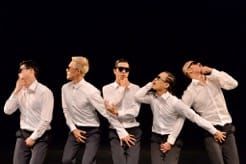
“Ambiguous Dance” appears to be the name of this group from Korea but also the title of what they performed. Fast-moving and fabulously entertaining, “Ambiguous” became an intricate mix of hip-hop, modern dance, ballet and circus. Abandon, hilarity as well as pain and sadness, flowed in and out of each other almost like a life's history. Often I wasn’t sure what was what. Madcap energy sent the six dancers from sunglasses and in underwear into business suits (to Beethoven) and back to shorts. A muscular body builder type (Boram Kim) was the ideal that these skinny guys tried to emulate. It was a colleague who pointed out the work’s subtext resided in the awkward crotch grabbing gestures.
Curiously, Baobab, an excellently performing quartet from Japan, also used a mixed vocabulary in the US premiere of “Laughing Frame.” Three women, each one a superbly trained comedian/actor/dancer, took on a score which can only be called percussive world music. As its tracks came up, the women tried to make movement sense out of them. The initial European salon music, initially had sent them into a frenzy of bone-shaking distraction. A male dancer brought in a picture frame into which the women tried to squeeze themselves even as they attempted to escape. I am not sure why the frame was introduced only half way through the work. (Baobab shared a program with Steamroller that time constraint prevented me from seeing.)
Dandelion/Bandelion, a dedicated group of performers with various professional training, always impresses with the dedication of its members. In the world premiere of “We are all Dragons in Drag ” they played with the idea of Drag/Dragons, making wonderful use of huge hoop skirts and odd little transformations. However if the group hopes to attract larger audiences, they probably will have to tighten formal constraints.
Since the Bay Area is rich in aerial performers, Troupe Vertigo’s northern California premiere of “Tableaux 2017” sounded like an intriguing contribution. Performing on, in and around a set of boxes, the five women did so with the skill and care, moving in and out of unisons and canons. On the slack rope and the trapeze they elicited well-deserved gasps. What I missed was the fluency of dance; each phrase ended in a pose.
Ushanjali Dance’s new “Divine Conversations” attempted something brave. Choreographer and Founder/Director Naina Shastri used excerpts from Martin Luther King Jr.'s magisterial “Beyond Vietnam” speech to create Indian dances, both classical and folkloric, on several quartets of her students. Unfortunately, this noble idea was poorly rehearsed; the students need to return several years from now. It was the live music, and particularly vocalist Shruthi Aravindan, that held the show together.
copyright © 2018 by Rita Felciano