Dance in Blood, Like Flowers
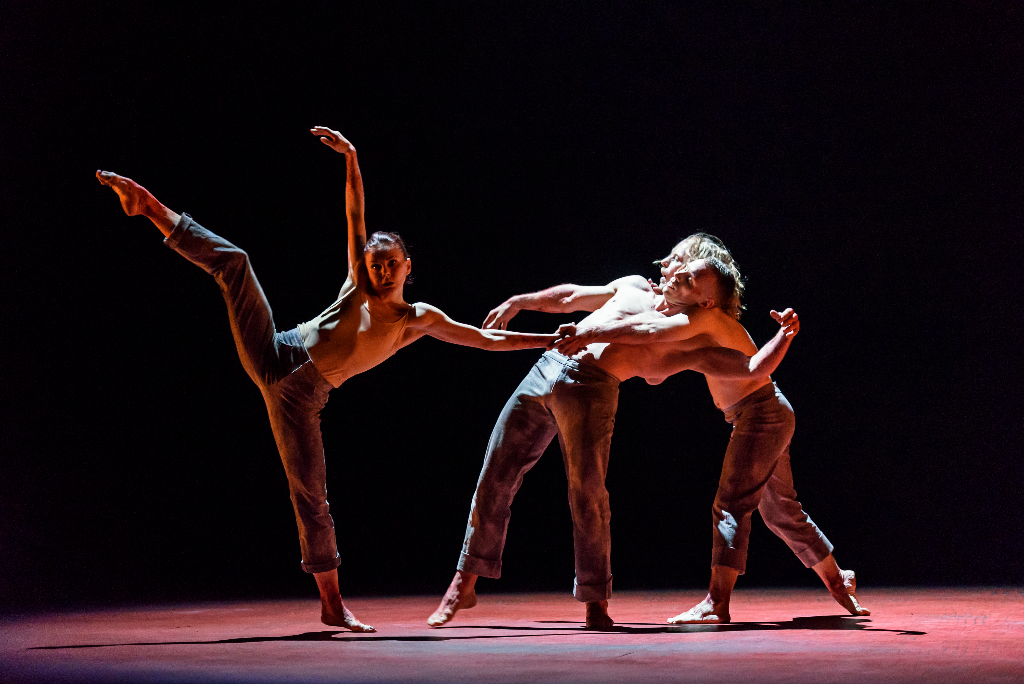
Natalia Osipova & Artists
A Sadler’s Wells London Production
“Run Mary Run,” “Qutb,” “Silent Echo”
New York City Center
New York, NY
November 15, 2016
“Don’t try to judge me, Don’t try to touch me” said the voiceover recording in the first few minutes of Natalia Osipova’s program, as she slowly moved across the stage in heels, a short green dress and red beehive wig. The moment was from one of the three US premieres of the night, this one of Arthur Pita’s “Run Mary Run” – a dance to a compilation of songs by the 1960s girl group The Shangri-Las, all mostly about “break-ups and death, told from the viewpoint of broken-hearted teenage girls” according to the bill – and it resonated throughout the program, its ballets, their darkness, creativity and range of emotional and physical transcendence. Osipova’s evening may have been first and foremost about dance, but what it really presented was rich, complex and beautiful theater.
Given the history of Pita’s and Osipova’s collaboration, and all the comedy and theatrics of “Facada” that he created for Osipova and Ivan Vasiliev in 2014, the abstract and daring storytelling in “Run Mary Run” didn’t come as a surprise, even if the depths of its darkness did. In this work Osipova emerged on stage from a pile of black ash, first her hands, then her body, completely covered in a raggy black trench coat, and then stumbled along the stage. It took just a little time for her to shed those clothes and reveal a girly little green dress and red wig, and then proceed to pull the body of her mate – danced by ballet’s “bad boy” and Osipova’s off-stage partner Sergei Polunin – from the same ash heap, and begin reviving him back to life. Once he finally inhabited his role of Jimmy, the couple delved into the dancing, starting with a duet that had Osipova perform many typical – for her – high jumps that she ended in supported lifts with her legs limberly wrapping around Polunin. This set the physical key of the night: daring but effortless use of acrobatics and super-honed skills to convey emotion, presented just casually enough to suggest that the dancers’ physical prowess was just their natural way of self-expression, and wasn’t being done for the unavoidable wow-factor.
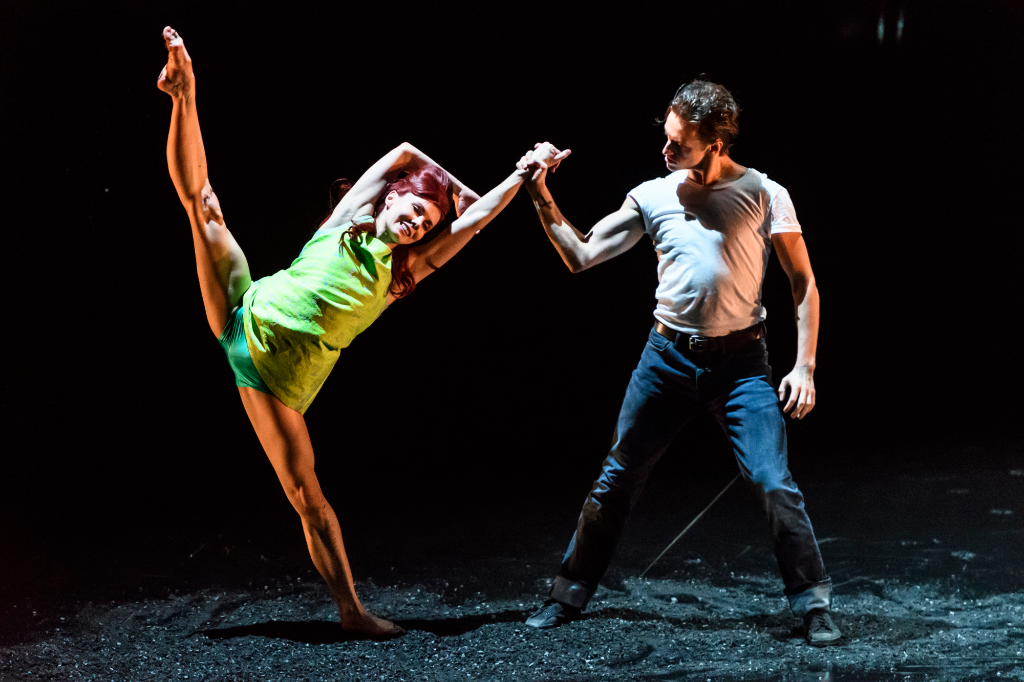
As the performance went on, Osipova’s acting ranged from playing a sexy vixen to a young woman broken down and alone. Besides the darkness there was plenty of comedy, such as when she wrapped her arms and legs around Polunin, and hung on to him as he walked first to stage right (to get a cigarette), then to stage left (to get a bottle of scotch and a glass), and then began the “drinking” and smoking which ultimately caused Osipova to tire and let go. The sequence of smoking, “drinking” and many lifts turned somber when Polunin’s Jimmy took it a step further, wrapping his belt around his arm and proceeding to “inject” himself with a syringe. For Osipova’s Mary, heroin was the line, and the stage immediately went black, with her dejected, shivering and alone, as though on an abandoned street.
Brightness and happiness came back soon enough though, with her reappearing in a poufy dress on a swing suspended from the middle of the stage’s ceiling, coyly flirting and falling in love with a different, more romantic, version of Jimmy, only to again lose him, and several scenes later end up wrapped in the same trench coat, lying next to him, next to their ash. Whether all of these scenes portrayed one relationship or many, the same or different people, or perhaps different perspectives on the same thing, was up to audience interpretation. What was undeniable though was the depth and power of the artists’ portrayals.
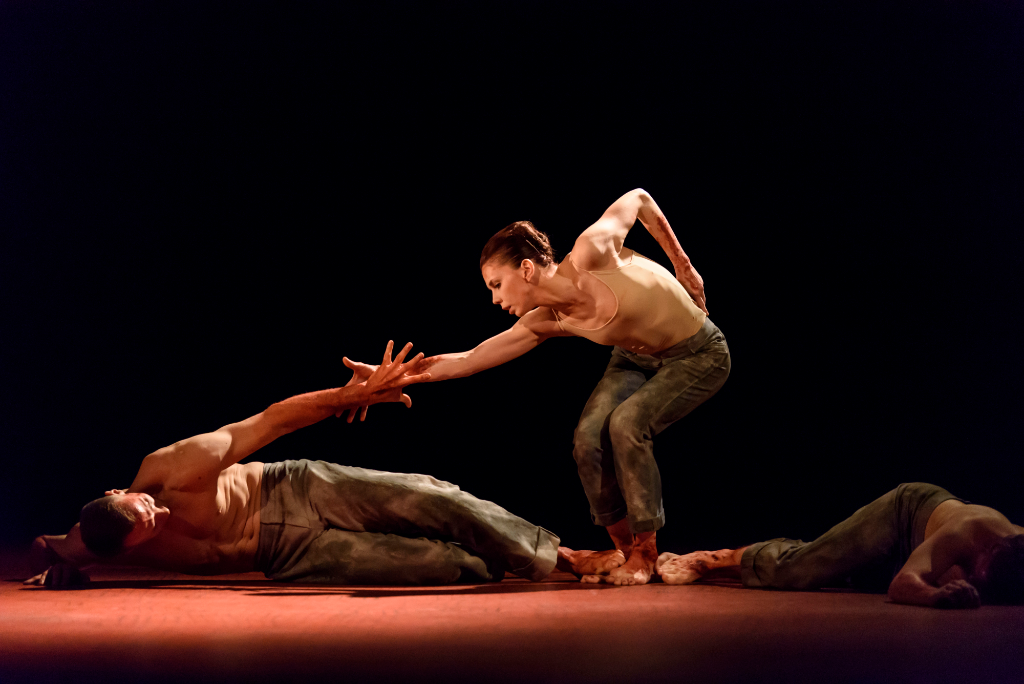
After an intermission, the second work possessed no less drama, though this time, in Sidi Larbi Cherkaoui’s “Qutb” – named with an Arabic word meaning “pivot” or “axis” - most of it came from dancing and staging. Cherkaoui’s goal with his ballet was to explore the unknown and the dangerous, and the ballet read like a portrayal of post-apocalyptic unity and disunity. Osipova and two guest artists, Jason Kittelberger and James O’Hara, were dressed only in jeans, with the men’s chests bare and Osipova’s covered by a nude top. Their bodies and hands appeared smeared in blood, and the beginning of the work showed them splayed on the floor in a state of complete defeat.
Cherkaoui’s ballet was full of slow, weaving movements of various physical, though not emotional, connections among the dancers. They seemed asexual, genderless and nameless, lost, and often appeared to be crawling through time and space, as though trying to find meaning, each other, or perhaps something, anything else. Despite this dark, somber, and at times desperate atmosphere, the artists projected a lot of resilience and hope, and found a way to evoke sympathy and connect to the audience. Whatever these characters’ past was, they were easy to care about. It was a provocative piece artistically, but also an incredible vehicle for showing just how well-honed of a movement machine Osipova’s body is if the viewer paused to analyze it: at one point she balanced her hands on the hands of a laying partner, all while standing on his stomach with one foot and delicately lifting one leg in a developpé to then bend the form altogether and gently come down to droop over his body.
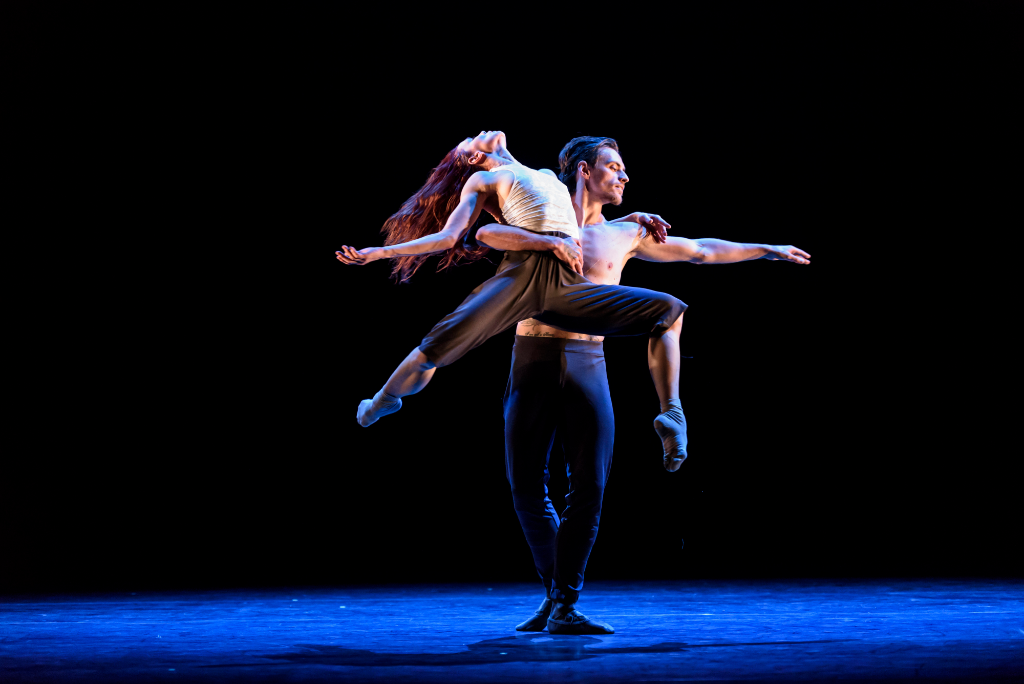
This striking physicality played even more of a role in the last piece of the evening, Russell Maliphant’s “Silent Echo,” which began with Osipova and Polunin performing isolated movements as a spotlight hit them in turn in pitch darkness. Maliphant’s goal was to take classical steps and use them as a point of departure to create modern dance, and though the work itself didn’t have a lot of intrinsic drama or content, the dancers’ rendering of it gave it flourish. Perhaps not surprisingly, Osipova came off as the dancer with a clearly broader expressive range. Her approach to the steps varied from curiously playing with the prescribed movements to completely dominating them, such as in one seamless transition from a loose-limbed body wave into incredibly quick and powerful chaîné turns.
Polunin’s dancing was less free and, as is frequently the case with him in modern dance, seemed to be just on the cusp of leaving classicism. Unlike Osipova, his transitions between the different styles of dance had clear demarcations – each classical jump looked strictly classical from preparation to completion, with an obvious pause at the end before he would dissolve the jump into a drop to the floor or another modern step. His infusion of dark drama into the piece – with long pauses and intense looks – also felt more forced and artificial than Osipova’s, but still the ballet, like the rest of the show, left an impression. And while all the darkness and strong creative detours from what might be expected from a classic ballerina felt unusual, Osipova’s show presented remarkable art, and a mix of the kind of creative fuel that was wholly honest and open, wondrously adventurous, and remarkably fruitful.
copyright © 2016 by Marianne Adams



