Cunningham and Balanchine
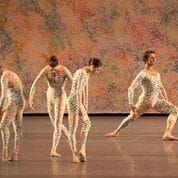
“Serenade,” “Summerspace,” “Tschaikovsky Piano Concerto No. 2”
New York City Ballet
David H. Koch Theater, Lincoln Center
New York
October 10, 2019
Throughout the dance world this year, celebrations are taking place to mark the centenary of Merce Cunningham’s birth. New York City Ballet has had Cunningham’s “Summerspace” (1958) in its repertory since 1966, so it is logical that the company would bring it back as its own way of honoring the great modern dance innovator. The work is one of Cunningham’s most famous, not only for the dance itself, but for its pointillist sets and costumes by Robert Rauschenberg and its experimental score by Morton Feldman. It was presented Thursday evening bracketed by two Balanchine works.
Cunningham’s dances would not seem to be a natural fit for NYCB, but there are historical connections between Cunningham and the company. Cunningham studied at the School of American Ballet in the 1930s, and he later taught modern dance there. Lincoln Kirstein invited Cunningham to create a work for Ballet Society, NYCB’s earlier incarnation, in 1946. The dance, titled “The Seasons,” was performed in 1947 as well as in 1949 during New York City Ballet’s first season. Cunningham’s relationship with Kirstein and the company eventually led to NYCB obtaining “Summerspace.”
When Cunningham developed his own technique, he incorporated aspects of ballet into it, including turn-out and an alert, erect posture. However, Cunningham’s whole rationale for making dances and his approach to materials was very different from that of a ballet choreographer. It is not surprising, then, that NYCB’s performances of “Summerspace” rarely look like they do when the Cunningham company dances the work. To begin with, the ballet dancers are not barefoot, as are the modern dancers. Instead they use soft ballet slippers (and apparently when NYCB first performed “Summerspace” the dancers wore pointe shoes). The addition of shoes means that the ballet dancers have a different relationship to the floor than modern dancers. They also have a different relationship to weight, with the ballet dancers appearing almost weightless. This makes the dance look strangely insubstantial, like icing without the cake.
Then there is the way in which Cunningham made his dances at the time, which was to incorporate chance procedures among other structuring devices. The incorporation of chance means that the steps do not necessarily have transitions or any other sort of balletic logic. It can make the movement difficult or awkward to do, which is part of the challenge and is allowed to be visible. But ballet dancers are trained to conceal the effort that goes into dancing.
So, in Thursday’s performance, we saw the dancers smoothing over the moments of awkwardness and concealing the effort and weight of the body. Only two of the six dancers looked as if they had captured some of the Cunningham approach. They were Andrew Veyette and Sara Adams, the two oldest dancers in the cast of six, whose experience perhaps gave them permission to give into the movement rather than attempting to defeat it. Adams suddenly looked like a Cunningham dancer as she darted across the stage, as did Veyette in both the jumping sections and in the unforced way he confronted and lightly touched another dancer, as if acknowledging her presence. Adrian Danchig-Waring, in the Cunningham role, was less convincing. A highly intelligent dancer, he nevertheless did not or could not grasp the essential elements that were needed. He looked too light and finished. Cunningham felt enough confidence in NYCB to allow the company to perform “Summerspace,” so there is no reason the company should not do it. But it’s worth remembering that it only vaguely resembles the dance Cunningham created for his own group.
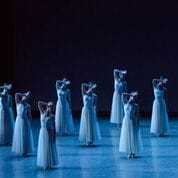
The evening opened with Balanchine’s “Serenade,” (1935) in one of the most eloquent performances of the work I have seen in recent years. The ballet is usually associated with the fact that it was the first one Balanchine created in the United States and his first for what would become NYCB. However, it is also very much a part of Balanchine’s interest in the neoromanticism of the 1930s and ‘40s that was influenced by surrealism and by artists like Pavel Tchelitchew, in which fantasy and mystery are prominent. Thursday’s performance brought out those elements in a way that exposed the powerful emotions lesser performances tend to muffle. It helped that the work looked meticulously rehearsed, giving the corps a forcefulness worthy of a Greek chorus. They seemed to enlarge and comment on the dramatic events emerging around them. Sterling Hyltin as the central ballerina was superb, dancing with great musicality and with unexaggerated feeling. Megan LeCrone and Erica Pereira in the second ballerina roles were also superb. Pereira has been dancing particularly well these last few seasons. Ask la Cour and Preston Chamblee, as the major men, are mostly porteurs in this ballet, but they conducted themselves with quiet dignity. The result was an unusually moving performance that demonstrated just how important a ballet “Serenade” would be, even if it had not had the distinction of being Balanchine’s first production in the United States.
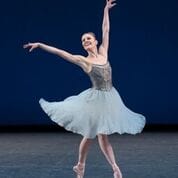
Balanchine’s “Tschaikovsky Piano Concerto No. 2” (originally “Ballet Imperial”) ended the evening. It has been in the repertory since 1941 and is the flip-side of “Serenade,” Petipa-inspired classical formality instead of romantic mystery. Elaine Chelton was the pianist for Thursday’s performance, playing with fierce attack. This year brings new costumes by Marc Happel that exchange pastel colors for gray-blue ones in a style similar to the last designs. Ashley Bouder and Russell Janzen were the central couple on Thursday, with Lauren King in the soloist role. Bouder was replacing the originally announced Sara Mearns, while Janzen stepped in at the last minute for Tyler Angle, whose name was listed in the printed program.
Perhaps because of the cast changes, Bouder was not at her best. This is a ballerina’s ballet, calling for a virtuoso. Bouder is that, and she attacked the choreography like a storm trooper. She can be a subtle dancer — I remember her as one of the few NYCB dancers who look at ease in the Emeralds section of “Jewels.” But here, she had a four-square hardness in the allegro sections, while in the adagio duet, where she is called on to expand and find emotion within the movement, she looked merely tortured. In fact, the only person who appeared truly happy was King, who danced with great freedom and apparent delight. She was the only principal dancer who had been originally announced. The cast changes seemed to have taken its toll on the performance as a whole; even the corps looked untidy, with crooked lines and groups that lacked clarity. The ragged performance could not, however, dim the luster of the beautiful “Serenade,” which began the program.
copyright © 2019 by Gay Morris



