Crown Jewels
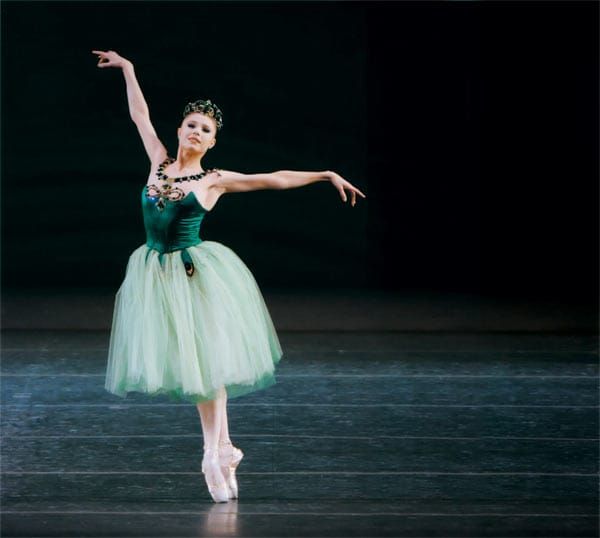
"Jewels"
New York City Ballet
David H. Koch Theater
New York, N.Y.
June3, 2011
"Jewels", Balanchine's three-act salute to dance style, and perennial audience favorite, has returned to the spring. It does still sport the 2004 rethinking by the original designer Paul Harvey, which are oppressive and gaudy. The mysterious "Emeralds" evokes a messy green swamp rather then French elegance, but the Raymondaesque costumes by Karinska still work their magic. There was other magic, as Tiler Peck debuted in the Verdy role. She is a young dancer, but, like Noel Coward's Amanda Prynne, she seems to have been born with a heart that was always jagged with sophistication, and her musicality, her intelligence, and her subtle sense of drama combined with her lyrical dancing created a woman of ever-changing shades and moods. The famous solo, with the mysterious arm movements, from the magical place where traditional mime and dancing merge, were luxurious and at times playful. She has a way of playing with her timing, holding a phrase, and then leaning into the music that seems to suspend time, but this was more than a trick, this timing seemed to meld into meaning; at one point in the pas de deux, she fell back into her partner (the reticent and noble Jared Angle), relaxing into complete stillness, then seemed to leave her body there and depart this world as the horns summoned her. But this timing never became over-acting or melodramatic, because it melded so perfectly with the music.
Sara Mearns, in the Mimi Paul role, is another inherently dramatic dancer, and the walking pas de deux had a true sense of mystery, as she seemed never to look at her partner (Ask La Cour, who supported her very well); it was almost as if she were the cousin of the Sleepwalker, pushed by some otherworldly power. Unfortunately, the pas de trois was a little choppy, and the center man, Sean Suozzi, who should evoke a courtly squire supporting two mini-visions, looked as if he would be happier in "Rubies".
"Rubies" as danced by Megan Fairchild and Joaquin De Luz became a very happy, peppy piece, playful and cute rather then witty and sophisticated. The steps themselves certainly don't phase Fairchild, but the little off-center grace notes (swinging the pelvis or twisting the hips) didn't look comfortable, and thus tended to overshadow the shape of the piece. De Luz looked better in his solo than in the pas de deux--he is a fine dancer, but is just to short to complement even as small a dancer as Fairchild. Savannah Lowery as the soloist was emphatic and she managed the difficult arabesque sequence without wobbling, but her rather bumptious approach lacked allure.
Wendy Whelan is not an outwardly alluring dancer, but in "Diamonds" she is hypnotic. Her command of every little detail, from the "Swan Lake" echoes (she is a magnificent Swan Queen in both Balanchine's and Peter Martin's versions), to the shifting emotional undercurrents of the pas de deux is unerring, even if the purely technical feats (like the unsupported turns) weren't delivered with quite her old fearlessness. The pas de deux is one of Balanchine's most formal and mysterious. The couple spend much of it at opposite ends of the stage, or at arm's length, so that the moments when they do touch have a striking power. Her partner, Tyler Angle in his debut, was attentive, but as yet, didn't quite have the instinctive dignity that he needs--his softness and pliancy evoke romanticism more than high nobility.
The corps, too, could have used some nobility lessons. Much of "Diamonds" is made up of corps patterns, and the Kirov's version, danced in New York in 2002, showed how magnificent these patterns can be. The NYCB corps doesn't have the Kirov's classical grounding, and their dancing was mainly about extremities, and looked weak and slightly sloppy. The girls' expressions tended to be of the toothpaste advertisement variety, though in the quartet, which should have a cohesive Russian flair, the expressions ranged from lots of teeth to slightly sullen. "We can go home now", I overheard someone say after the iridescent pas de deux, and unfortunately he had a point.
copyright © 2011 by Mary Cargill



