Contract and Release
“Ekstasis,” “Panorama,” “Histoire,” “The Rite of Spring”
Martha Graham Dance Company
City Center, New York, NY
April 14, 2018
In an elegant program that started at the most essential, then wove into the complex, the Martha Graham Company offered a program that was pure Martha. All of the works, from the 1933 solo, “Ekstasis,” to Graham’s mature 1984 “The Rite of Spring,” offered Graham’s signature body geometry, the breath, fists, and sweeping kicks creating scenes and stories of power. Even Lucinda Childs’ “Histoire,” whispered Graham’s name as often it evoked Childs’ own choreographic style.
“Ekstasis” is Graham at her simplest. A woman, Anne Souder in the Saturday program, stood tall and proud, a column of elegant white in a center spotlight. For long minutes, she moved in place to a jungle-like score of drums and squeaks, breathing, releasing her diaphragm (that movement, the proud signature – almost cliché now – associated with Graham,) then twisted and torqued her center and her hips (the Graham torso spiral,) thrusting her arms in one direction as her knees angled to the other, all deliberate and powerful, beautiful contortions.
Souder moved with intention and intensity, in a dance that included deep squats, knees to either side, and arms squared, bending the elbows 90 degrees to the ceiling – all very familiar Graham geography. And re-centering herself at the close, the simple column of Souder’s body split into the deep curve of a parenthesis, another torso spiral, her arms whipped high to the right and her deeply bent back. A powerful woman moving with all drama, there was not a touch of lightness or humor. Welcome back to Grahamland.
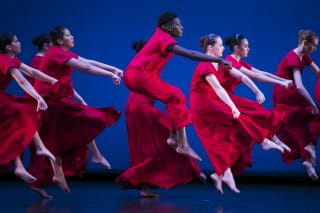
After Graham's single body geometry had been laid out, it was time to be re-introduced to the power of Graham’s collective. In inspired casting, an energized group of students – Teens@Graham – were trained over several months of Saturdays to dance the 1935 large group work “Panorama,” a piece supposedly built around three themes: Dedication, Imperial, and Popular. Almost 80 years later, those weren’t the ideas that particularly came to mind as the scores of scarlet clad teens danced in shifting pattern. They did indeed, though, form a panorama: all power to the people.
The parallel choreography created a trio of dance flocks, tight mobs moving across the stage. Their legs scissored crisply, and their erect posture matching the military sounding score. Although occasionally an individual dancer took the lead, those moments were brief. This work was not about the glory of any individual, but a mass of disciplined humanity in tight formations, often mirroring each other, driving forward like the segments of a single tribe.
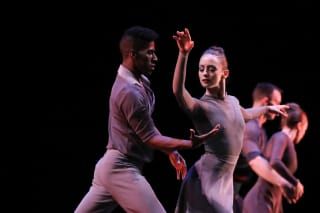
The non-Graham work of the program, “Histoire,” is a 2018 world premiere expansion of Lucinda Childs’ original 1999 duet for the Graham Company; the new work is an octet. The original couple, still central, was framed by, and then woven with three additional couples. The passion and drama of Graham’s choreography seems almost opposite to the cool, intellectual movement that is Childs’ signature, but the dancers seemed to revel in both the technique and the intelligent challenge of Childs’ work. The duets borrowed from many dance techniques, jumps and arabesques, even some unexpectedly romantic floating lifts from ballet, and jazzy lovers’ flirtations, as the women peered coyly and half-hidden over their partners’ shoulders, or pushed and pulled in seeming conflict. Near the work’s end, the four couples wove masterfully, as partners separated then reclaimed each other, evoking Childs’ complex movement puzzles. The new “Histoire” never quite came together, though; it remained two dance segments in search of deeper integration.
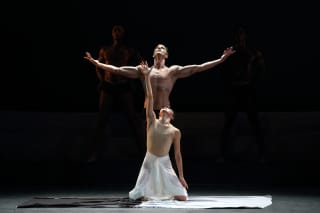
The crowning work of the evening was Graham’s mature 1984 work, “The Rite of Spring,” set to Stravinsky’s dark masterpiece. Like Pina Bausch’s work set to the same score and calling on the same ancient, mythic elements, Graham’s “Rite” is hard to take. A lush dance, it had all of Graham’s signatures – the powerful solo female performance of the Chosen One, danced by Pei Chien-Pott; the core conflict and dynamic of the central duet between the Chosen One and the Shaman, Ben Schultz; and the powerful tribe of dancers in energized patterns, not quite human in their slavishness to the requirements of the sacrifice. The discipline and power of the characters, and the crisp combination of dance and mime to project archetypal images and experience, were stunning.
The sacrifice of the young woman in the blood-thirsty spring ritual has always been hard to watch without cringing. The misogyny and violence of the work, though, is even more unsettling seen through the lens of a #MeToo world. Yes, art raises a mirror to our darkest instincts; but after 40 years, the shrieking sexual predation felt more disturbing than ever, despite the undeniable beauty of the movement, rich patterns, and gorgeous power.
copyright © 2018 by Martha Sherman



