Consanguinity
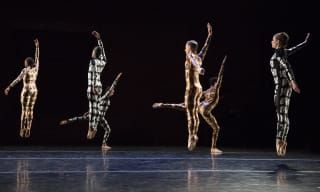
“Signals,” “Wild Wild World,” “Hardness 10”
Stephen Petronio Company
Joyce Theater
New York, NY
March 20, 2018
It is all right there. Stephen Petronio is in the middle of a five-year project (maybe longer,) “Bloodlines,” in which he remounts and reflects on the influence of the great choreographers who have been his mentors and inspirations. In the current offering, the link is beautifully clear to the stunning genetic material that he gleaned from Merce Cunningham, whose “Signals” (1970) opened the Petronio Company’s evening at the Joyce Theater, followed by “Wild Wild World,” an excerpt from Petronio’s 2003 work “Underland,” and a world premiere of “Hardness 10.”
There were moments in both of Petronio’s creations that proudly and directly echoed Cunningham’s DNA. The shapes of the dancers’ bodies, their extended limbs, and even the ensemble’s connections (like the echo of Cunningham’s sextet in Petronio’s “Wild World” sextet) doffed a hat to the master. Petronio’s dynamic, though, is his own. “Signals” demanded long intense postures (some that looked like quite a challenge for the dancers.) A mix of serious movement and playful patterns let the troupe have more fun with the group dances as they moved from serious solos and duets into an exuberant sextet. “Wild Wild West” and “Hardness 10” pushed in whirling momentum – the same stretch and muscle, but a completely different energy, the momentum and sexuality more pronounced.
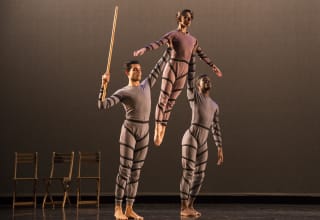
Petronio’s company, powerful and athletic, attacked Cunningham’s “Signals” with all of that muscle and balance. The dancers’ “signals” included gestures, finger counting, and occasional vocal grunts and eye contact that moved the work or let the dancers communicate their position. In the solos, one danced as the next performer sat in one of four folding chairs set upstage right; they waited for their moment, engaged in watching and listening. As they grouped to the trio and the sextet, their signals were increasingly important to the flow of the work.
They danced in mud-colored body suits that were laced with criss-crossed tape straps (also from the original Cunningham staging,) like the leather straps that bind phylacteries, but winding around their legs and joints. Their athleticism was beautifully highlighted by the trio danced with Jaqlin Medlock at its center, the lifts and falls smooth and strong. Her male counterparts seemed to split the role of partner and director (or choreographer?) who cut the space between them with a stick that acted as boundary-tamer and disciplinarian.
The accompanying score was played by the scene-stealing live musicians of the Composers Inside Electronics, who have worked with Petronio throughout the Bloodlines series, and who worked with Cunningham and offered a recognizable and necessary cacaphony to Cunningham's movement. The imaginative set-up included whirligigs of sound-making, metal contraptions like flowers that were moved by light shakes and a hand-held fan, as well as the computers used to manipulate electronic sound. The otherworldly squeaks were at first birdlike, then expanded to an electronic jungle, the odd sounds tinkling and squealing. By design different players and patterns change the score nightly, a Cunningham standard that is as challenging (and stimulating) now as it was when the master directed it.
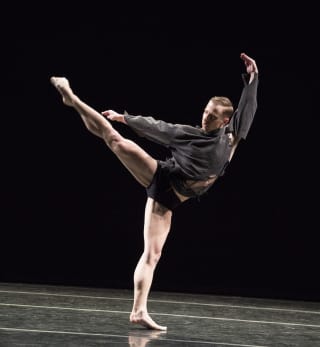
Petronio’s “Wild Wild World” excerpt was a worthy second work (pretty impressive, given that it was set off against Cunningham's classic.) It offered the most sweeping athleticism of the evening, and was also set to scene-stealing music by Nick Cave. Nicholas Sciscione, a pillar of Petronio’s company, exploded onto stage in a solo of huge moves, every muscle and limb stretched out, covering the full stage in moments. Each dancer's costume was a different form of ragged and spangled as designed by Tara Subkoff, and Sciscione, in his black rags, set the stage for the wild piece, hips swiveling and outstretched legs and arms scooping. If their bodies had been slicing paper, the dancers would’ve created lengths of winding spirals. And although, they moved in and out of many parallel patterns, the movements still felt powerfully random. This company has perfected the art of flailing. “Don’t push me,” Cave’s voice growled, “It’s a wild world.”
The last piece of the program was a world premiere, “Hardness 10.” On the raw stage, the lights (beautifully controlled by Petronio’s long-time lighting designer Ken Tabachnick.) barely rose on a violist sitting high upstage. A harsher light grew as a quintet of dancers moved in a walking pattern, deliberate, turning as a unit, shoulders shifting. Petronio credited the influence of Yvonne Rainer for the walking patterns, but that influence didn’t last long before the dancers exploded into Petronian movement, and stayed there.
The dancers wore body suits with slogans hand-painted on each by Iris Bonner/These Pink Lips. The slogans were hard to read around the curves of bodies, and were distracting to figure out, but the messages came from the current #MeToo wave (“Look don’t touch,” “She says,” “Read my lips,”) anchoring the work in this politically charged moment.
The dance vocabulary and patterns pushed in many directions, but often echoed the lessons of Petronio’s masters. In a series of trios, the dancers found triangular balances, weaves, and lifts that were reminiscent of Cunningham’s, but came with Petronio’s particular momentum. Two trios framed another brief Sciscione solo, before the men melted away, leaving two pairs of women who supported, encircled, leaned and lifted each other, whipping their flailing arms in perfect parallel.
The lessons that Petronio has learned have become fully ingrained in his dancers’ bodies and relationships. From Cunningham, part of the lesson is that beginnings and endings are the same-- and always present. The final pose of “Hardnesss 10” shined a light on the four powerful women, three standing together, fists outstretched, as a sister faced toward them. At any moment, power is possible. This may be a political moment of “hardness,” but no one is alone, and there will be no backing down.
copyright © 2018 by Martha Sherman



