Connections
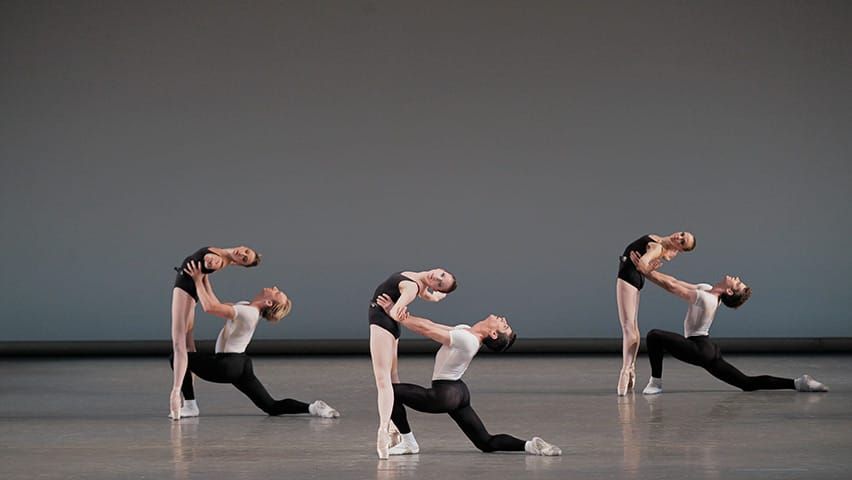
"Episodes", "Agon", "The Four Temperaments"
New York City Ballet
David H. Koch Theater
New York, New York
February 26, 2016
The current tread of programming similar ballet together has its uses. "If you like one you will like them all", the marketing department seems to promise subscribers, but it does dilute the effect that contrast can offer and it is a shame that the idea of a program as a substantial meal has been lost. But the current "Balanchine Black and White" concoction does highlight interesting threads and combinations in the different works.
"Episodes", from 1959, opened the program. Its current arrangement combines four pieces by Anton Webern to create brief, stark vignettes unrelated to each other but forming a perfect square by exploring the quirks and nuances of the music to find odd bits of wit and a transcendent, Bach-inspired ending (much like "The Four Temperaments", which closed the program).
Savannah Lowery and Jared Angle were the black and white couple trying to find their balance, even when upside down. Rebecca Krohn and Russell Janzen (in his debut) danced the Bach-infused Ricercata. Janzen had a noble and restrained dignity but Krohn, though the shapes she made were lovely, wasn't able to convey the towering power that can seem just by lowering her arms to create complete harmony.
Unity Phelan (also a debut) and Craig Hall captured the mechanical quirkiness of the third movement, with its poses so reminiscent of "Agon", choreographed two years earlier. Hall was magnetic, concentrated and grounded, and Phelan, with her leggy beauty, made a striking debut.
Miriam Miller, another leggy blonde, also debuted in the "Agon" pas de deux, vividly supported by Amar Ramasar. She danced with extraordinary aplomb and seemed to float through the dance, letting the shapes make their impact without the extraneous heavy breathing that some recent dancers have added; this was not an audition for the Siren. Miller is a classic beauty with a slightly illusive air, as if Grace Kelly had been painted by a Pre-Raphaelite. Ramasar, crouching down beside her, looked at her with understandable awe.
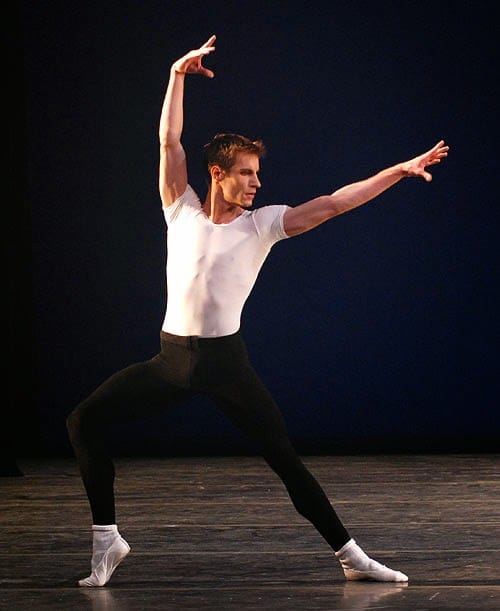
Ashly Isaacs danced the Bransle Double with an understated wit, seeming to hold on to those balances until the music forced her arms down. Andrew Veyette seemed a bit subdued in the Saraband, with a slightly stiff upper body, but his solo had weight and the off-centeredness that connected it so clearly to Phlegmatic -- Balanchine choreographed them both for the modern-trained Todd Bolender.
The connection was clear, as "The Four Temperaments" closed the program. Adrian Danchig-Waring danced Phlegmatic with a smooth, slightly goofy musicality. Gonzalo Garcia was equally smooth in Melancholic, a bit too smooth, as he seemed to indicate the emotions with elaborate flourishes rather than experiencing them.
Sara Mearns and Tyler Angler were the sanguine couple. Sanguinic is not an adjective that attaches itself to the intense, dramatic Mearns, but as usual, she used her imagination and intuition to create her own compelling short story, bursting through the opening with a restless abandon. Though she slightly fudged the sharp, clear steps, she seemed to emerge from the sturm und drang to find serenity in the final radiant low lifts around the stage. Sanguinity, she seemed to say, was something that had to be fought for, and she, ardently supported by Angle, let the audience see the struggle and the ultimate transcendent victory. It was a unique and unforgettable interpretation.
Copyright © 2016 by Mary Cargill



