Community Values
"Clearing", "Trio Sonatas", "Nights and Dreams", "Undercurrent"
Lydia Johnson Dance
The Alvin Ailey Citigroup Theater
New York, New York
June 6, 2019
The small company (thirteen dancers plus a guest appearance by former New York City Ballet dancer Craig Hall) presented four works by Lydia Johnson, one premiere ("Clearing") and three older pieces. Johnson has a wide-ranging taste in music and the evening had works set to Handel ("Trio Sonatas", Schubert ("Nights and Dreams"), Henryk Górecki ("Undercurrents"), and Philip Glass ("Clearing"). The budget, of course, does not allow for live musicians but the choreographer's respect for the music is clear and, unlike most programs, the company lists the titles of the individual pieces, the names of the musicians, and the details of the recordings.
Her quiet but penetrating choreography uses the music in unexpected ways, and her seamless choreography combines a solid but not flashy ballet technique (her dancers have pristine arabesques) combined with a relaxed, almost casual upper body which creates a conversational feel, as if the dancers were talking with the music.
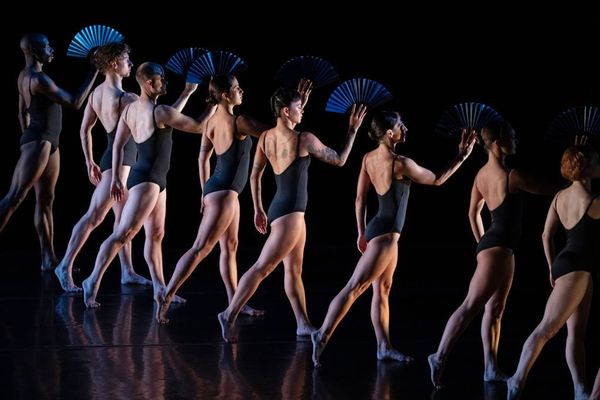
There are gleams of emotion in many of her dances, and "Clearing" featured three couples, Laura Di Orio and Chazz Fenner-McBride, Katie Martin-Lohiya and Jacob Taylor, and Min Kim and Malik Williams, whose pas de deux illuminated the subtle variations in Glass's music. Johnson used her small corps well to comment on and support the couples. The final movement was stunning, as the women, formerly in white tunics, changed into black leotards and formed silhouetted lines as the movements rippled backwards and forwards through the group, a haunting and memorable picture of a community.
This communal feeling where dancers emerge from and return to a group is a feature of many of her works, both bright and somber. "Trio Sonatas" is on the bright side, though there is a darker moment where a man lays on the floor before being raised up and comforted by the communal circle. It ends happily, in a sprightly chaos as the dancers run on and off the stage to the sparkling music.
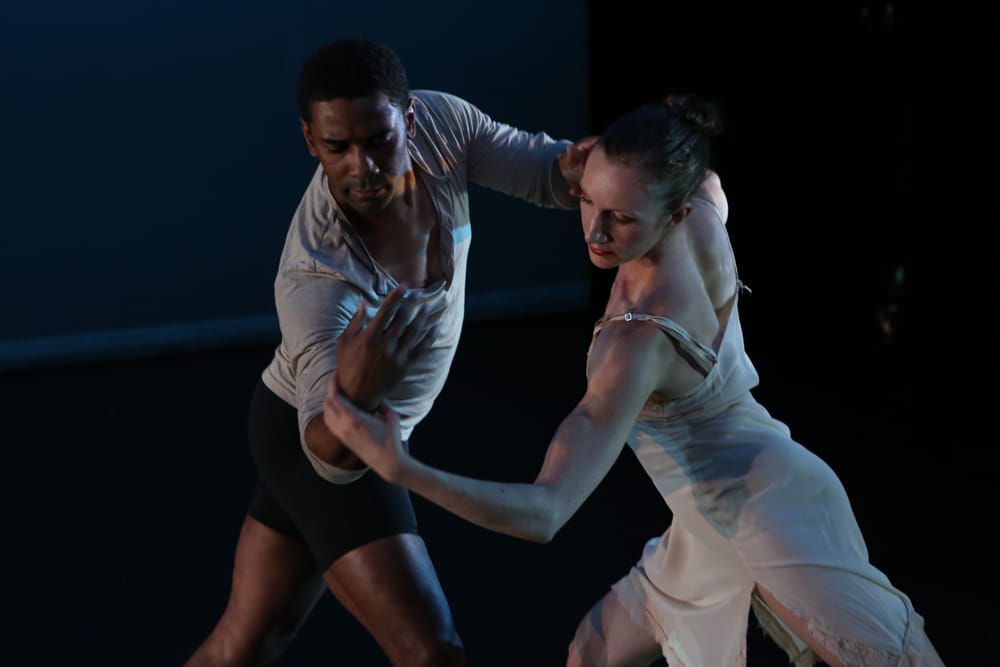
There is nothing sparkling about "Nights and Dreams", set the six of Schubert's songs. Johnson used a recording by Ian Bostridge, whose light clear tenor gave the songs a floating, otherworldly quality, a comment on the emotions, not a cry of pain, and Johnson's choreography reflected that timeless, hard won serenity. It was most effective when the dancers (the women in simple white shifts and the men in grey shirts and black shorts) formed groups, walking through the music and letting it run through their bodies. One especially moving moment was the phrase "kehret wieder" from the final song, where the dancers' expanded their arabesques to match the soaring music. Craig Hall danced in this work; always an impressive dancer, his quiet and grounded nobility blended well with the company. He was understated but magnetic.
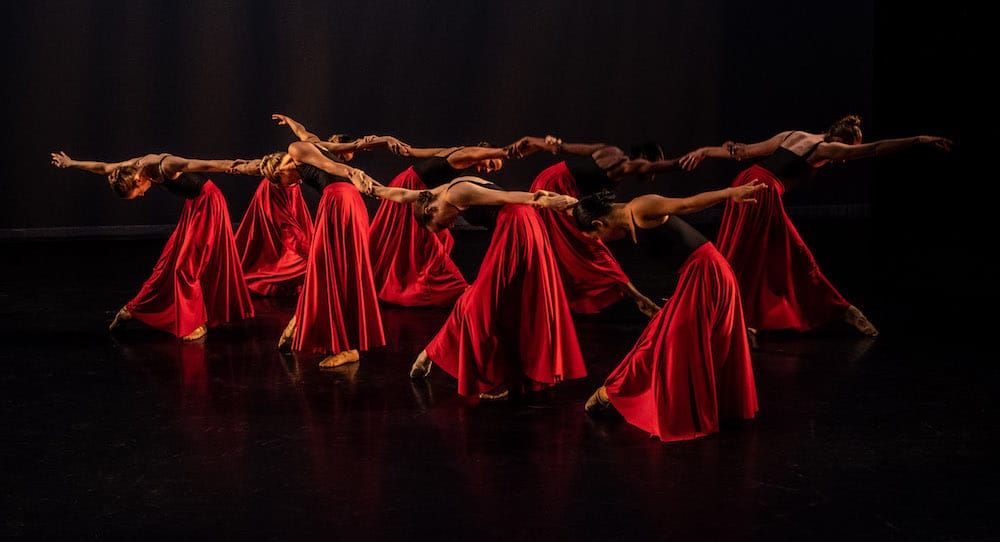
"Undercurrent", with its bright red skirts, was a rousing change of mood. It uses three of Górecki's dances, exploring the different moods. The opening is dramatic, almost apocalyptic, with powerful, jerky moves. The second movement is celestial, with a starry backdrop and the choreography has a floating, serene quality, as if there is no more gravity. (One woman, Erin Ginn, lets her arms float effortlessly in her solo.) The final movement is back on earth, but an earth filled with groups dancing in circles, lines, and intersecting shapes to echoes of eastern European folk music. Johnson augments her company with students from her school; they help fill the stage but also seem to be pointing towards the future; those community circles are endless, they seem to say.
Copyright © 2019 by Mary Cargill