Color Coded
"Concerto Barocco", "Allegro Brillante", "Brahms-Schoenberg Quartet"
New York City Ballet
David H. Koch Theater
Lincoln Center
New York, New York
January 23, 2025
This all-Balanchine evening showed off three ballets, each with its own distinctive flavor; “Concerto Barocco” has a luminous white and black simplicity, “Allegro Brillante” is a bright and golden celebration of classical technique, and “Brahms-Schoenberg Quartet” with its haunted-ballroom mauve setting, is an elegiac valentine to a lost (and somewhat imaginary) world. There were two debuts, Miriam Miller, commanding as the second violin in “Concerto Barocco”, and Alec Knight, a stalwart partner in the Intermezzo of “Brahms-Schoenberg Quartet”. It was also a demonstration of Balanchine’s love of geometry, as the well-rehearsed corps formations wove through intricate, ever-shifting waves of patterns.
In "Concerto Barocco" Mira Nadon, as the first violin, and Miller were well matched. Both are tall, long legged beauties who dance with clarity and precision. Nadon’s silky flow was a fine contrast to Miller’s expansive lyrical-heroic style. They danced without any exaggerations, letting the choreography flow without extraneous pauses to admire their balances, though their brief interactions did hint at two goddesses sharing a private moment.
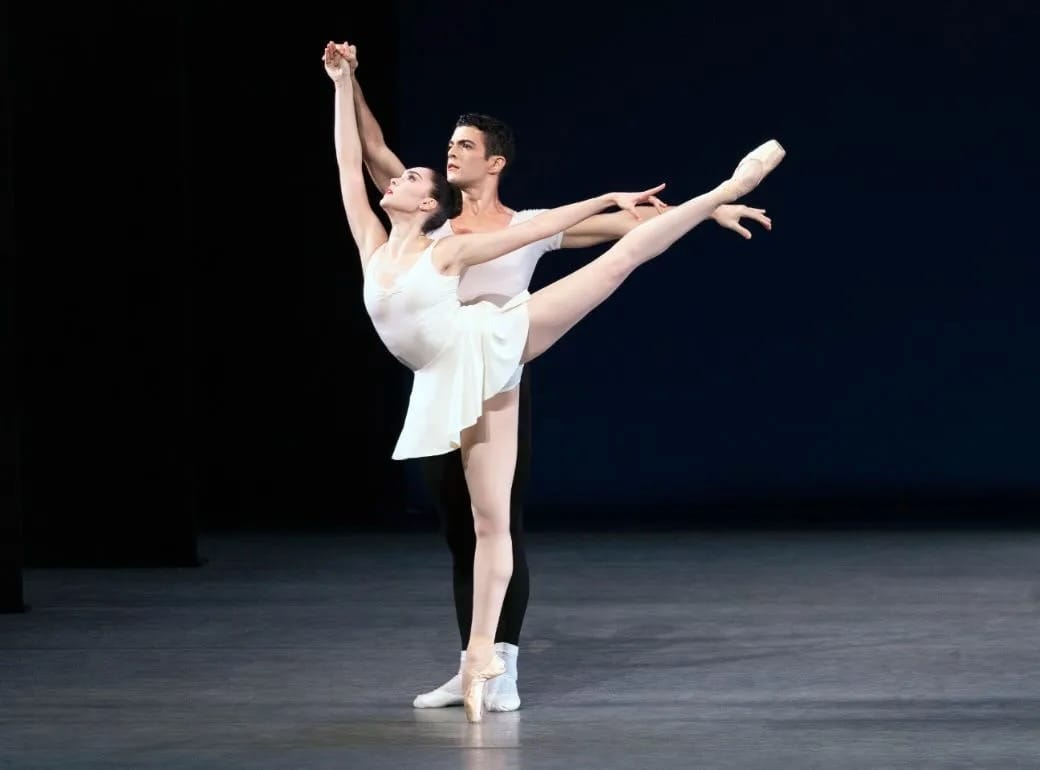
Nadon and her partner, Gilbert Bolden III, shared a long, glorious private moment as they seemed to float through pas de deux with a single breath. Bolden moved with a deferential modesty, supporting Nadon, lifting her effortlessly, and then seeming to fade into the background. He is a generous and imaginative dancer who can be outgoing and bravura at times (he is loads of fun in “Western Symphony”), human at others (his warm and fun-loving father in “The Nutcracker” was wonderfully vivid), and seems to approach roles by thinking “What does the ballet need from me?”. And he is tall--a wonderful addition to the company.
“Concerto Barocco” also needs a precise and vivid corps, and this evening they were sharp and accurate and made the complicated counterpoint of their arms seem instinctive. The corps patterns as they wove through the knotted formations seemed like a metaphor, as if a hidden hand pulled an invisible string and in a flash all confusion was resolved into a harmonious whole. The ballet’s shimmering serenity seemed to linger after the curtain fell, leaving the audience in its spell.
The spell didn’t last, and in a somewhat jarring transition, “Allegro Brillante” started after a brief pause; the company has recently been eliminating intermissions whenever possible, a boon to those who need to catch trains, but in this case a bit more time to revel in “Concerto Barocco’s” magic before the bravura explosion would have been welcome.
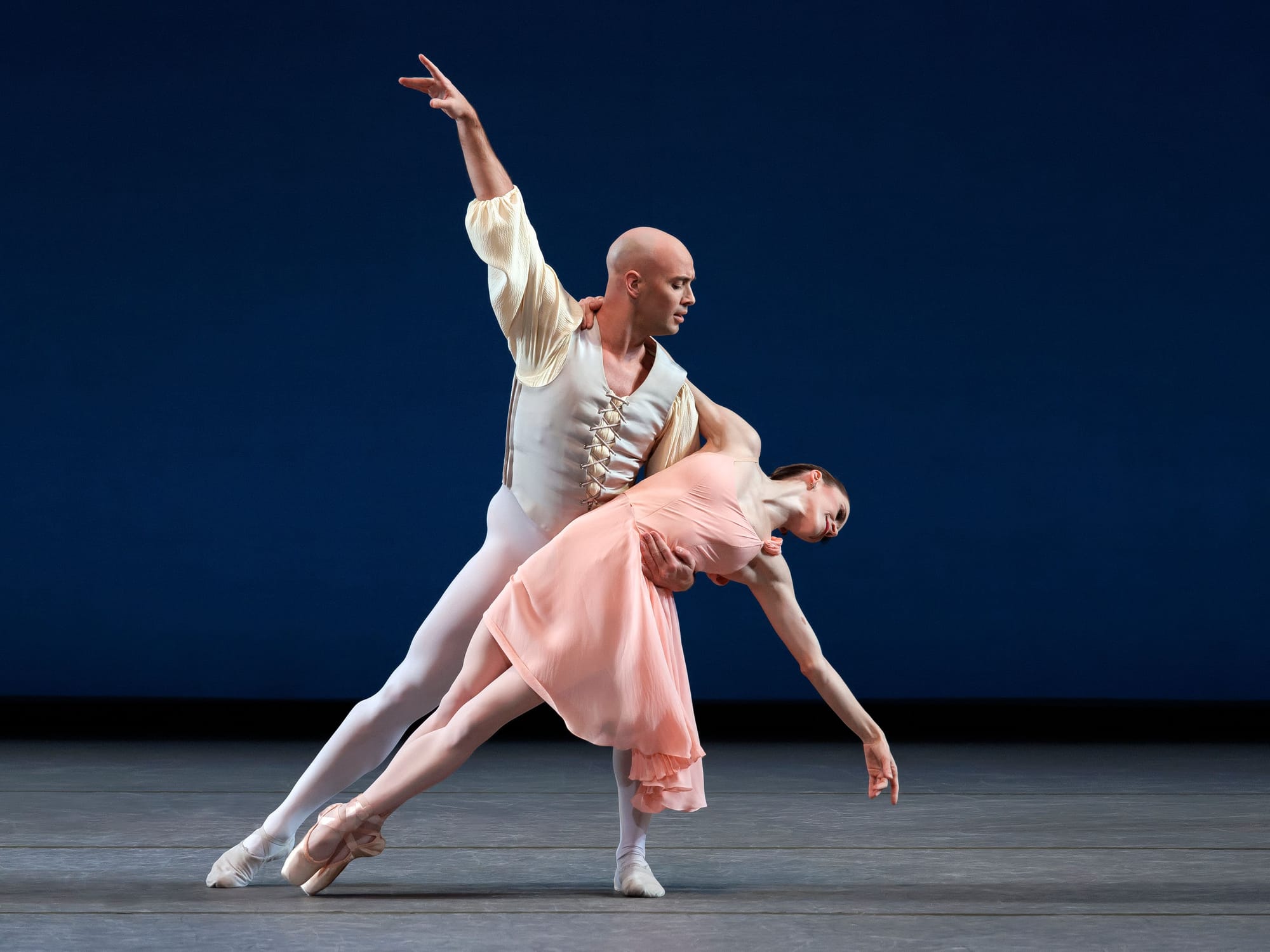
Balanchine famously said that “Allegro Brillante”, choreographed in 1956 for Maria Tallchief, contained all he knew about classical ballet in thirteen minutes. It starts with the four couples of the corps mid-dance, and sweeps through expansive allegro variations, full of turns and fast footwork, with a brief hint of adagio romance, and includes some intricate knot work for the corps. Megan Fairchild and Tyler Angle were the virtuosic couple. Her dancing was sharp and clear, with soaring, triumphant jumps and diamond clear beats. Angle, though his jumps were a bit sluggish, was a fine partner, catching Fairchild mid-turns in photo-perfect poses. I did miss the gentle undertones of emotion that I have seen some dancers give the work; this performance was bright and elegant but a bit impersonal and seemed to be tied to the rehearsal hall.
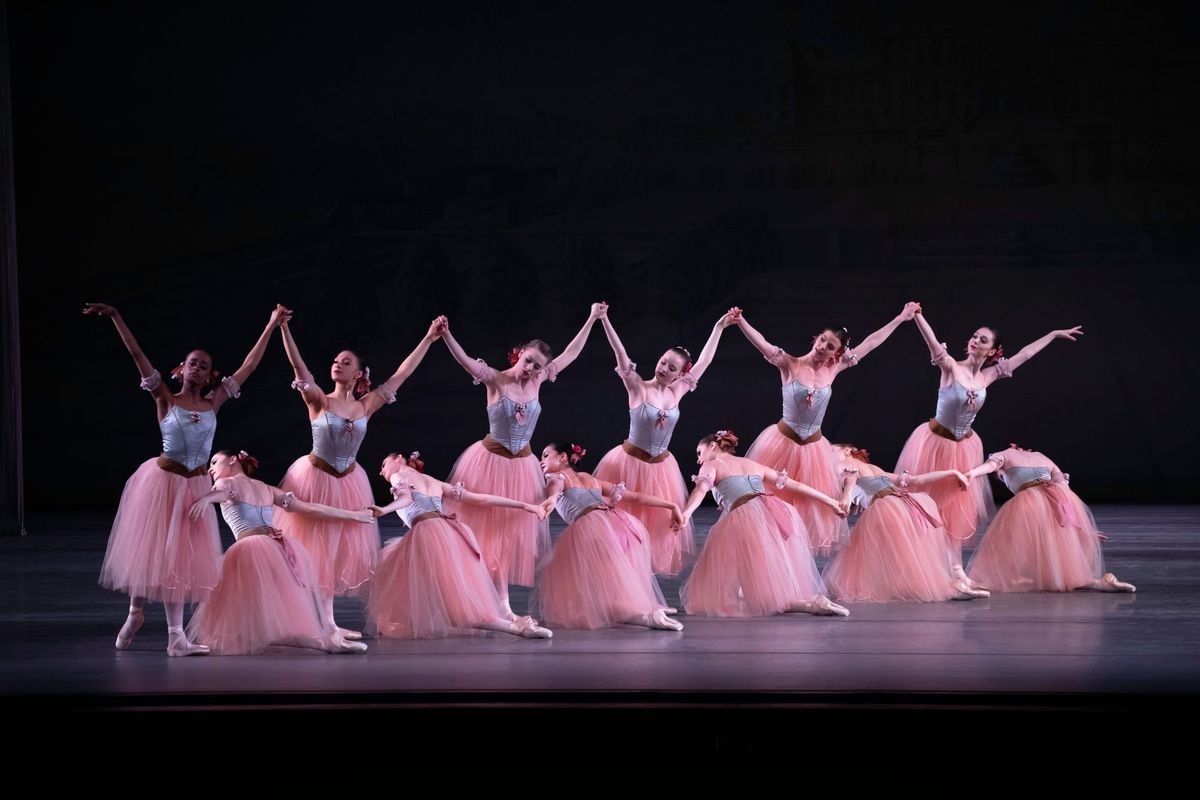
“Brahms-Schoenberg” on the other hand, expanded far beyond the stage, into the mystical past. David Mitchell’s backdrop illuminates a misty view of Vienna’s Schönbrunn Palace and the four movements seem like lyric poems set somewhere near the Neo-classical building. Emilie Gerrity and Taylor Stanley, with Emily Kikta as the imperious soloist, danced the first movement, supported by an elegantly designed corps of four men and eight women in beautifully swishing skirts who echoed the slightly restless melodies of the luxurious music. Gerrity seemed to be a dream or a memory, with her expressionless but compelling face, flitting through the dancers without seeming to touch the stage. (Balanchine used demi-point to great effect in this movement.) She moved with an urgent melancholy that matched the surging, unresolved chords of the music, remaining just out of reach of her partner; it was a vivd and memorable performance.
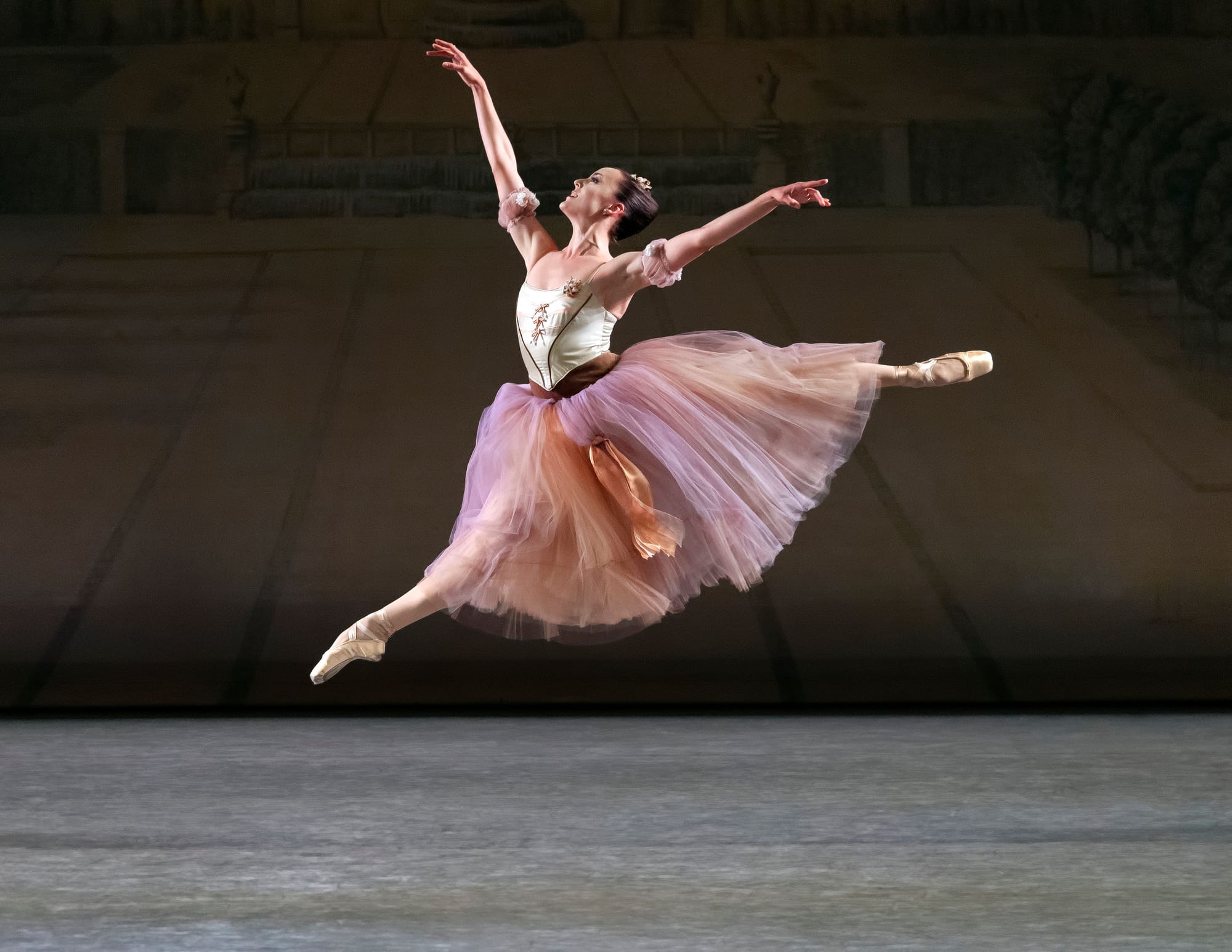
Kikta too was vivid and memorable. She was both lyrical and commanding, using her height and upper body with a controlled smoothness. Her jumps seemed to eat up the stage, yet appear light and effortless and her radiance made her seem like an Austrian Lilac Fairy. Indiana Woodward and Alec Knight, in his debut, danced the Intermezzo. It is an apotheosis of swooning—backbends to not really begin describe the twists and turns, the rising and falling, the daring falls and soaring lifts of this enigmatic interlude. Knight was a solid partner, but as yet seemed to concentrate more on mechanics than mood.
There was plenty of mood in Emma von Enck and Roman Mejia’s Andante, as von Enck gave a luminously elegiac tinge to the role, which has sometimes been danced with a sprightly military air. Her face seemed almost ghostly, as if she were was lost in the past and her dancing, usually so bright and confident, had a floating, shimmering feel, as if she were some Austrian sylph wandering around the Vienna woods. It was a hauntingly beautiful performance. Mejia too, caught the slightly unreal mood, and soared through his solo with clear but not overly bravura jumps, and soft landings.
There weren’t a lot of soft landings in the final “Rondo all Zingarese”, with its cascade of gypsy swagger. Unity Phelan and Andrew Veyette were the colorful couple. Veyette, though his jumps have lost some height and power, was thrilling as he dug into the floor commanding his companions. He danced with a blazing confidence and a certain seriousness, with no hint of tongue in cheek kitsch, and let the audience luxuriate in those gorgeous melodies. Phelan, too, seemed to be having fun, almost flirting with the audience, but I missed the devil may care grit that more exuberant dancers give the piece; there was no hint of the campfire in her dancing, but it was a glorious ending to the evening.
© 2025 Mary Cargill



