Cock-a-doodle-do
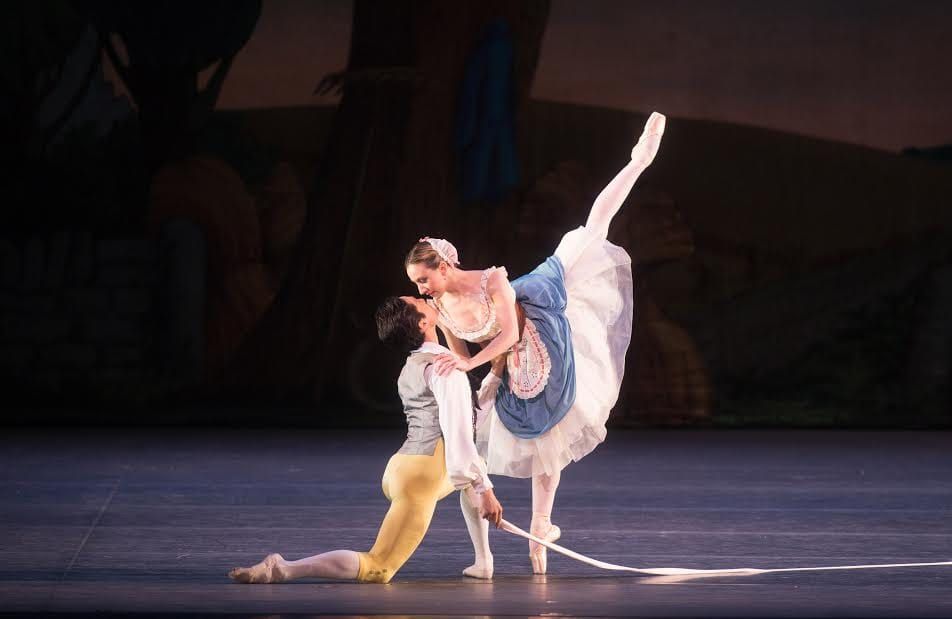
"La Fille Mal Gardée"
American Ballet Theatre
Metropolitan Opera House
New York, NY
May 24, 2016
There was much to crow about in ABT's revival of Sir Frederick Ashton's "La Fille Mal Gardée", including the fact that after 13 long years ABT is finally dancing it again. It tells an old story – poor girl, ambitious parent, lowly suitor, rich looser – with wit, humanity and charm, and, as in all good comedies, love wins out. (As Oscar Wilde would say, "That's why its called fiction.")
Isabella Boylston and Jeffrey Cirio made their debuts as Lise and Colas, negotiating the deceptive and not so deceptive difficulties of Ashton's choreography very well. Like Aurora in Ashton's beloved "The Sleeping Beauty", Lise must show different facets of a woman's nature in each scene; young and playful in the beginning, triumphantly virtuosic in the harvest scene and meltingly, transcendently lyrically adult in the final pas de deux. Colas, a cocky charmer, is more straightforward, but he, too, must show in the final tender mime scene, that he wants adult responsibilities.
Boylston's acting was warm and natural and she avoided the trap of playing cute; Lise is not Swanilda's little sister. I especially loved the moments after she sees Colas at the door in the last act--she was about to burst with joy, but couldn't say anything to her mother, so just let it all flow out in her tambourine dance. The famous mime scene, imported from the old Petipa version by way of Tamara Karsavina, was beautifully and simply done, a private whisper as she gave the audience time to see her dreams developing and the pretend wedding as the music soared was both funny and poignant.
Boylston has wonderful gifts -- a soaring jump (though she can land with a resounding thump) and a natural musicality. Her final open-armed embrace seemed to merge with the soaring melody and included Colas, her companions and the audience, a gentle, profoundly moving moment. She doesn't, though, have the sharp, clear footwork which can make the harvest dance a machine gun blur and her upper body, luxuriously soft as it was, couldn't always create those perfect photo op moments. But her performance was emotionally rich and detailed, and her pure joy more than made up for a few technical wobbles.
Cirio also seemed to have having a wonderful time. His dancing was crisp and clear and his jumps were high. Though his turns weren't always secure, he stayed in character and this was a genuine performance, not a technical excuse. He is a bit short, even for Boylston, and some of the lifts teetered a bit, but he pulled off the flamboyant one-handed lift. (The Bolshoi was one of Ashton's many inspirations.) He was a devoted, sympathetic partner and made the final pas de deux, so full of low, skimming lifts, look like one long contented sigh.
Ashton's secondary characters, unlike the Spanish version of the story known as "Don Quixote," are not just comic stock figures. Lise's mother, the Widow Simone, is a practical, materialistic woman with a wide streak of vanity (she must have been a dancing queen when young), whose quick tempered exasperation hides a soft inner core, a very human combination. Roman Zhurbin was a deadpan, understated Widow, without any of the broad, bosom flaunting vulgarities that have marred some other widows (the Royal Ballet, shockingly, is especially guilty). His sniffy, pursed-lipped approach made his explosion in the clog dance even funnier. It was full of musical accents, as if his body was taking him back to earlier triumphs.
Craig Salstein has, in a sense, danced Alain before, when he was known as Gamache, but Ashton has made his rich suitor both ridiculous and poignant. Salstein looked like he had made good use of films of Alexander Grant, the original Alain, and he had much of Grant's stiff awkwardness and puppy dog eagerness, and caught the clown's essential loneliness and he used his eyes to tell the story without extraneous mugging -- this was a Buster Keaton approach, not a silly man with a red nose. Salstein gave his dances an almost split personality, with a stiff upper body and light, airy, floating jumps, as if he were trying to be a grownup but didn't quite know how. His deep backbend in his father's arms and his sad little hops looking for someone who would take his rejected ring had a rich pathos, while his ultimate joy when reunited with his beloved red umbrella summed up Ashton's hope for outcasts everywhere.
Duncan Lyle as the Village Notary and Alexei Agoudine (who moonlighted as the strutting rooster) as his Clerk gave almost Dickensianly detailed portraits of fussy, pettifogging officialdom, smug and officious, and very funny. There were some minor disappointments. Ashton had insisted that be pony trotting off to the harvest feast be small and white, while ABT's was large and brown, reducing the "Aww" quotient significantly. Colas' response to the mime scene used to be "Three children?" but now he holds up ten fingers, a joke too far. I missed Alain's gleam during the storm when he realized that he alone had an umbrella; the Widow just gestured vaguely in his direction and the moment has no impact. In a letter in response to one of my reviews, Alexander Grant wrote that that had been his favorite moment in the ballet, allowing Alain to say "See, I'm not such a dummy after all" and providing him with a brief triumph, one that Salstein certainly deserves. But overall ABT's production provides many triumphant moments, and it was worth the 13 year wait.
copyright © 2016 by Mary Cargill



