Classics or Not, with Debuts
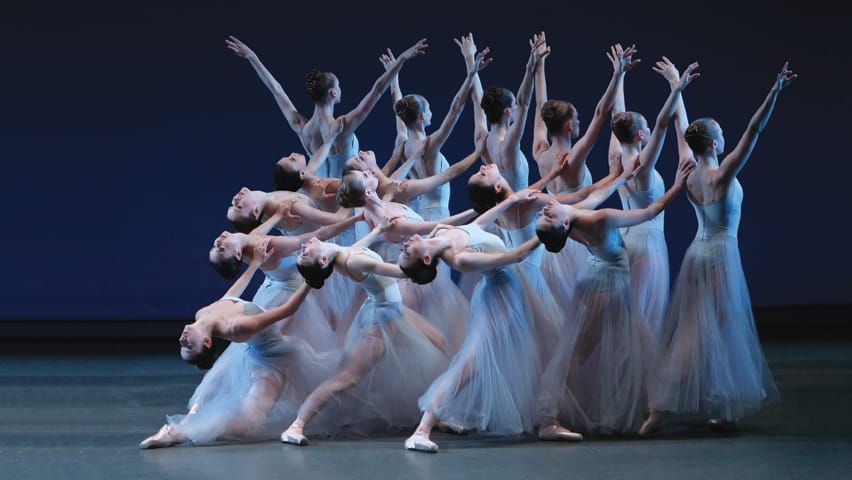
"Serenade", "Hallelujah Junction", "Duo Concertant", "Western Symphony"
New York City Ballet
David H. Koch Theater
New York, New York
May 19, 2016
NYCB's Marketing Department presumably came up with the title "Classic NYCB II" for this program, more aspirational than descriptive, perhaps, but "Serenade" is certainly timeless. There were two debuts, Rebecca Krohn as the Waltz Girl and Russell Janzen as her partner. Krohn's willowy tendrils curved around the choreography, but she seemed a bit bland, giving every movement the same air of floating passivity. The wonderfully evocative series of backward glances were all done with the same emphasis, with no attempt to build excitement or tension. Janzen, on the other hand, gave his brief part a protective, romantic air, shading his dancing. He even managed to look incredibly handsome wearing those blue Dr. Denton's.
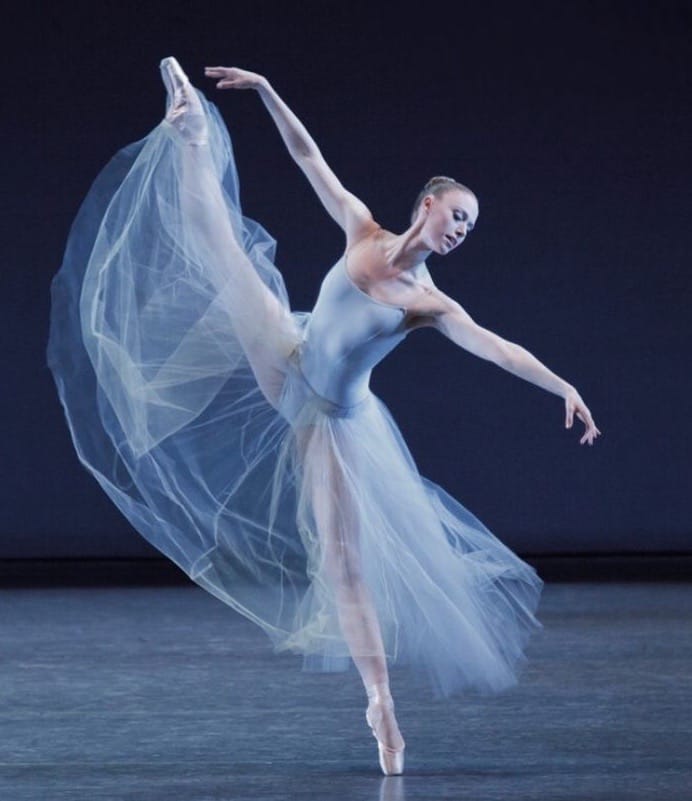
Erica Pereira danced the Russian Girl with a well-rehearsed precision, hitting all the right poses; she has a beautiful arabesque. But she gave that mysterious part a perky energy, smiling through like a dutiful little girl skipping over to see Grandma. Teresa Reichlen was a cool Dark Angel, conveying an implacable mystery, especially as she swept the dignified Adrian Danchig-Wearing away.
Peter Martins' "Hallelujah Junction" and Balanchine's "Duo Concertant", performed together, have certain similarities. Both are black and white leotard ballets, both use on-stage musicians, and both are titled after their music. John Adams' "Hallelujah Junction" is high-intensity minimalism, with no discernible development or arc, and Martins' choreography matches it well. Andrew Veyette was the man in black, who was used as a man in black. There was no emotional difference between his steps in those of Amar Ramasar (dressed in white); at times they did the same steps and at times Veyette did them in double time. The dancing, despite Veyette's explosive strength and intensity, was visually striking but dramatically empty.
Sterling Hyltin, in a white leotard with cut off tights (as unflattering now as they were in their heyday) was Ramasar's partner. Their stop and start choreography was all poses and exclamation points and their intricate pas de deux, full of complicated, finicky lifts (they were barely able to make eye contact) was certainly watchable but about as emotionally involving as watching two giant sea anemones comparing tendrils.
The couple in "Duo Concertant", on the other hand, delves into a range of emotions. Lauren Lovette, in her debut, danced with Anthony Huxley. They gave the piece a youthful air and the opening movement, where the two dancers stand still and listen to the music (surely one of the most difficult of ways to begin a ballet) did not have the sculptured, marble quality of some older dancers; they seemed like a young couple enjoying a concert, sharing happy glances. It was a natural, engaging approach.
Their dancing, too, was youthful, as they seemed to be playing with the music. Huxley gave a light, airborne quality to his solos and his smoothness made it look as if he were floating on ice. The brightness was a notable contrast to the brief adagio, as the music turned plaintive, and there seemed to be echoes of Odette as Lovette fell back into Huxley's arms. Their youthful individuality, though, couldn't quite translate into the abstract, transcendent finale, where Everypoet must mourn Everymuse.
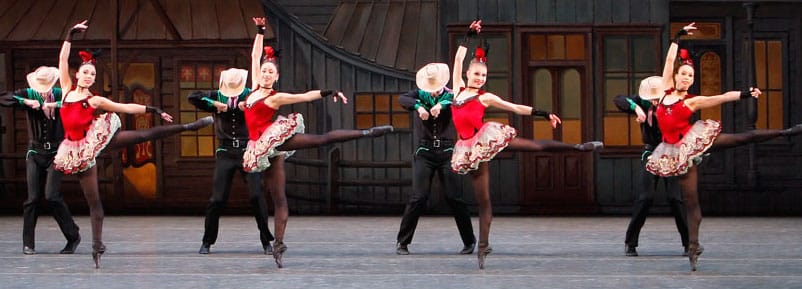
There is no mourning in "Western Symphony", that classical salute to the imaginary Old West. Lauren King and Chase Finlay made their debuts as the opening couple. Finlay's openhearted and generous dancing was a delight though his upper body seemed stiff and some of the lifts were a bit perfunctory. King was a sunny dancehall girl, combing elegance with spunk; she has one of the most naturally appealing smiles in the company.
Brittany Pollack smiled through the adagio, too, though her grin didn't seem natural. Despite her crisp dancing, she seemed to be reminding the audience that This was a Joke. But the piece is a parody of "Swan Lake", not "Baby Snooks". The deadpan Jared Angle was truly funny, dancing with a stolid awkwardness and an "aw shucks" shrug when Odette left--a truly sensible Siegfried.
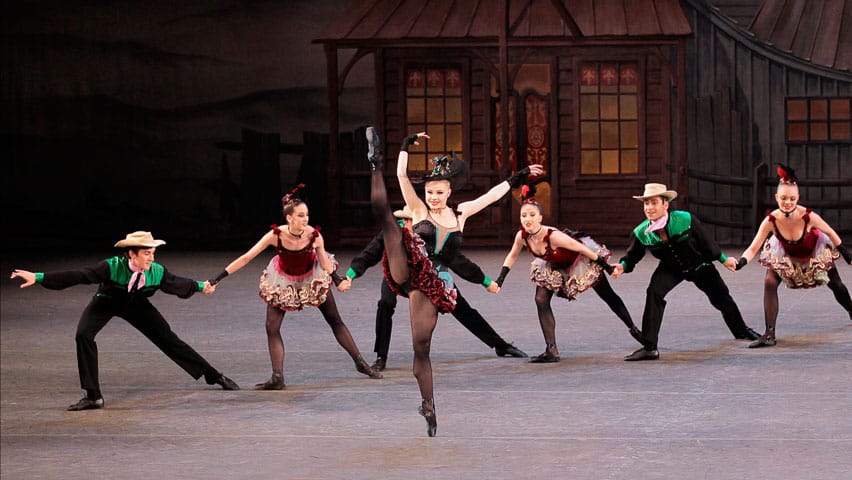
Sara Mearns and Zachary Catazaro were the final couple. Mearns swaggered through the choreography like a good-hearted saloon owner, completely in charge of the place. The elegant Catanzaro looked like an Eastern visitor wearing chaps for the first time who was out to impress the natives. The natives in the audience were certainly impressed.
Copyright © 2016 by Mary Cargill



