Cinderella Revisited
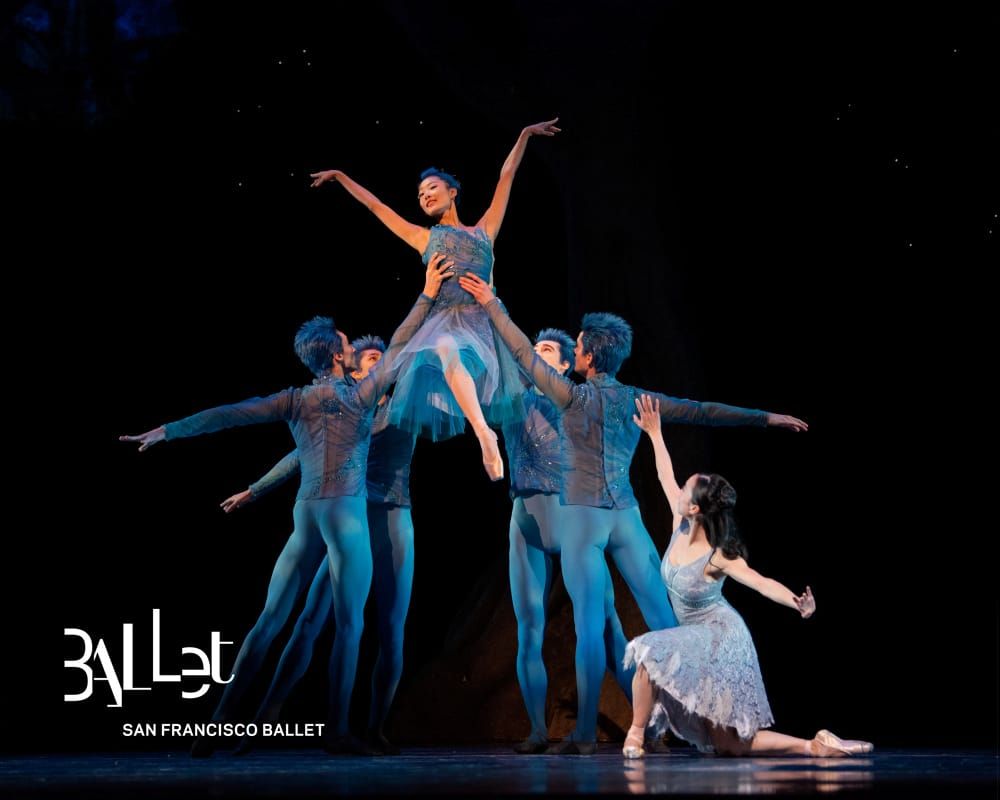
"Cinderella"
San Francisco Ballet
War Memorial Opera House
San Francisco, CA
January 22, 2020
“Third time is a charm” can work, but often it is also a case of wishful thinking. Such is the case of Christopher Wheeldon’s take on “Cinderella”, first seen locally in 2013 and again in 2017. It is a co-production by SFBallet and the Dutch National Ballet. The delights of this hobbled together fairy tale are many, but missteps keep the rethought story from as wholly involving as it could be. Still performances regularly sell out, and rousing applause is the norm. The second cast, the one I saw, was no exception.
The production is sumptuous. Julian Crouch’s scenic and costume design offer plenty of visual delights, yet they were just about outshone by Basil Twist’s magically growing tree. His projected horses and carriage that transport Cinderella to the ball take your breath away. Some of the backdrops, kitchen tools in Cinderella’s home and portraits of ancestors in the palace set up their own stories just as the ballroom’s closed windows open up to let in the dawn, promising a new era. These visual elements elegantly pushed the narrative along but I could not help but sometimes feel that the spectacular production values took away the need for more telling choreography.
Craig Lucas’ libretto, drawing on Perrault and the Brothers’ Grimm, added some fine touches. He gave the two lovers a childhood. The antics of Guillaume (Carlo Di Lanno) and his childhood friend Benjamin (in a star-making performance by Hansuke Yamamoto) made their later exchanging of roles plausible. They also set up a parallel universe to Cinderella dysfunctional household.
Four Bunraku-inspired Fates (Sean Bennett, Vladislav Kozlov, Myles Thatcher and Mingxuan Wang) took the place of a Fairy Godmother or (the Grimm’s theatrically problematic) doves. Their presence added a welcome touch of mystery to an otherwise well-known tale.
Even after repeated viewing, I still could not understand how this lovingly exasperated King (Ricardo Bustamante) and Queen (Anita Paciotti) could preside over a ball where the (stunningly) waltzing couples are drawn into maelstrom of uncertain origins. (Matthew Bourne brilliantly contextualized this waltz in his WWII “Cinderella.”)
But my reservations turn primarily around “Cinderella’s” sense of humor. The young ladies, and some not so young ones, involved in a madcap game of musical chairs trying on the fateful slipper, was comedy at its best. Lucas topped it by the chairs becoming an overhead garland. However, the satirized princesses as possible brides were crudely conceived even when considered as a slap at 19th ballet conventions. Despite excellent performances by the stepsisters, Edwina (Jahna Frantiskonis) and Clementine (Julia Rowe) their explosive tantrums quickly fizzled. More wit and less slapstick would have been welcome. Jennifer Stahl’s hysterical stepmother, Hortensia, however, timed herself excellently. She deserved Cinderella’s kiss.
Wheeldon’s ballet started with a tight, microscopic prologue of small moves, gestures and surprises and the end of Cinderella’s birth family. Tiit Helimet excellently developed the trajectory from a loving parent into a hen-pecked husband, being defeated to almost collapsing from sheer fatigue and desperation. Yet, this is a fairy tale after all, he ended as a beaming Father of the Bride. Actually, two of them.
Di Lanno’s princely Prince was perfectly matched with the delightful André’s Cinderella. With softly billowing arms and clearly defined steps and gestures she did not cave in to the chaos at home. She seemed to be aware of her “helpers” even when they were invisible. Her radiant smile and big eyes in her kitchen dance nevertheless stopped the Guillaume from "becoming fresh”. As performer she triumphed in the crucial ballroom encounter. Looking at first somewhat bewildered ,she gradually woke up to what had happened her. Yet even in Di Lanno's arms, she periodically glanced at her slippers as if needing some reassurance. André is a refined dancer but a strong dramatic perspective.
To speak the truth, it was only at this third viewing that I realized that in the athletically showy topsy turvy Grand Pas de Deux, that looked so inappropriate, Wheeldon reflected on the tradition’s exaggerated appreciation of technical virtuosity. In the third act, the wedding Pas de Deux's filled with gentle turns and soft lifts — and a walk straight towards the audience. It was show business after all.
copyright © Rita Felciano 2020