Ceremonial and Free
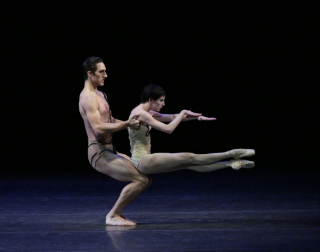
“Symphonic Dances,” “The Cage,” “Andantino,” “Cortège Hongrois”
New York City Ballet
David H. Koch Theater
New York, NY
January 30, 2015
Besides the music composers’ national origin, the works presented by New York City Ballet as part of the “Hear the Dance: Russia” program had one artistic commonality: dancers in all of the pieces seemed on a quest for a freeing approach to the stylized and formalistic aspects of the choreography. Despite a number of debuts, it was mostly the veterans who were successful.
Opening the night with their first performance as the leading couple in Peter Martins’s unnecessarily repetitive “Symphonic Dances,” Teresa Reichlen and Zachary Catazaro did their best to bring Sergei Rachmaninoff’s multi-colored score to life, and by their closing duet they almost succeeded. But if in their last dance Reichlen’s romantically supported back bend with a developpé to the front reflected the longing and softness of the music, everything before it could be best described as a quizzical search for meaning in this tangle of a ballet.
From the start, Reichlen’s arms felt superfluous, moving with excessive embellishment in the first duet of little romance and meaning. Although love seemed to be the theme of both the music and the choreography, the couple struggled to both understand its nature and articulate it. Instead of looking romantic, for most of the ballet Reichlen’s repeated draping of her arms around Catazaro seemed odd, begging the question: Why was she doing so? Was it because he kept slipping off to dance with the corps? If so, it was hardly surprising. Catazaro seemed more at ease with the rest of the dancers, performing both the classical and folk-inspired steps with precision, and giving the repeated accents that punctuated his dance with the male foursome an assertive grandness that invited the viewer to keep watching him. Though there are ways to make repetitive works look not repetitive through choreographic architecture and execution, besides these few moments from Catazano and several inspired passages from the female corps where some of the dancers really seemed to have felt the music, the cast failed to fix Martins’s shortcomings.
After an intermission, Jerome Robbins’s primal “The Cage” was refreshing, with a standout performance from Sterling Hyltin as the Novice. Frail and uncertain, Hyltin’s Novice looked almost premature as she stood awaiting her unveiling and ceremonial induction into the killer insect tribe on the side of the stage, her knees buckling. Hyltin’s dancing retained this gentle frailty throughout the ballet, slowly revealing glimpses of her character’s instincts as this Novice embraced her nature and became part of the clan. Next to her, debutant Emily Kikta looked assertive as the Queen, with powerful leg kicks and a commanding presence, but the difference in their stature and frame made Kikta’s assertive handling of Hyltin’s small and thin Novice seem almost cruel. Somehow though Hyltin made this size difference work to her advantage. After a mesmerizing duet of mostly animal instinct rather than any sensual or conscious attraction with Justin Peck, who matched Hyltin’s intuitive portrayal that redacted any human cognitive resolve or certainty, Hyltin’s Novice completed her second kill and flourished into her own, appearing to have grown both in experience and stature and neatly drawing the ceremonial dance to its logical conclusion.
Immediately following this savage and inventive performance of “The Cage,” Robbins’s gentle “Andantino” seemed destined to come off as mild, but Ashley Bouder and Andrew Veyette’s performance was anything but. The two company veterans transported you from Stravinsky’s rhythmic score to Tchaikovsky’s tender romance with such ease it was the highlight of the night, and the usually technique-focused Bouder was almost unrecognizable in her refinement as her arms gently caressed the air to the score. From the lovely softness of the first lift in a split, in which Bouder was supple but elegantly reserved, to the gentle turns as Veyette graciously supported her as she changed position to a plié on demi-point, this short ballet was a delight.
Balanchine’s “Cortège Hongrois” ended the evening, but despite the music’s grandness and the ballet’s history of being intended as the big and imperial farewell to Melissa Hayden when she retired, the overall cast gave too much, and then too little splendor, in its quest to make the ballet its own. The standout was one of season’s debutantes, Georgina Pazcoguin, in the Czardas, who started off reserved and dignified in the introduction and then raised the temperature in her dancing for the main dance. Even if at times her footwork was too wide and over-exaggerated and her dancing in need of a more traditionally Hungarian dignified presentation, her dedication to dancing the role as she felt it was exciting.
Of the dancers appearing in the ballet for the first time, Brittany Pollack in the first variation treated the fast-paced steps with too many accents and jerky movements, but Megan LeCrone performed the second solo very crisply and with aplomb in tune with both the music and Hungarian style. For the pas de deux, Maria Kowroski was partnered by this year’s winner of the Clive Barnes Foundation award in the dance category, Russell Janzen. Making his debut in the role, Janzen stole the spotlight from Kowroski with his attentive and dignified treatment of her during their adagio, providing a reprieve from what seemed like Kowroski’s focus on making the duet all about showcasing her arabesques. His ease may have dwindled by the variation, but not the precision with which he performed, and his dancing stood in stark contrast to the almost violent, uncontrolled slaps of the hands by Kowroski in her own variation, which approach ran counter to the traditional treatment of the Marius Petipa choreography that was largely retained intact by Balanchine in that piece of this ballet, and conflicted with the determined but regal elements of Alexander Glazunov’s score.
copyright © 2015 by Marianne Adams



