Celebrating Merce
“Night of 100 Solos: A Centennial Event”
Merce Cunningham (staged by Patricia Lent)
Brooklyn Academy of Music
Brooklyn, NY
April 16, 2019
The blockbuster birthday party celebrating Merce Cunningham’s 100th could not have made a better case for the enduring power of his choreography and vision. In creating this “event” (his own phrase about reconfiguring dance elements to make a new work,) three splendid, invented “companies” of 25 dancers each were assembled to offer live performances in Brooklyn, Los Angeles, and London. Each company included dancers from across the spectrum of classical and contemporary dance – none of them from Cunningham’s own company, whose members were, instead, the mentors, teachers, and stagers who worked with the performers to learn these choreographic forms and methods. All three performances were live-streamed, and around the world, dance lovers celebrated.
BAM’s live performance was sold out far in advance, as dancers and aficionados clamored to attend the unique performance in person. People wondered how would 100 solos be enacted? Would the performance last into the wee hours? How would the soloists, drawn from such diverse backgrounds, meld? Would it actually feel like Cunningham? The answer to that last question was, resoundingly, Yes.
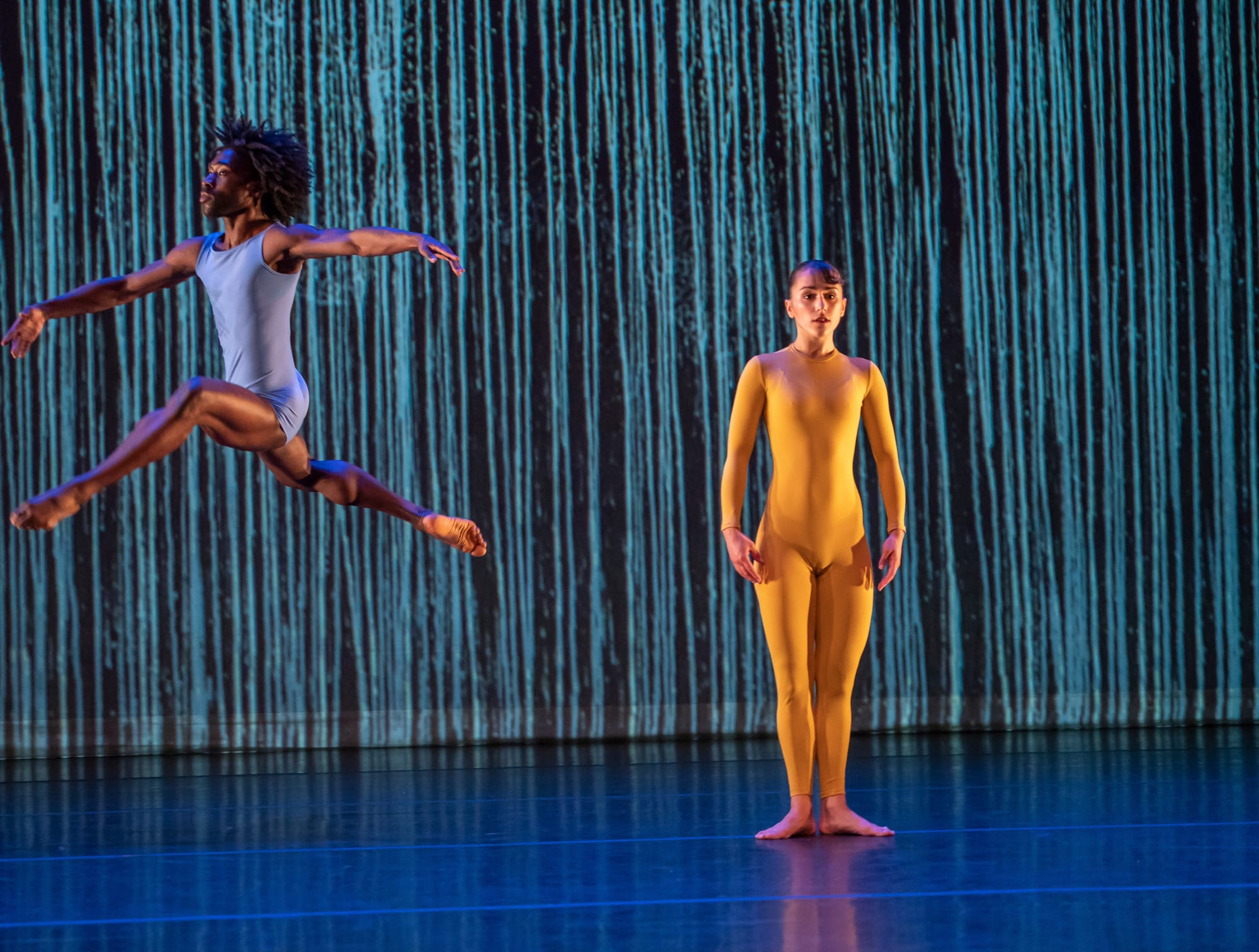
In these “events,” the solos themselves were the elements woven into a new fabric, a new work. The dancers, who each learned four solos, were arrayed in pairs, trios, or larger groupings, entering and exiting over 90 minutes of movement. Sometimes the solos echoed each other as leans, arabesques, or lines of movement seemed vaguely parallel, though they represented individual works. In Cunningham’s way, the music was entirely separate from the constructed dance. The dancers didn’t rehearse or even hear the beautiful bespoke score by John King until the performance itself.
Soloists often simply walked on (or off) the stage to enter the scene (with some witty exceptions, like the bicycle tour around the stage by Keith Sabado, and the periodic placement of a folding chair upstage for a dancer to move around and into, then lounge as a new audience member.) Patricia Lent, who masterfully combined the solos in her staging, wasn’t limited in her vision of “100 Solos” – the dances were both individual and in service of something so much larger. In one of the many beautiful grouped scenes, Vicky Shick gently placed her cheek in the palm of Sara Mearns’ hand; and Mearns moved on, to lay her own cheek on the hand of a third dancer. Breaking the rules of “solo” offered many rewards.
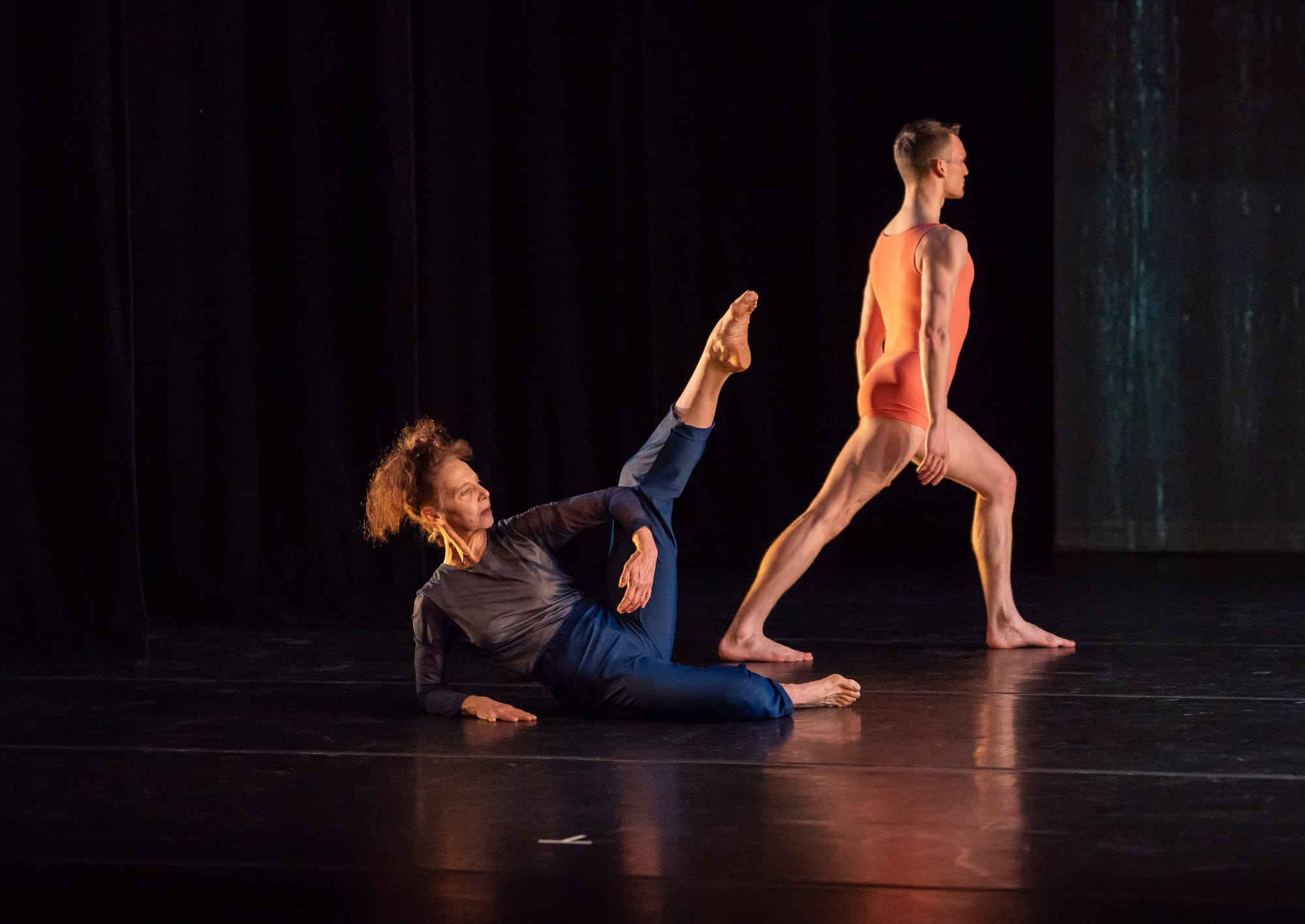
Each of the dancers’ training and styles were repurposed in service of Cunningham’s style and form. Mearns, a New York City Ballet Principal, offered her impeccable ballet discipline, but incorporated Cunningham’s unexpected shifts of weight and balance. Other distinct movers – mysterious Shick, powerful Kyle Abraham; and long-time dancers and exemplars of other seminal choreographers like Martha Graham’s Peiju Chien-Pott, and Shayla-Vie Jenkins, who spent many years in Bill T. Jones’ company – each found their hidden Cunningham, melding their techniques with his torques and limb shifts. The rhythms of Cunningham’s choreographies anchored each pattern; the relationships between the fragments gave shape to the whole.
The cast’s diversity was one of the evening’s most satisfying constructions. Cunningham’s focus on pure movement, without emotion or intention, seemed to free them all from inhabiting a particular identity. They enacted Cunningham’s maxim that “the dancers are not pretending to be other than themselves…They are, rather than being someone, doing something.”
The shapes on stage were built in careful juxtaposition. In a solo by Reid Bartelme, he posed downstage before prancing in a long diagonal across the stage, changing his balance by an unexpected knee bend and using his arms to frame the air around his head; on the opposite corner, and behind him, two other dancers moved in tighter geographies, one twirling into a low knee bend before leaping offstage, another jumping from a squatting diamond shape of legs, then angling his elbows in their own flat diamond. As dancers built and dressed the stage in these overlapping solos, it became hypnotic. Focusing attention on one dancer meant the others faded to background, as our vision shifted between the cast as forest and as trees.
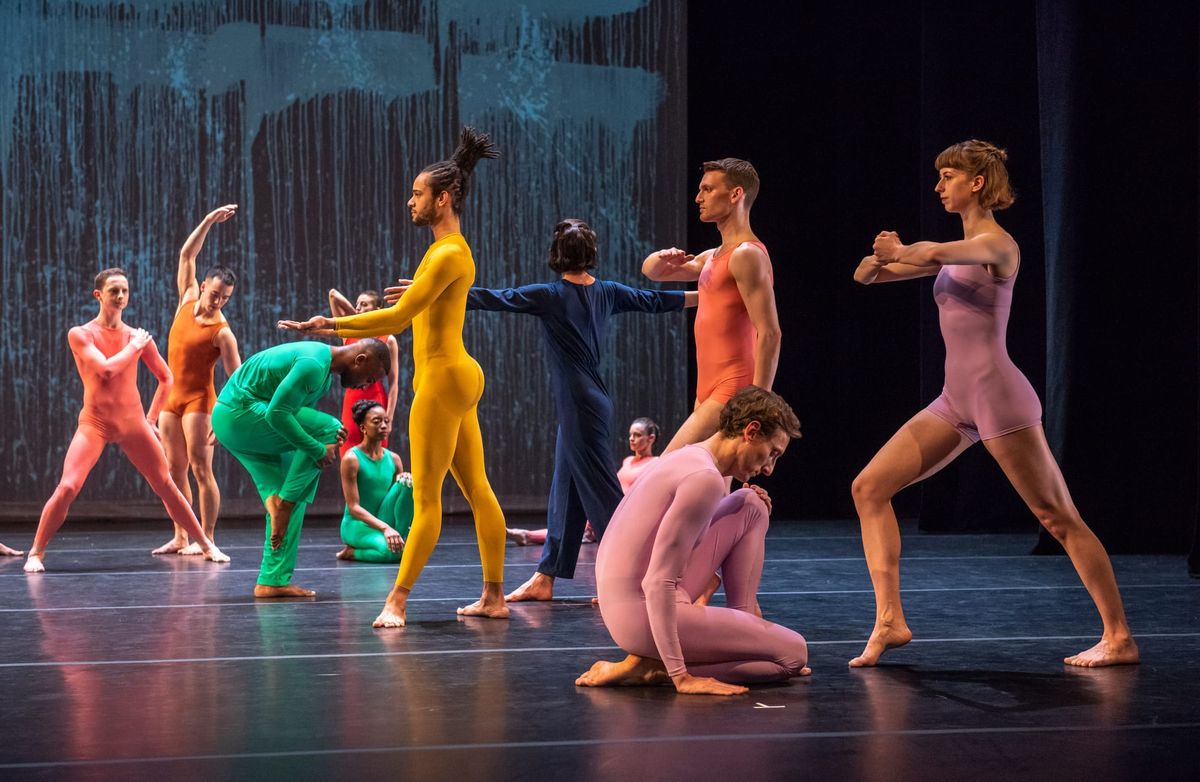
The two most resplendent scenes were the ones that filled the stage, Grand Jatte-like, with the entire company. Halfway through the performance (for John Cage’s 4’33” of silence, used with permission of the John Cage Trust,) the multi-colored dancers emerged from a brief black-out, arrayed on the stage together, a rich design of bodies, some spread on the floor, others posed standing, or leaning. Each faced their personal direction in space. Some shifted positions – arms down, a face turned, a knee lifted; and others stayed still. The shapes and images were rich and riveting, a patchwork of poses combined into a unique whole, in deep intentional silence.
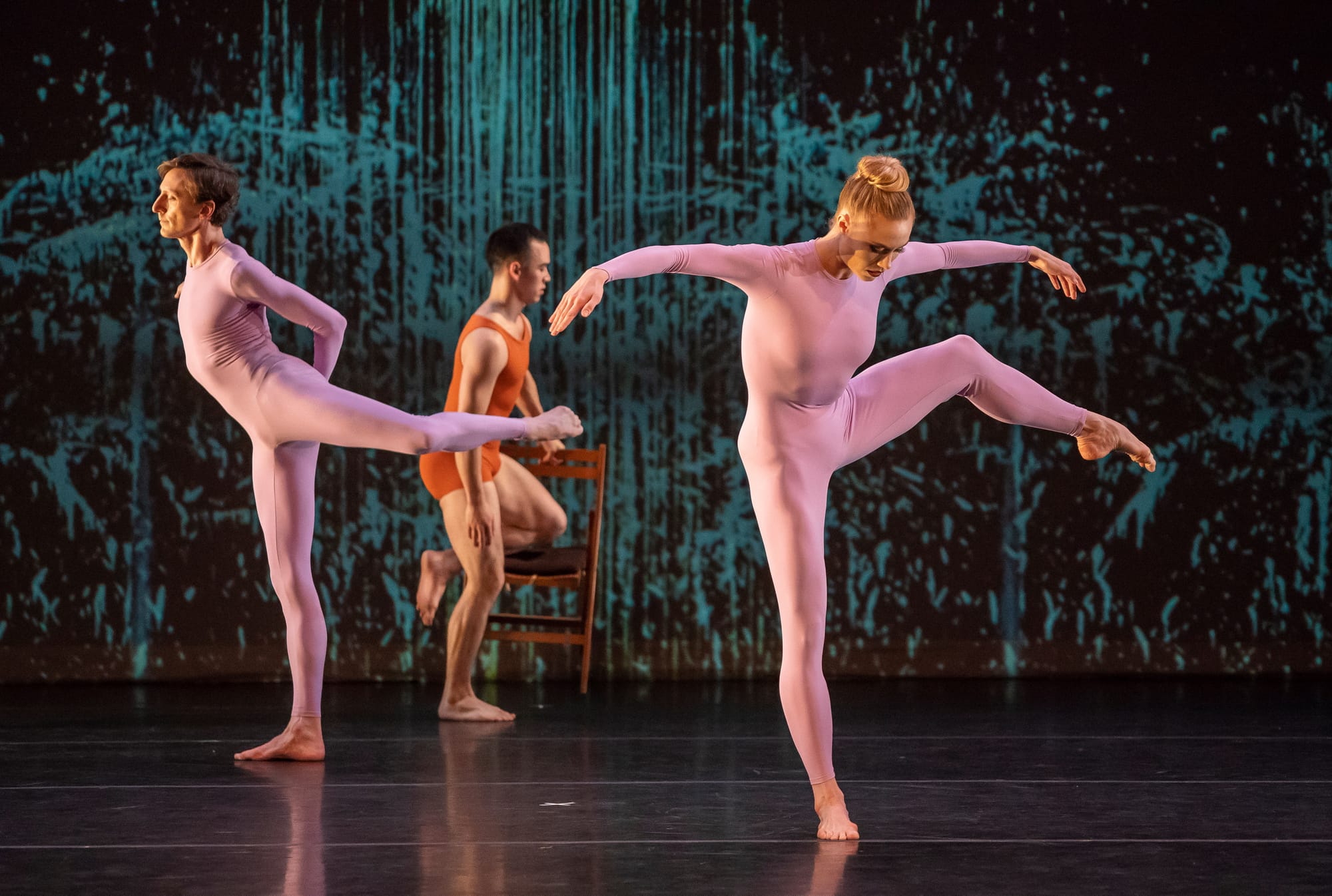
The colors in that pattern were the jewel-hues of the costumes designed by dance soloist Bartelme and his design partner, Harriet Jung. In single color unitards or simple tops and bottoms, the stage swirled in oranges, reds, pale blues, yellows. The changing combinations of like colors and contrasting ones offered another application of Cunningham randomness.
Behind the brightly clad dancers, there was also a shifting backdrop by painter Pat Steir, (an homage to the grand sets by Cunningham’s artist collaborator, Robert Rauschenberg.) Steir’s dripped “Waterfall” paintings were the model for the shifting scene, from white dripping cascades against neutral color, to bright splashes of falling color against boldly colored backdrops. The patterns of the costumes against the backdrop was yet another layer of random texture and energy – color and movement in relentless combinations.
At the close, the dancers returned again to end the performance in a rich group tableau. This one-night company – along with the matching companies performing thousands of miles away – brought its own life to Cunningham’s still fresh and compelling dance ethic. Like the final performance of his own company on the last night of 2011, this evening was unrepeatable – a reminder of the fleeting magic of dance, just as Cunningham insisted on creating unique, never-to-be-repeated moments of random confluence. It was a reassuring reminder, though, that, as long as devoted followers and supporters continue to teach, share, and grapple with his work, Cunningham and his influence will live for far longer than the century since his birth.
copyright © 2019 by Martha Sherman



