Ceaseless
“Fase, Four Movements to the Music of Steve Reich”
Anne Teresa de Keersmaeker
New York Live Arts
New York, NY
September 26, 2019
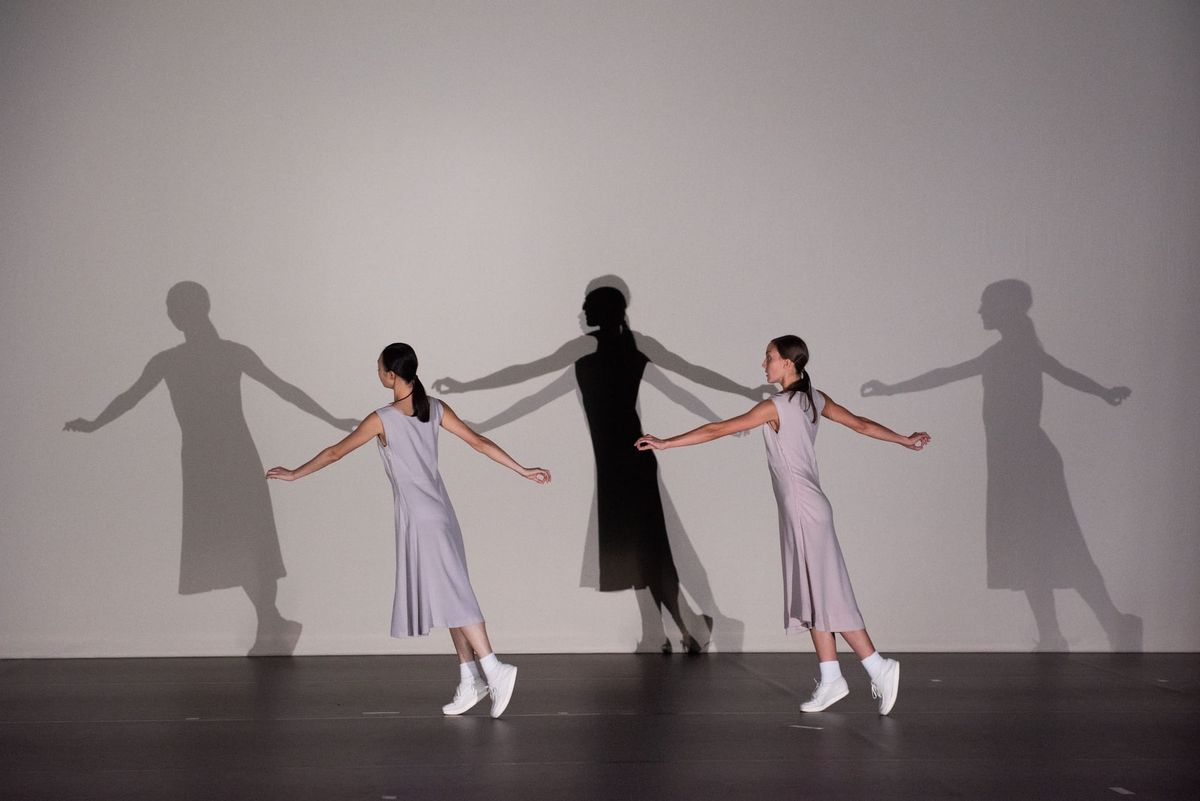
It is hard to get much more minimalist than this, especially while offering so much. Anne Teresa de Keersmaeker’s latest re-staging of her early composition continues to mesmerize. On the bare stage, a pair of women moved in and out of hypnotic parallel to four musical “phases” by Steve Reich. In pale gray shifts and sneakers, they were lit by a bright horizontal streak of light, their black shadows dancing across a screen that covered the back wall. The dancers each shot a straight arm up, pivoted precisely 180 degrees, and snapped their elbows in parallel bends, moving in preternaturally perfect sync, except when the repetitive Reich music drifted slightly askew. As his phase shifted, so did theirs, in lightly edged retreats from the movement pattern. Then, just as facile, they found their way back. The movement discovered its shifts, along with the music, and the continuous repetitions and subtle changes created a study of stunning body memory. The first few minutes of the “Piano Phase,”– or any choice of minutes in the piece – served as apt synecdoche for all of “Fase.”
As fresh as it feels, “Fase” was developed decades ago, partly in de Keersmaeker’s young participation in Dance Theater Workshop’s 1982 “Choreographers’ Showcase”, the precursor to “Fresh Tracks” (a program for emerging artists, still programmed, now by New York Live Arts.) Over the decades, de Keersmaeker has always danced one of the roles herself, the relentless movement drilled into her body. For the first time this year, she passed the dancing to two pairs of dancers who alternated performing the work, made of three duets, and one solo.
Although easily differentiated by their faces, Yuika Hashimoto and Laura Maria Poletti were like identical sides of a coin. Their bodies, matching high ponytails, swirling skirts, and movements made them twins, and the sharp shadows projected against the back screen were indistinguishable.
The only dressings of the stage were the powerful lighting, designed by Remon Fromont, and the back screen, used to label each of the four movements during short blackouts, and to project the twisting shadows. “Piano Phase” was danced in a horizontal white stripe of light, far upstage, the clipped half-turns and swinging arms moving in a narrow plane. When the dancers moved forward, they moved in quarter turns that brought them downstage, into new horizontal stripes of light. In this two-dimensional world, with the choreography flattened and minimized, this “phase” put all focus on the dance’s propulsion and dynamism, on the small shifts in patterns that matched Reich’s minute musical wanderings.
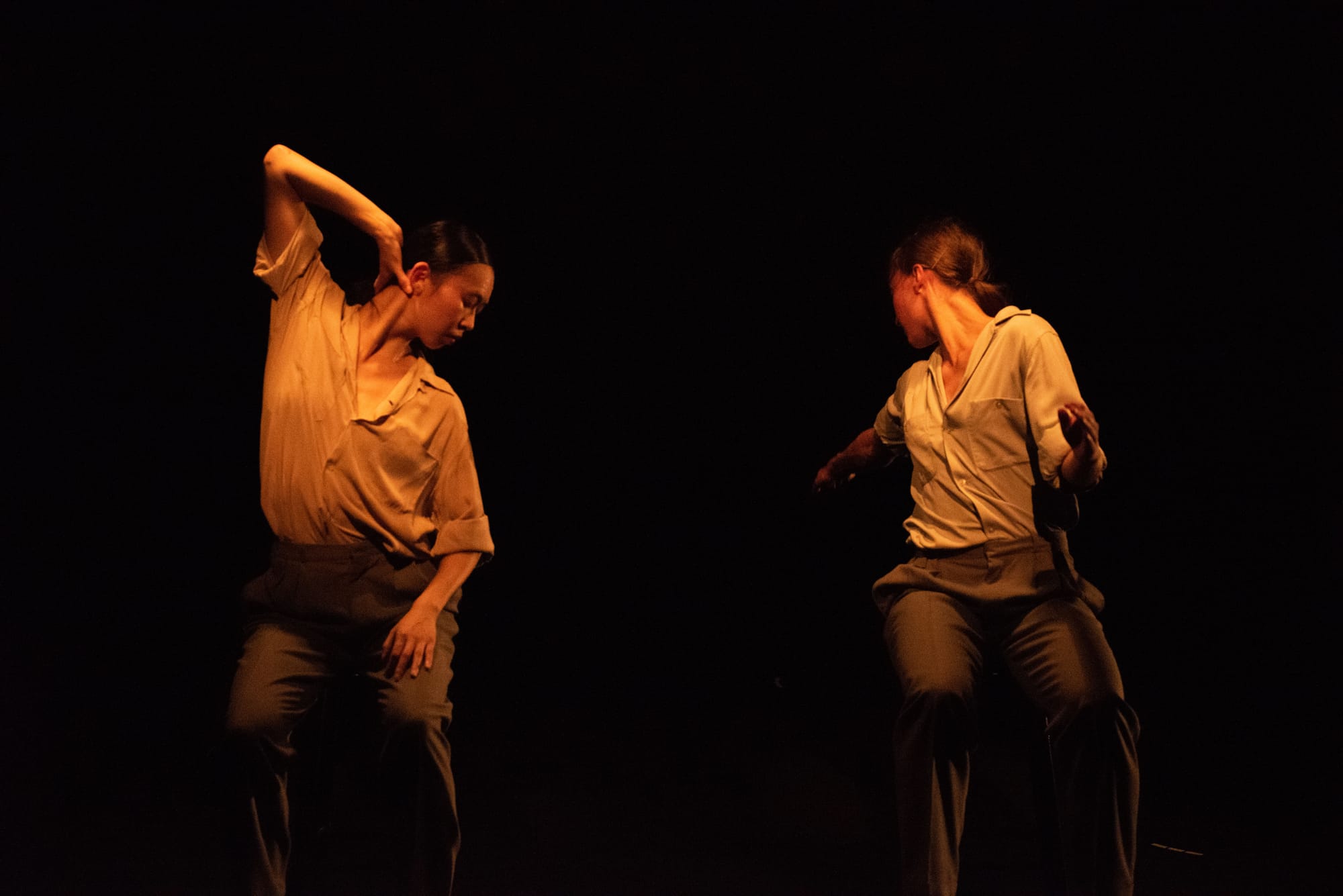
In the brief pauses between movements, the dancers changed into light, short-sleeved fatigues, which were visually better suited to “Come Out” (the second movement) and to “Clapping Music” (the fourth.) In “Come Out,” the score was based on vocal phrase repetition and was danced in a small rectangle downstage corner. Under a pair of cone pendant lights, the women perched on high bar stools, and used their arms, chests, and heads in sharp-edged movements accompanied by angled turns of the stools – in sync, out of sync, back to parallel.
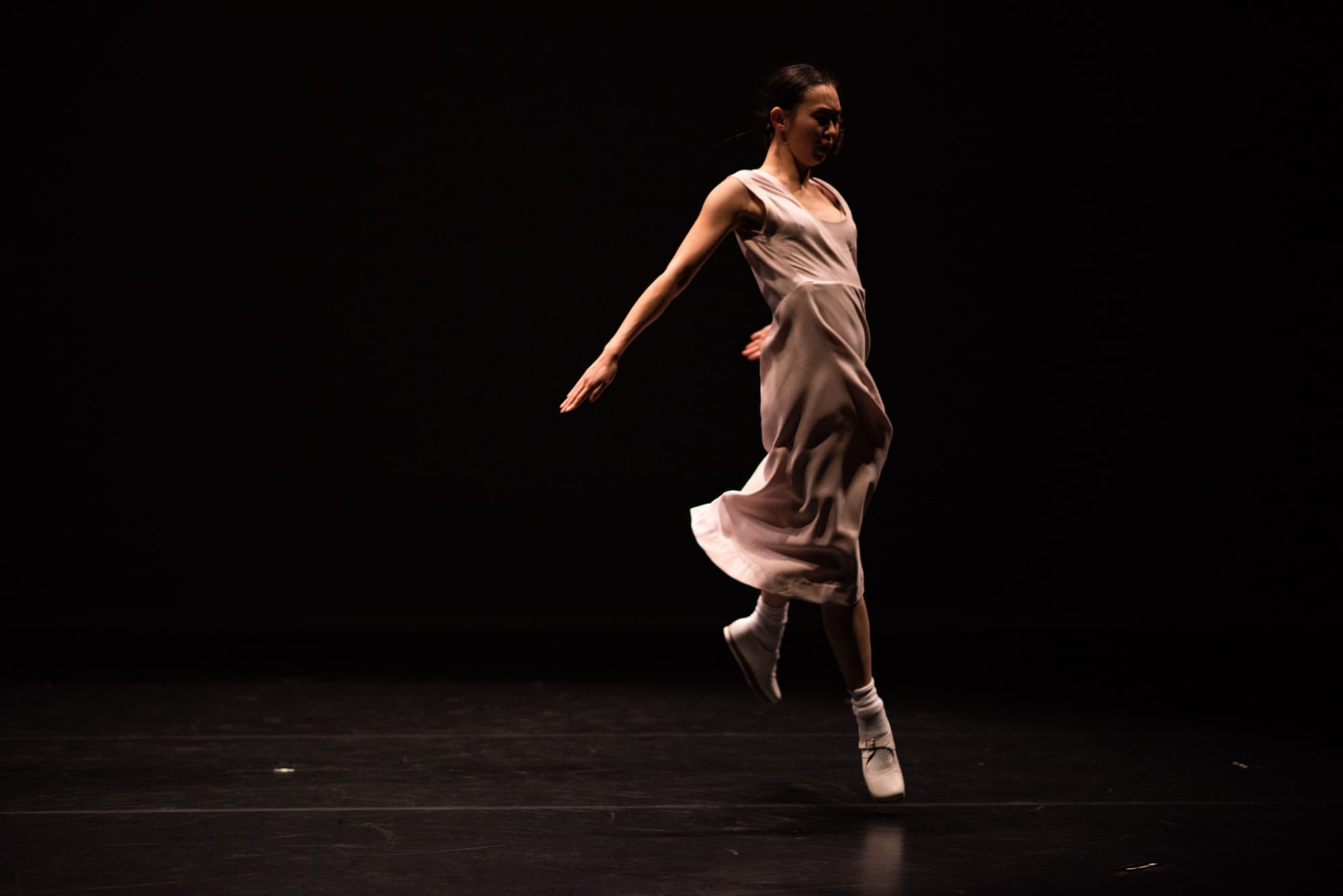
The third movement “Violin Phase,” has always been de Keers- maeker’s solo. As the choreo- grapher’s doppelgänger, Hashimoto twisted in crisp half turns, her arms bent around her waist, and her round white skirt whipping back and forth. This time, the repetitive movements built a new geometry and flow, again echoing Reich’s score. In a pattern that could also be imagined as if seen from above, Hashimoto moved in a wide circle around the stage, then cut the space into quarters, then eighths, by the shift of her movement – quick, sharp hops and arms raised above her head in repeated variations built around the pie wedges she drew with her body. Like the duets, this solo was driven not just by the violin patterns, but by momentum and will.
With the incessant repetition of Reich’s music, and only the subtle markers of shifting sync to guide the dancers, these long repetitions of dance patterns – and their changes – are a marvel of discipline; the dancers inhabited the choreography close to flawlessly in every movement; it was never clearer than in the instant of the final note – and synced final move -- of each segment.
The last movement, “Clapping Music,” was all staccato rhythm. It was danced in the fatigues costumes, and back in the horizontal planes of light, edging toward the downstage light pendants – costumes, lighting, simple repetitive movement phrases knit together from every other movement, now in a new iteration, a new phase.
Just as Reich never warns the listener before the music stops, there was no signal that the repetitious patterns were coming to the end; only the dancers’ bodies knew. In those final notes of “Clapping Music,” the dancers stood in profile, each under one of the overhead caps of light, their sharply-etched shadows moving with them as crisply as if they’d just begun. Then they stuck their final poses at the last, unexpected note, like ice dancers nailing their skate tips to the ice with a flourish. The audience was exhilarated. Each performance of this work is an achievement to be celebrated.
copyright © 2019 by Martha Sherman



