By Committee
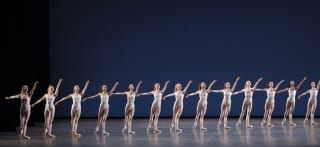
Mozart "Divertimento No.15", "Zakouski", Stravinsky "Pulcinella Variations",
"Tchaikovsky Pas de Deux", Stravinsky "Symphony in 3 Movements"
New York City Ballet and Kennedy Center Opera House Orchestra
Opera House
The John F. Kennedy Center for the Performing Arts
Washington, DC
March 26, 2018
A formidable feast, a menu of five different ballets, was served by the New York company for the first of its two 2018 programs in Washington. All the works shared an aesthetic: to take music that had been shaped by human feelings and reflect it as crafted motion, as living architecture, as deliberate anatomic action.
The groups of bodies in George Balanchine's Mozart are gracious and pliant, whereas those in his Stravinsky symphony are linear, angular and insistent. For the romance of Tchaikovsky, Balanchine has an imposing couple display its relationship: each partner declares an individuality that is inextinguishable. Peter Martins’ choreography selects tunes from several composers in order to challenge and kid the traditional balletic duo, and Justin Peck responds to Stravinsky reworkings of 18th Century themes by Pergolesi and his commedia dell'arte colleagues and competitors. Key roles in this repertory were taken by well-known dancers but also by new talents. Despite a brief mishap in one of the “Symphony in Three Movements” duets and the narrow avoidance of a group space crunch, the committee which currently directs NYC Ballet is proving to be quite competent in maintaining performance quality.
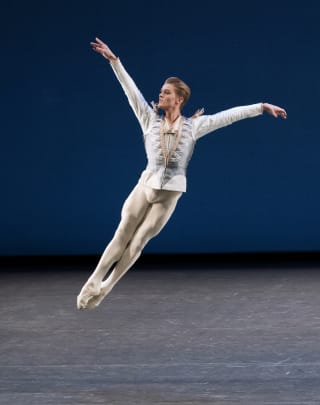
The similarities and contrasts between the Balanchine "Divertimento" and "Symphony" were vivid. Both ballets are group works. 16 dancers are required for the former and twice that number, 32, for the latter. Yet the latter and more "modern" work (1972) devotes an entire scene to a full-fledged pas de deux; the ballet’s principal couple (Sterling Hyltin and Adrian Danchig-Waring) has the score’s 2nd Movement all to itself. While "Divertimento" also includes a principal female/male pair (Ashley Bouder / Chase Finlay), for symmetry's sake he has to be shared, as are this ballet's two other prominent men - Daniel Applebaum and Andrew Scodato. The sharing is necessary in "Divertimento" (from 1956) because there are five “theme” women but only three such men, compared to the more even "Symphony" which has balance with its three theme women (Hyltin, Megan LeCrone, Erica Pereira) and three theme men (Danchig-Waring, Sean Suozzi, Daniel Ulbricht).
As ballerinas, the leading women of "Divertimento" and "Symphony" are quite distinct. Bouder has authority; whether she delivers a large phrase or one that is small, its impact is immediate. Hyltin moves with seeming detachment from the moment of action, building her dance coolly and cumulatively until it is perfected. As danseurs, the leading men of "Divertimento" and "Symphony" share some traits but also and differ. Finlay – tall. chiseled, blond - is acquiring the status once held by Peter Martins, who was the NYC Ballet's Apollonian danseur noble. Danchig-Waring, also tall but less blond than he used to be and with an expressively involved presence plus corresponding facial features, may be evolving into the company's Dionysus. Both men dance cleanly, meticulously.
"Tchaikovsky" is as fine an example as one can find of the balletic duet. Tiler Peck dazzled as its ballerina. Since the departure of her former partner, Robert Fairchild, she has polished her already considerable technique. There seems to be a clarity even sharper, a speed that’s faster still and additional elevation. Peck delivers her skills soberly, without bragging. Tyler Angle, as the danseur, could be relished for his quality of movement. Its substance is rich yet there is rebound. What there isn’t is rush, yet he leaves no vacuum in space. Both Peck and Angle appeared to enjoy their own solo forays, and when they met again for the finale, their appreciation of each other sprang from their happiness with themselves.
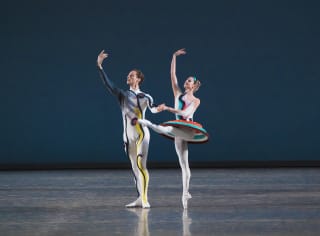
“Zakouski” is more than humor at the expense of ballet’s conventional pas de deux. Martins explores balance, placement and format. The work is full of novel stances and holds, and the ballerina gets to intrude on the danseur’s solo. The piece could have been made shorter by cutting a section by one of its four composers (Rachmaninoff, Stravinsky, Prokofiev, Tchaikovsky). The lighting by Mark Stanley made the skirt worn by the ballerina too raucously red and the danseur’s blousy, purplish shirt a stale orange. Joaquin De Luz danced as if he weren’t about to retire, and Indiana Woodward took the ballerina role intended for Megan Fairchild as if there was no such thing as a substitute.
“Pulcinella Variations”, the program’s newest work (2017), shows Justin Peck’s skill devising unexpected entrances and speedy divertissements. There were seven variations, perhaps a couple too many. The second variation was a slower and sustained and somewhat secretive serenade for the fulsome Sara Mearns. She was partnered - at first I thought it was by Tyler Angle – but it turned out to be by the more streamlined of the brothers, Jared Angle. Lydia Wellington took Indiana Woodward’s place, and Joseph Gordon was paired with Tiler Peck in an innocent gavotte that contrasted sharply with the earlier, informed Mearns / Angle serenade. There had been previous versions of “Pulcinella”. The first, in 1920, was by Leonide Massine. In 1972, for the Stravinsky Festival, Balanchine had wanted to revive Massine’s version but Lincoln Kirstein, NYC Ballet’s general director, forgot to mail Balanchine’s letter of invitation to Massine. So a new “Pulcinella” was staged by Balanchine with Jerome Robbins. If there were any references to this history in the current production, they were perhaps hidden in Tsumori Chisato’s busy commedia costumes rather than in Peck’s choreography. The costumes were a bit much and distracted from the dancing.
Daniel Capps conducted the Kennedy Center Opera House Orchestra for this opening night. To find a new artistic director for NYC Ballet, a search group has now been formed or is about to be. Wouldn’t, though, continuing the current directorial committee for a while be an experiment that’s worthwhile?
copyright © 2018 by George Jackson



