Bundles from Britain
"There Where She Loved", "Monotones I & II", "La Chatte", "Les Patineurs" (pas de trois), "Méditation from Thaïs", "The Two Pigeons" (final pas de deux)
Sarasota Ballet
Joyce Theater
New York, New York
August 18, 2018 matinee
Sarasota Ballet's Saturday program honored Sir Frederick Ashton on the thirtieth anniversary of his death with an all-British program, beginning with Christopher Wheeldon's "There Where She Loved", and continuing with Ashton's astounding "Monotones I & II", followed by four shorter works illustrating Ashton's wide range of styles, from the lighthearted "La Chatte", a tribute to Fanny Elssler, to the sweet-natured romanticism of "The Two Pigeons". These short works were tantalizingly brief, and, one hopes, previews of coming attractions.
Wheeldon's ballet is an uneasy amalgam of songs by Chopin and Kurt Weill, which, though it showed off the Sarasota dancers, was neither tantalizing nor brief. The choreography for the Chopin songs looked liked an exaggeration of Jerome Robbins, replete with overly complicated lifts -- the poor girls barely had a chance to stand, much less dance. The cast though, made it look as fresh and engaging as possible, underplaying the whimsy and dancing with a straightforward honesty. Ricardo Rhodes was absolutely winning as the flirtatious man abandoned by four women and Samantha Benoit and Ivan Duarte had a youthful charm in their pas de deux.
The pastiche Robbins, though, was not as unfortunate as the misguided take of the Brecht/Weill songs and Wheeldon covered those ironic lyrics in a thick coat of molasses, as the dancers swirled and soared. The low point, for me, was the lovely Christine Windsor, dripping with chiffon and long, elegant legs, being hoisted aloft in a serene, elegant pose just as the resigned, hard-bitten prostitute of "Nanna's Lied" was claiming her sour independence. Pretty and romantic are not words that apply to Weill's music.
Nor do they apply to Ashton's "Monotones I & II", those austere, hypnotic trios of pure dance. Thomas Giugovaz, the only male in "Monotones I", was especially fine with an elegant, pliant upper body and a juicy plié. There were a few wobbles from the women (Ryoko Sadoshima ad Samantha Benoit) but overall, the performance was fresh and pure, as their upper bodies turned in unison and those traveling arabesques moved in radiant harmony.
"Monotones II", danced by Amy Wood, Jamie Carter, and Daniel Pratt cast its spell, as the dancers twisted and turned with a constant flow, subtly changing the accents and dynamics, so the piece, for all its surface sheen, was full of shifting undercurrents. All the dancers in each section has an impressive quality of dynamic stillness and each little nod or shoulder shift creating a haunting afterglow.
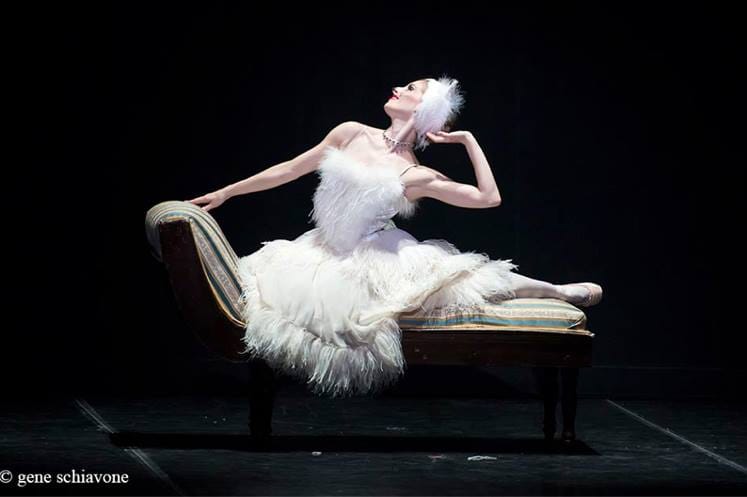
"La Chatte" leaves a different afterglow, one of cheerful good humor as Ashton's bonbon about a cat who identifies as a woman lets her cat-like nature seep through her elegant posturing, and when a mouse runs across the stage, just had to meow. Kate Honea was a feisty little beast, with luxurious backbends and sharp claws, as well as a long series of sharp, clear hops on point. (Ashton used Elssler's original costume design but his choreography celebrates modern technique.)
"Les Patineurs", Ashton's 1937 Christmas card of a ballet, is another light-hearted romp and it has to some extent become Sarasota Ballet's "Revelations", a familiar classic that is always welcome. The audience got a taste of it with the frisky, if far too brief, pas de trois, danced with stylish flair by Asia Bui, Samantha Benoit, and Ivan Duarte. It was fascinating to see it after "Monotones I", as both had sections where two women and one man hopped in uniform arabesques, those in "Monotones I" so fluid and mysterious and those in "Les Patineurs" so joyful and buoyant and both perfectly suited to the music.
Ashton set "Méditation from Thaïs" to the top ten classic by Jules Massenet and his light and elegant choreography avoids mawkish condescension. The mysterious veiled woman floating just out of reach of the solitary man has been used many times and Ashton's luxurious version is one of the most beautiful. It certainly is an object lesson in how to use complicated lifts, as Ashton's grow out of the music and are used as exclamation points, not as a long series of glottal stops.
Ricardo Rhodes showed a quiet dignity and an impressive line and was a generous and unobtrusive partner. Katelyn May, a dancer of piquant elegance, had etherial control as she seemed to float over the stage.
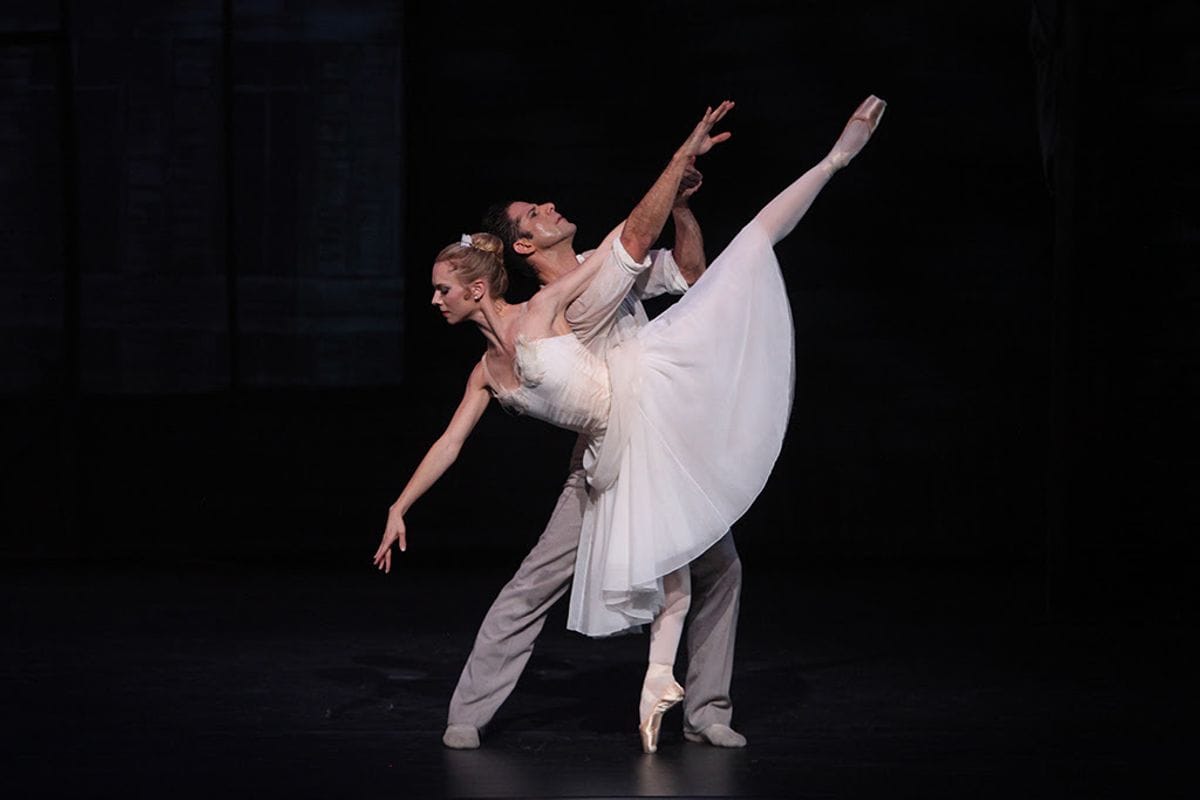
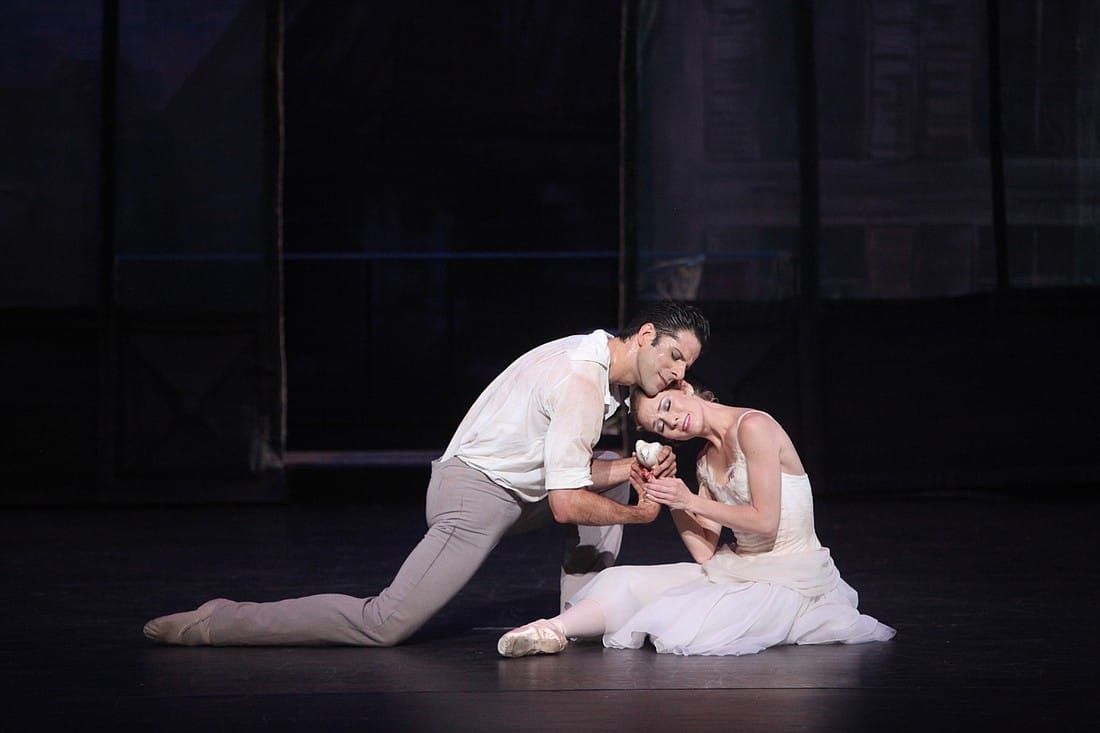
Ashton's "The Two Pigeons" is another excursion into the nineteenth century, as he used Andre Messager's tuneful, charming ballet score for the simple story of a Parisian artist and his model/girlfriend and a band of traveling gypsies. The artist runs off to join them, regrets it and returns to his studio and the abandoned girl. Their final pas de deux, like the story, is simple and sweet, and intensely moving.
Victoria Hulland and guest star Marcelo Gomes danced the full length ballet two years ago in Sarasota, and reprised the final pas de deux. This was Gomes' first New York appearance since leaving ABT and the audience clung to his every move. Gomes, always the most magnificent of partners, seems to have a special rapport with Hulland and they gave the pas de deux a hushed intimacy as he knelt before her, asking for forgiveness. Their elegant, serene lines radiated peace and happiness. Who but Ashton would have the confidence, imagination, and daring to have his dancers sit still for the musical climax, as the bells pealed over the roofs of Paris, and just watch a live pigeon fly in to join it mate? And who but Ashton could make an audience cry just by watching that bird?
Fortunately, these were chic, well-trained Parisian pigeons, not New York scavengers, and they performed right on cue. If only the complete ballet could fly in too.
Copyright © 2018 by Mary Cargill



