Blues

Blues
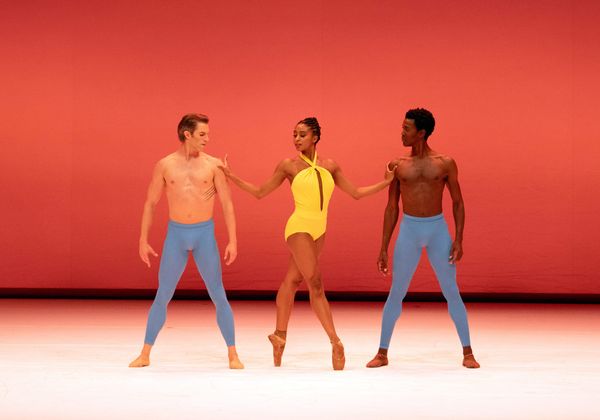
Ashley Tuttle in Pam Tanowitz's "Untitled: The Blue Ballet" photo © Paula Court

Pam Tanowitz Dance
"Untitled" (The Blue Ballet)
The Kitchen
New York, NY
March 8, 2012


Uptown and downtown combined in the hour and a half long work, featuring former ABT dancers Ashley Tuttle, Sasha Dmochowski, and Brian Reeder, Jean Freebury (formerly with Cunningham), and John Heginbothan (currently with Mark Morris) performing Morton Feldman's String Quartet #1, performed live by the FLUX Quartet.  The music is atonal, un-rhythmic, austere, with occasional bursts of energy.  Tanowitz often choreographs through the music, as if she is creating a dialog, commenting on its moods.The simple, effective staging by Philip Trevino had two streams of fabric hanging at the back of the stage, where the dancers could disappear.  The women's costumes, by Karen Young, were very flattering, with the short, sheer skirts and colored tops (royal blue for Tuttle and grey for Dmochowski and Freebury).  The men's costumes were not as successful--the grey muscle shirts were fine, but the black pants seemed distractingly baggy. 

The focus was Ashley Tuttle, the former ABT principal noted for her delicacy and pristine musicality.  She was on stage for the whole dance (except for a hiatus in the when the dancers retire and the music takes over).  Tanowitz used her classical rigor, with glancing references to some of her noted classical roles (there are Giselle poses scattered throughout),  and often gives her a rigorous pose that oozes into an off center one.  Tanowitz, however, focused less on technique than on Tuttle's iridescent reticence, creating an isolated and slightly troubled presence.  There was a repeated motif of her quietly but forcefully slapping her arms against her body, like a captive bird.

The other dancers performed around her, sometimes ignoring her, and sometimes dancing with her.  There were some repeated motifs; Heginbotham had a series of elegant little prancing steps, taken up eventually by Reeder, who had a final dance with Tuttle, though the last scene was Tuttle alone in a sea of blue light.  But this was a work of mood, not narrative, and reflected the discordant, isolating music.  An hour and a half might be a bit long for some (it was for me), but the elements of the work itself were riveting, and all the dancers gave committed, finely honed, and haunting performances.

copyright © 2011 by Mary Cargill
Read more

Ballet's Beautiful Ghosts

Ballet's Beautiful Ghosts


“Mephisto Waltz,” “Soon,” “Quiet City,” Ghost Light”
London City Ballet
The Joyce Theater
New York, NY
October 27, 2026


London City Ballet returned to the Joyce Theater two years after its first New York tour as a reconstituted company, and on opening night it made its case in a program of beautifully haunting works. The troupe once called Sadler’s Wells home and counted Princess Diana among its supporters, then vanished in 1996. Christopher Marney revived it in 2024 with

By Marianne Adams
Modernity Wins

Modernity Wins


“Petal,” “Petite Mort,” “Paquita”
American Ballet Theatre
David H. Koch Theater
New York, NY
October 25, 2026


In programming Helen Pickett’s stripped-down, richly hued “Petal” and Jiří Kylián’s curious “Petite Mort” with Natalia Makarova’s tired staging of “Paquita,” ABT, perhaps inadvertently, made the best case yet for a slick (and sensual) modern direction. The dancing was most multilayered and revealing of the dancers in those works, and while the company danced the lone classical offering well

By Marianne Adams
Movie Time

Movie Time


"Femme Fatale"
Tom Gold Dance
The Goldman-Sonnenfeldt Family Auditorium
Marlene Meyerson JCC
New York, NY
October 29, 2026


Tom Gold, a former New York City Ballet soloist, has been choreographing for his small pick-up company since 2008, an impressively resilient number.  His insistence on live music is equally impressive, and his choice of chamber works had led to some fine and interesting discoveries.  For “Femme Fatale”, he chose small violin and piano works by the famous

By Mary Cargill
Men Alone

Men Alone


"Birthday Offering", "Mercurial Son", "Ballet Imperial"
American Ballet Theatre
David H. Koch Theater
New York, NY
October 23, 2026 and October 24, 2026, matinee


Perhaps coincidentally, the “Neoclassical Works” program with ballets from three very different choreographers (Sir Frederick Ashton, Kyle Abraham, and Balanchine) all featured glimpses of men alone on stage searching yearningly or restlessly for something.  Ashton’s “Birthday Offering” (1956), a radiantly abstract celebration of classical ballet, had an anonymous cavalier looking longingly around the empty

By Mary Cargill