Blind Date
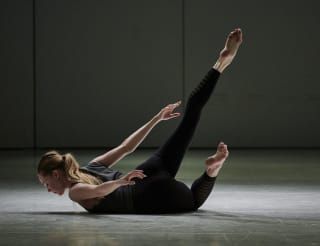
“One of Sixty-Five Thousand Gestures/NEW BODIES”
Jodi Melnick
Guggenheim Works & Process
New York, NY
January 15, 2018
In a new work by Jodi Melnick, three traditionally trained ballet stars come face-to-face with this iconoclastic choreo- grapher, and it is, truly, as if they were coming into their eponymous “NEW BODIES.” Dance writer (and now occasional curator) Claudia LaRocco came up with an intriguing programming idea for a 2017 Danspace Project Platform when she matched pairs of ballet dancers with contemporary choreographers to see what they would make together. Although pairings like this are not unheard of (Wendy Whelan’s partnership with Brian Brooks, one of the best recent examples,) it is usually an already existing personal chemistry that triggers the idea to work together. What LaRocco did was pair strangers (“blind dates between dancers”) in an experiment to see what might stick; one of the partnerships that stuck was between choreographer Melnick and New York City Ballet principal Sara Mearns.
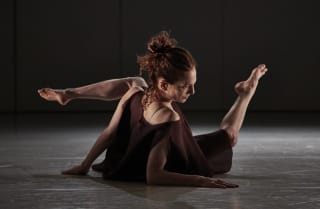
“NEW BODIES” was an unusual commission from the Guggenheim for its Works & Process series. Melnick was asked to develop a site-specific work for the oddly shaped performance space in the museum basement, and chose to expand the Danspace work that she and Mearns had continued to develop in a Jacob’s Pillow residency. The Guggenheim performing space is a shallow, arc-shaped stage with long curved tails that protrude into the round auditorium; there is as much space at the sides as in front of the audience.
Down one of the stage tails, Taylor Stanley (another NYCB dancer and recent cast addition, replacing an injured Gretchen Smith), made his subtle solo entrance, Kabuki-like, into the space, and settled onto the floor, his curved back toward the audience, as he paused to ponder a large curved Ellsworth Kelly sculpture that loomed to the side. The dramatic lighting was Joe Levasseur’s, and honored the space and the art, as well as the performance. Mearns followed, also from the long side entrance, sitting to watch the audience from the center of the stage. When she stood, it was a in a brief still first position, the most basic of moves, but fully inhabited in her ballet dancer's body -- and then she melted away; she found a perfect balanced arabesque, and leaned into it before it, too, dissolved. Each shift was a reminder, first, of her perfect discipline, and then of her choice to move in a new way. The third member of the NYCB dance trio in the cast was Jared Angle, tall and elegant, who anchored the three as they eased into a graceful line across the space before they let their hips lightly swivel into a Melnick shiver.
Melnick’s choreography is bracingly casual, with easeful shifts of weight and limbs, shoulders and hips that build into unexpected, unpredictable patterns. She dances her own movement with fluid poise. In addition to the commissioned new work, Melnick danced an opening solo from a gorgeous collaboration with Trisha Brown, created in 2012, “One of Three Hundred and Sixty-Five Thousand Gestures.” The swift, compelling solo seems to use at least that many individual, identifiable movements, coolly incorporating each muscle in Melnick’s body, from her fluid back and floating arms to the most delicate shifting of her fingers tapping against the air.
Dancing to a subtle score by Hahn Rowe, Melnick was mesmerizing. She slid and shifted her limbs, shoulders, and hips in wide arcs that somehow propelled her to the floor, or changed their scale to move from a small area in the center to – all of a sudden – the entire range of the stage. We didn’t see it coming; she melted into space with every gesture, large and small.
In “NEW BODIES,” though, Melnick honored ballet discipline, offering plenty of room for the lush lunges, arabesques, and easy pirouettes that are the core vocabulary of the dancers’ day jobs. When she pushed them to use new vocabulary, it was to test and trust their bodies in different ways – as simple as dancing in bare feet, or in silence rather than to a score (“it was so intimidating,” Mearns confessed in the post-performance discussion.) There was permission, too, for them to inhabit the stage without owning it; as Angle danced a solo that played with his body’s shifting options, his partners sat upstage against the back wall, respectful observers.
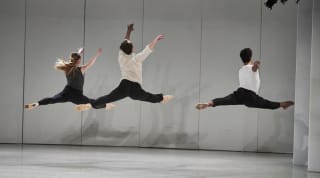
For Melnick, who uses the body itself as her “aesthetic material” (not a story or score), these new bodies were powerful new material indeed. The movement choices could have been more radical, but in this hybrid offering, Melnick was as respectful of the dancers’ roots as they were open to her more expansive expectations. Their fingers found their wiggle, and they walked across space, instead of moving in the toe-first procession of ballet shoes on elegant parade. For each comfortable, controlled leap in this choreography, the dancers also made space for inertia, and crumbling torsos, and simple, rising and falling limbs – no stretch or perfection required.
The ballet patterns were most evident when the trio moved in a long diagonal, smoothly parallel. Instead of graceful ballet lifts, though, the dancers’ intersections looked like controlled falls, one dancer shifting out of balance into the arms of another, more like interruptions than connections. In one intersection, Stanley and Mearns were heaped on the floor, and out of that coupling, Mearns' arms and legs rose, poised as if in flight, just barely held by the floor and gravity. Although most of Melnick’s work is done barefoot, these scenes also allowed for some work in ballet flats, as if an accommodation to meld the two worlds. The harpsichord score adapted from Ligeti, also engaged the dancers’ ballet heritage, and was played live on one of those long stage wings by Robert Boston, as the dancers strayed out into that idiosyncratic space. Later, violinist Monica Davis emerged from the darkness and set up her music stand to play next to the Kelly sculpture.
At its close, “NEW BODIES” ambled from the dance into conversation. As the movement ended, the dancers wandered to the wings, then toted chairs in for a discussion, now with Melnick and Smith joining them. Here, it was not their bodies, but their eyes that connected; Mearns melted her upper body onto the floor from her seat, as Melnick began to speak. The conversation and text were just part of the work; unlike in ballet, there was no big (or even clear) finale. The conversation that ends this dance morphed quite naturally into the traditional discussion that is central to each Guggenheim’s Works & Process program. As is Melnick’s way, the cast continued an investigation about process and self, as important to this work as dance rigor, which was the gift of these marvelous dancers.
copyright © 2018 by Martha Sherman



