Birthday Party
"Walpurgisnacht Ballet", "Duo Concertant", "The Four Temperaments", "Cortege Hongrois"
New York City Ballet
Koch Theater
Lincoln Center for the Performing Arts
New York, NY
January 22, 2011
New York City Ballet celebrated Balanchine's birthday with matinee and evening performances of wall-to-wall Balanchine. The matinee was sort of a marshmallow sandwich, with beautiful fluff surrounding a substantial filling, and showed off some beautiful music. The company has continued its "Dancers are really just folks" approach by having the program open with a casual introduction by several dancers, in this case Amar Ramasar, Sterling Hyltin, and Robert Fairchild. Despite the usual assortment of uhs and ums (I overheard someone behind me say "They talk with their feet, not their mouths"), the comments about Balanchine and music seemed sincere and touching; the introduction did have an obvious impact, since those performers garnered some extra applause.
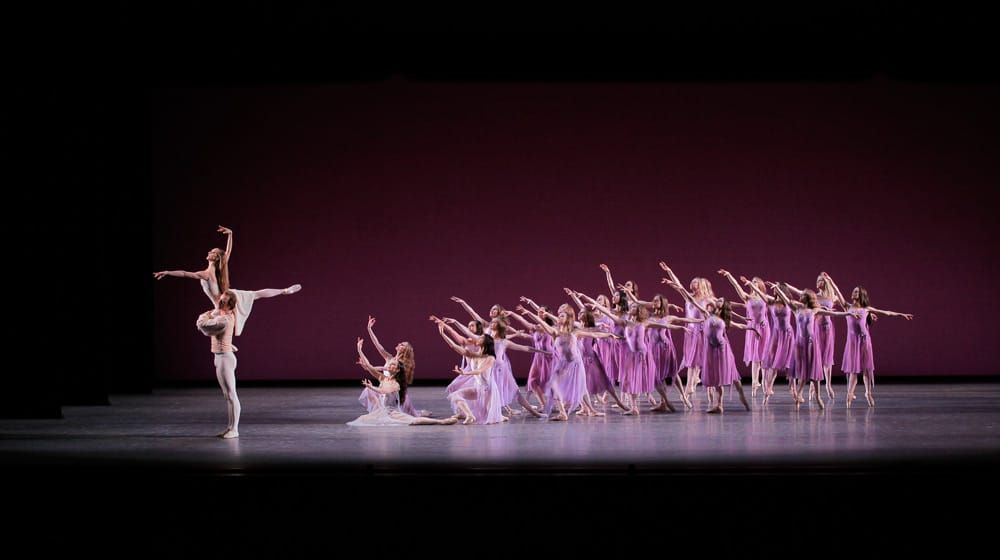
Of course, people don't go to the theater to see regular folks, they go to see dancers, and once the curtain rose, the dancers too over. "Walpurgisnacht Ballet" is a late Balanchine bauble to Gounod, remotely connected to Faust. The delicate and frisky bacchanites, in lush magenta, are about as dangerous as a bouquet of orchids, and just as beautiful. Maria Kowroski, with Ask La Cour, moved as if dancing on a cloud and swept through the two solos (though she stumbled a bit in some of the tricky point work). La Cour was a gracious partner, and showed off a fluid jump. The soloist, Erica Pereira, as she often does, looked like she was leading a ballet class, flashing nervous grins now and then, and picking at the steps, though now and then, when she seemed to relax, she danced clearly.
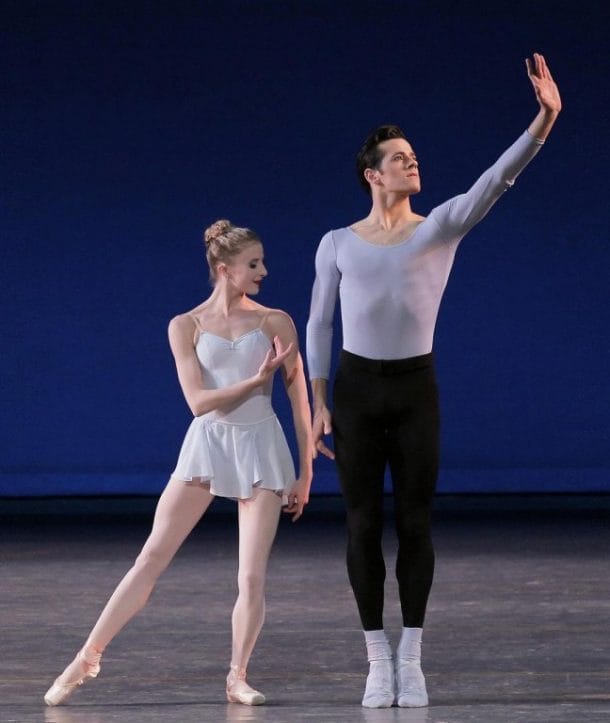
"Duo Concertant" is a difficult ballet to get across, since much of the time the two dancers just have to look at the musicians, and the ending, with the spotlights and hand kissing, can be mawkish. But when done well, it is truly moving. Robert Fairchild was magnificent, moving with a weight and dignity. He dominated the times spent listening to the music by concentrating on the violinist, and it really seemed like the audience was hearing the music through his eyes. His partner, Sterling Hyltin, was less at ease, and seemed to be thinking "one, two, three--turn head, five, six, seven, lift chin and repeat as necessary". Her dancing had an interesting syncopation and a beautiful lightness, but she was dancing, while Fairchild was living.
"The Four Temperaments" is another Balanchine ballet in which the dancers become the music, and the performance was very good. The opening themes avoided some of the exaggerated posturing and extensions of some performances, while giving the movements color and individuality; Ashley Laracey and Justin Peck, in the third theme, especially, were a memorable combination of cool and hot, reacting to each other, yet not over-emoting.
Melancholic especially needs a combination of impersonality and profound feeling, and Sebastien Marcovici was very good, dancing with a desperate weight through the push-pull of the choreography. Jennie Somogyi was incisive and elegant in Sanguinic, and as usual brought a vividness and a clarity to the choreography, helped by Jared Angle's secure and generous partnering. The low, skimming lifts just floated. Phelgmatic, with the deadpan Amar Ramasar, and Choleric, with Teresa Reichlin, were equally impressive. Reichlin's presentation and projection sparkled, something this fine, but sometimes diffident dancer hasn't always managed.
"Cortege Hongrois", I suspect, is on no one's list of top Balanchine ballets. It is basically a series of finales set to the top tunes in Glazounov's "Raymonda", one of the most musically lush ballet scores ever written. But it does include my desert island solo, Petipa's (lightly reworked by Balanchine) Hungarian-tinged salute to the perfect woman. It got as near a perfect performance as we can expect to see in Sara Mearn's voluptuous, rapturous, and technically scintillating rendition; she is a dancer who doesn't just make the stage disappear, she can make the world vanish, and for a brief while, seem to be the only real thing around. Charles Askegard, replacing Jonathan Stafford, was her cavalier, and was (like Jared Angle) gracious and generous. He is a natural turner, and the choreography suits him very well.
The classical contingent, let by Ana Sophia Scheller and Gwyneth Muller, sparkled, but the character branch seemed like canned paprika, colorful but flat. Sean Suozzi, though, as the lead Hungarian, danced with true panache and an exciting weight. But the performance belonged to Means, a present for everyone.
copyright © 2011 by Mary Cargill



