Beyond Butoh
"Darkness Odyssey Part 2: I or Hallucination"
Kota Yamazaki/Fluid hug-hug
Baryshnikov Arts Center
New York December 14, 2017
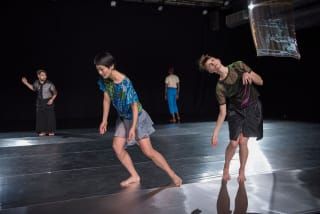
Five dancers take part in Kota Yamazaki’s “Darkness Odyssey Part 2: I or Hallucination,” but for the most part each dances on his or her own, on a shiny floor, with a diaphanous rectangle of silver fabric hanging overhead. The overall feeling is one of slow, liquid movement – but with fits and starts troubling the surface calm.
Joanna Kotze stepped delicately like a long-legged wading bird, or like a child with autism, on tiptoes, whiffling her fingers under her chin and wrinkling her nose, as if working on an insoluble private riddle. At one point she spoke up to say she saw three power lines, or maybe it was four.
Raja Feather Kelly stood still for long periods with his mouth open. When he moved it was in long lines, opening into eccentric arabesques. Wearing a white shirt and blue pants, he rolled over with his back upright, so that his blue butt formed a dome over what looked like a featureless white face, and then began to talk animatedly with his hands. Later he lay down and said out loud that he smelled cigarette smoke, coming from next door. “Maybe it was hers?” he mused. This was the only mention any character made of another person.
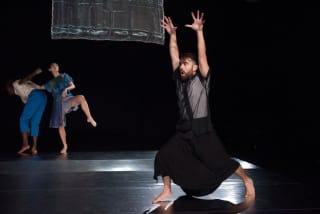
Julian Barnett, wearing a black skirt over his pants and a diaphanous robe outside his shirt, pinched in on himself as if trapped in a contraction. He stared and glared in stillness, then lurched around spasmodically, as if he had something to say but couldn’t.
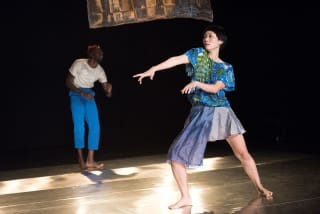
Mina Nishimura danced like a flower in a garden, revolving slowly in a skirt that looked like petals, turning her feet in then out as she glided across the floor, silent and serene, exuding an inaccessible tenderness, fortified by Tai Chi. She spoke at one point, in English, but her words were unintelligible.
Kota Yamazaki, the choreographer, entered by the public door to the theater and immediately lay down near the front right corner of the stage with his bare feet to the audience. He spent the next fifty minutes or so crawling glacially along the sideline, moving only a few feet.
The turning point of the piece comes as he stands up, takes a few steps onto the floor, then turns and rushes to the nearest fire exit and plunges out of the theater. Hell breaks loose – Barnett is seized by violent vibrations shaking his whole body, finds his tongue and howls in desperation on the paradox of existence: It’s empty! It’s not empty! It’s inside! It’s outside!
He rushes out the door and back in, up the steps of the auditorium, furiously trying to get what’s inside outside. This goes on a long time, and there is conviction in his conniption; it has an effect. The whole cast seems to calm down after this, moving in the same ways, but aware of each other. At the end they take up four corners on the floor, like the diaphanous rectangle above. They move in concert, backs to the audience, away from us, and then slowly turn, moving forward, seeing us. The end is stillness, flooded with white light.
This may not sound like much of a plot, but it made for a riveting hour-plus of pure theater. The dancers are masters of their moves and their quirky characters, and their drama is illuminated with subtle shifts in the lighting by Thomas Dunn, and a hypnotic sound score by Kenta Nagai – a steady drone full of chirps and echoes, building to shots and sirens, a screaming crescendo, then flowing water. Fluid hug-hugs? Not on the stage, but maybe in the mind.
This “Odyssey” is the second part of a planned trilogy by Yamazaki, whose roots are in Butoh – Japan’s post-war, post-traumatic “dance of utter darkness.” Now he is in New York, a world citizen, eclectic dancemaker – but still with Butoh in his bones, slowly emerging from the darkness.
copyright 2017 by Tom Phillips