Best of Times
Masters & the Next Generation
"La Cathedrale Engloutie", "Chrysalis", ""There is a Time"
Limón Dance Company
Baryshnikov Arts Center
New York, NY
December 15, 2010
The two masters of the program title were Jiří Kylián and Jose Limón, and the next generation was Limón dancer Jonathan Fredrickson, whose "Chrysalis" was a clear, if too long, riff on the virgin sacrifice motif. The opening work, Kylián's 1975 "La Cathedrale Engloutie" was accompanied by his usual somewhat opaque program notes, this one talking about "the battle between self-imposed laws and order and, at the same time, resistance against these laws is one of the most complex facets of the human character"--apparently grammar is one of those complex laws that can be resisted. But what was on stage was a moody, haunting, and completely captivating series of dances, set to the sound of the ocean interwoven with piano music by Claude Debussy.
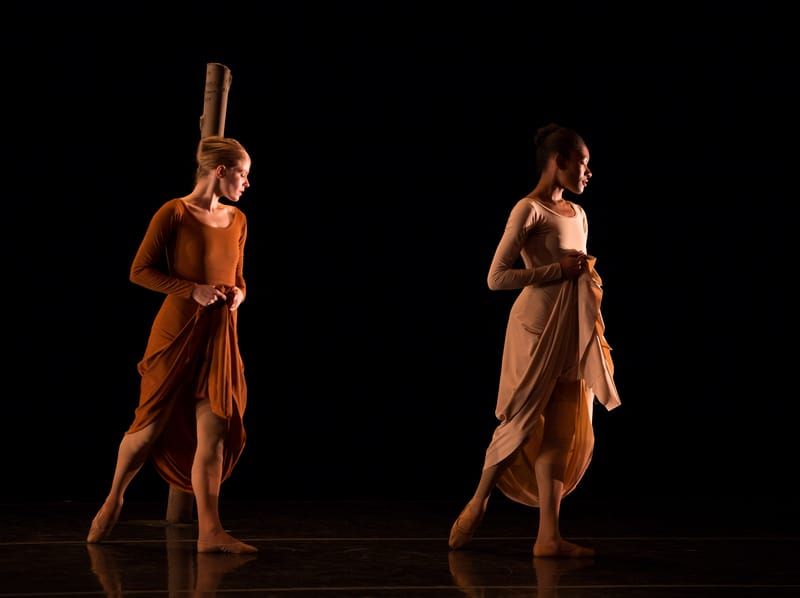
The two couples, Logan Kruger and Durrel Comedy, and Kristen Foote and Dante Puleio, wear sand colored outfits and enter to the sound of the ocean, with logs standing on each end of the stage, and somehow conjure up the feeling of the vast and eternal sea. They dance with a sense of separation, of yearning, with an undercurrent of sadness and missed connections.
Jonathan Frederickson's "Chrysalis", to live music composed by Marcos Galvany (a very danceable and atmospheric score), is set in an all-female, vaguely classical period, perhaps a nod to the Greek dances of Doris Humphrey (the notes say it was inspired by the Oracle of Delphi). But the costumes (by Melissa Schlactmeyer) said clearly "This is not your Grandmother's Greece", as the hints of classical drapery of the tops were paired with modern pants. The opening section had a ritual intensity, and as one girl (a vulnerable and touching Belinda McGuire) was stripped of her clothes to reveal grey underwear and draped with a long black cloth, thoughts of "The Rite of Spring" were in the air. The four remaining women returned in colorful costumes to continue, at great length, persecuting the victim. Though the work needed cutting, the work was clear and musical.
Limón's 1956 "There is a Time", too, was clear and musical, and certainly not too long. It is a suite of dances evoking the famous Biblical passage from Ecclesiastes. The choreography combines humanity and impersonality, individual warmth and universal feelings. There are many variations of circles and straight lines, with the timeless feel of folk dancing. The costumes, too, especially the women's, seem to be inspired by some eternal medieval period, rich with allegory. This is truly a work to treasure.
copyright © 2010 by Mary Cargill



