Beauty Betrayed
“The Sleeping Beauty”
American Ballet Theatre
Metropolitan Opera House
New York, NY
June 1, 2007
Other than the dancing, there’s very little beauty in American Ballet Theatre’s new “Sleeping Beauty.” The words “additional choreography by…” added to any Petipa ballet have always struck fear into a balletgoer’s heart, but a new fear has been added — the word “dramaturge”. The Sleeping Beautyhas always been the tightest and most coherent of classical ballets. Conceived by Maryinsky director Ivan Vsevolozhsky, a lover of French culture, it looked back to the classical form of the ballet de cour, and honored the French values of the Enlightenment: beauty, harmony, order, and reason. In Petipa’s great choreography, form and structure illustrate and amplify these virtues.
This choreography is well-documented, both in archives and in performance tradition, since the Royal Ballet’s version (though not always their design scheme) came directly from the records in the Imperial Theater, now in the Harvard Theater Collection. The Kirov used these records to produce their magnificent 1999 reconstruction, so there is really no excuse not to give the audience the original choreography.
For some reason, ABT chose to base their version on the 1952 Kirov revision by Konstantin Sergeyev, and the result is rather like Petipa chopped up in a blender. Odd phrases now and then look somewhat familiar, but it is basically an unmusical mishmash. ABT has added a Concept, devised by the stager Gelsey Kirkland and her husband Michael Chernov, which is that this most hallowed celebration of female beauty and harmony is really about one man’s destiny, and an enchanted river. And the Prince gets some extra jumping time.
In the original libretto, Aurora sleeps for 100 years, from about 1600 to 1700, and the costumes and settings echoed the France of that time. In ABT’s production, she now starts off in some mythical Middle Ages, a period completely divorced from any of the values celebrated by the ballet, but it does allow the female courtiers to look as though they are auditioning for extras in The Flying Nun, and the King and Queen to look like they are on their way to Alice in Wonderland’s card party. In an article in the Playbill, Kirkland is quoted as saying the longer sleep shows the Lilac Fairy’s power. In that case, why not set the Prologue in the Stone Ages, so she could have quite a snooze?
The sets, while pretty in a simplistic way, cramp the stage, and don’t have any of the grandeur and perspective that this most majestic of ballets needs. The final act, especially, with its dull turquoise curlicues and the little toy stage in the back feels much more like “let’s put on a show in the barn” than Versailles.
Dramatically, the first act is fairly traditional, if choreographically weak. The fairies all came to the Christening, though they had no pages bearing gifts and were basically hoisted on by their cavaliers like so many bags of potatoes. They danced around Aurora to Tchaikovsky’s lovely music, with vague echoes of Petipa’s sublime geometry, but then, in an unfortunate addition, the Lilac Fairy picked up the baby and romped around, a bit of ridiculous realism worthy of the Trocaderos. At least she didn’t change her diaper.
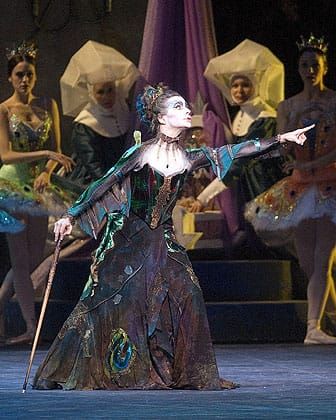
Carabaosse entered on cue, but apparently Tchaikovsky’s music wasn’t enough, because she came and went with additional thunder and fireworks. She was accompanied by fluorescent dung beetles, was costumed like Elsa Lancaster as the Bride of Frankenstein, and generally flounced around, literally being tossed into the air by some very active Fairy Knights. There was none of the profound simplicity of the traditional version, where Carabosse has an outraged dignity, demanding her rights, exemplifying the narrowness of blind, rigid justice.
This diminution of Carabosse’s metaphorical role made the expanded knitting ladies’ scene, where the Queen and the court beg the King to forgive and not just enforce justice — which the Kirov made so central in its reconstruction — much less potent. The fact that the acting was based on the fist to forehead, “Unhand me, you villain” school didn’t help.
The Rose Adagio was traditional (though it must have taken some control for poor Aurora not to burst out laughing at the Scottish Prince in his red wig, green rhinestones, and purple feather boa), though there was too much extra moving about by Aurora’s friends, which tended to distract from the focus. But the finger-pricking scene was not as moving as it can be, again because the stagers don’t seem to understand the power of structure. Instead of a court unified in mourning, saved by the Lilac Fairy, the new version has the Queen run to the center stage and indulge in a Lady Capulet fit of rending and chest-beating, while everyone watched, completely ignoring Aurora in the corner. According to the libretto, she was crying a river. This apparently cheesed off the Lilac Fairy, who sent the King and Queen out to the forest to die while she put everyone else to sleep, as if they were some old Eskimo couple shipped out to die on an iceberg.
After the intermission, unfortunately, the story just came apart. The hunt scene opened with the Prince and his friends bounding on, in the “Me Prince, I jump” school of choreography. This destroyed any possibility of the Prince as a restless, dissatisfied aristocrat, instinctively seeking something beyond the limitations of his court. The traditional scene shows his character so clearly in just a few potent gestures — the Countess tries to get him to play blind man’s buff as he stands sadly to one side, he somewhat abruptly rebuffs her, and then, as befits a true gentleman, apologizes, but still cannot take part in the frivolity. Here, after some frisky jumping, he was perfectly happy to wear a blindfold and play games. (Though considering the bright and tacky red costumes everyone wore, a blindfold did make sense.)
Every so often, a picture of Aurora’s castle appeared in the background of the hunt scene, like some sort of a pop up ad. This apparently made the Prince send everyone off, so he could sleep in some dry ice while the famous entr’acte music played. The implications of the Prince dreaming of the Fairy Knights appearing and hoisting him around, while Aurora is dragged on and off are probably best left unexplored.
Then, in a jarring musical transition, the scene shifts back to the bright hunting music, and the hunting party returned, only to be sent off again. The Lilac Fairy’s attendants then appeared and danced around, and finally Lilac herself showed up, and we saw some of the mime scene where she asks the Prince why he is sad. For some reason, she never showed him a vision of Aurora, and the yearning, triumphant music where he begs the Lilac Fairy to take him to see her is wasted in some vague gesturing. He did get to see yet another pop up version of Aurora’s castle. It may be that this touch is designed to appeal to New Yorkers, where a glimpse of choice real estate is certainly far more spiritually enticing than any pretty face, but presumably the Prince has his own 18th century palace, and an old medieval castle shouldn’t be that exciting.
But off he went, led by the Lilac Fairy. This led to some complicated stage business, in which the Prince was captured by Carabosse and tied up in a large spider web, where he was released by the appearance of the Lilac Fairy, who waved her wand and watched Carabosse float away. Then the Prince ran up to kiss Aurora. Presumably this was to bring some drama to the proceedings, but it really takes away much of the power of the wonderful metaphor of love triumphing over danger — since Carabosse has already vanished, it wouldn’t matter if the Prince found Aurora or not.
The last act is quite truncated; only Lilac, to the Gold Fairy music, the Bluebirds, and the grand pas de deux are left dancing. This is too bad for several reasons; most of the lovely jewel music and beautiful choreography are gone, along with the ability to give some of ABT’s wonderful dancers a chance to shine and the shape of Petipa’s last act, with it contrast between character and classical dancing, building to the majestic climax of the apotheosis. Unfortunately, this climax seems to have been directed by Disney, since the Lilac Fairy was harnessed like Tinkerbell, dog paddling desperately in the air high above the stage.
The costumes, designed by Willa Kim, range from gorgeous (Aurora’s Rose Adagio costume and the lovely tutus her friends wore), to the acceptable (the various multicolored fairy costumes), to the pretty awful (most everything else). The mustard yellow/turquoise combination of the peasants’ costumes was unfortunate, but the worst costume award went to the courtiers in the last act. For some reason, the women’ skirts came only to the knees, so the white tights combined with the fantastically beribboned panniers made the mazurka look like a mushroom convention in Las Vegas.
In the middle of this, there was some very fine dancing. Veronica Part certainly overcame her reported problems in the Gala, and gave a secure, if sometimes careful, performance. She is not a natural Aurora, since quick, tight footwork is difficult for someone of her height and she did fudge a bit on some of the pointework. It was a shame that she could not dance the Royal Ballet version of Aurora’s vision scene, with its lovely and musical reverse développés; the jumpy, jerky version performed wasn’t very magical.
Her prince, Marcelo Gomes, was simply wonderful: lush, sincere, with a beautiful line and jump. It seems a crime he had to wander around through such silliness. Michele Wiles’ Lilac Fairy was beautifully danced, if not quite as naturally radiant as some Lilacs. The various fairies, despite the sometimes jarring changes in their variations, all did well. Yuriko Kajiya, in the second variation, was irresistible. Zhong-Jing Fang danced the song bird fairy — promoted to a sort of deputy Lilac in this production — and it was good to see that lovely dancer featured. She was elegantly fluttery, but missed the serene elegance that I have only seen Yan Chan deliver in the previous version of ABT’s Beauty. Herman Cornejo and Xiomara Reyes were the Bluebirds; she was brought on in a covered cage, which seemed like an traditional touch—how fond Petipa was of unveiling women. Cornejo bounded through his role on springs, electrifying the audience, which seemed relieved to see some truly great choreography. Reyes, too, was charming as Florine, though some of the little listening gestures, which give the role character, seemed to have been replaced by some extra fussiness.
The grand pas des deux was the familiar version, and there is really no more wonderful sight than Gomes looking at a ballerina, hand on heart, and miming “you are mine”. The fish dives looked fearless, and the solos beautiful. But there wasn’t the sense of majestic fulfillment that The Sleeping Beauty can have, though this was no fault of the dancers. This production has certainly made clear that what the ballet needs is not additional choreography or a dramaturge, it needs an honest broker who will present the ballet as originally intended. With new sets, new costumes, more Petipa, and less Drama, this would be a fine Beauty. The wonderful dancers, and the audience, deserve no less.



