Balcony Blues
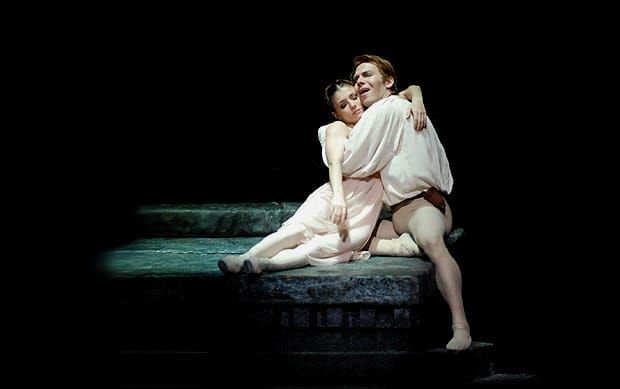
"Romeo and Juliet"
American Ballet Theatre
Metropolitan Opera House
New York, NY
June 20, 2012
Another couple got their chance to charge through "Romeo and Juliet" when the real-life couple Alina Cojocaru and Johan Kobborg (both from the Royal Ballet) danced the crowd-pleaser. MacMillan gives his lead dancers lots of opportunities to stamp their own interpretations on the roles, and Cojocaru and Kobborg have had many years to work on their characters. The ballet tends to glow whenever Juliet is on the stage, and Cojocaru made Juliet a sweet-faced, lovely child, who, however ineptly, managed to take control of her life.
Her opening scene, with that doll, was less frantic than some, and she was light-hearted and playful, with a slight awkwardness when she was introduced to Paris. This was a well-brought up girl, used to obeying her parents; if Romeo hadn't come along, she probably would have been satisfied with her parent's choice. This dutiful sweetness was reinforced in the opening of the ballroom scene, where she danced politely, and apparently quite happily, with Paris. Cojocaru's shimmering dancing was lovely as she floated through the little sideways lifts.
She was curious and intrigued when she saw Romeo, but still a child, and danced with a growing confidence and assurance, as she made sure she could have some quality time with him at the ball. The balcony scene was a bit more restrained than some, less overtly physical; again, she was still a young girl unsure exactly what was happening. This youthful innocence made the ultimate confrontation with her parents almost shocking, as she stood up to them for the first time in her life. It may be that she is used to working on the small Covent Garden stage, but the sit on the bed, get control of you life moment wasn't as effective as some I have seen. She seemed very far away and it was hard to see her face, which, at least from my seat, didn't seem to change as the music surged around her. She just got up and ran rather decoratively around the stage.
Kobborg's Romeo was in perfect tune with Cojocaru's Juliet. He was carefree and fun loving at the beginning, happy to flirt with Rosaline, but just as happy to dance with those endless harlots when she wasn't around. His buoyant, gentle jump reinforced his approach, and his dancing with his buddies before entering the Capulet's house had a beautiful, fluid quality. His Romeo was a very nice boy who was awe-struck when he first saw Juliet, almost afraid to move. His solo in the ballroom was danced softly and lyrically, which so suited his approach.
Even his reaction to Mercutio's death was muted at first, so there was an extra shock when he picked up the sword and attacked Tybalt. The death scene, as he tried to dance with Cojocaru's small, helpless body, trying to echo the shapes of happier times, was certainly tear-inducing. Cojocaru made it all the more tragic by barely making it up the bier to reach down to Romeo's body.
Romeo's friends, an elegant Jared Matthews as Benvolio, and Craig Salstein as Mercutio, with his wicked timing, were also basically as light-hearted and fun-loving as Jerome Robbins' three sailors. Their essential good nature is important, for really, they do provoke Tybalt and his gang from the very first meeting. ABT's insistence that Mercutio also perform the Mandolin dance is, I guess, a way to make him more good-natured, but I miss the original version, where he was closer to the worldly cynic of Shakespeare--Salstein could be nothing more than the class clown. Gennado Saveliev, as always, was a very fine Tybalt, elegant and sneering, with a hair-trigger tied to his honor. In an attempt, I suppose, to gin up interest in the second act, Tybalt and Lady Capulet (Kristi Boone) cast a few cow eyes at each other, and she went stark raving loony at his death. Indeed, the second act with the endless dancing and fighting and sweeping (the streets of Verona must have been the cleanest in Italy) makes me believe that the most wonderful word a choreographer could utter would be "cut", but the ballet comes alive when dancers have their characters as well-thought out and cohesive as did Cojocaru and Kobborg.
copyright 2012 by Mary Cargill



