Balanchine’s “Dream”
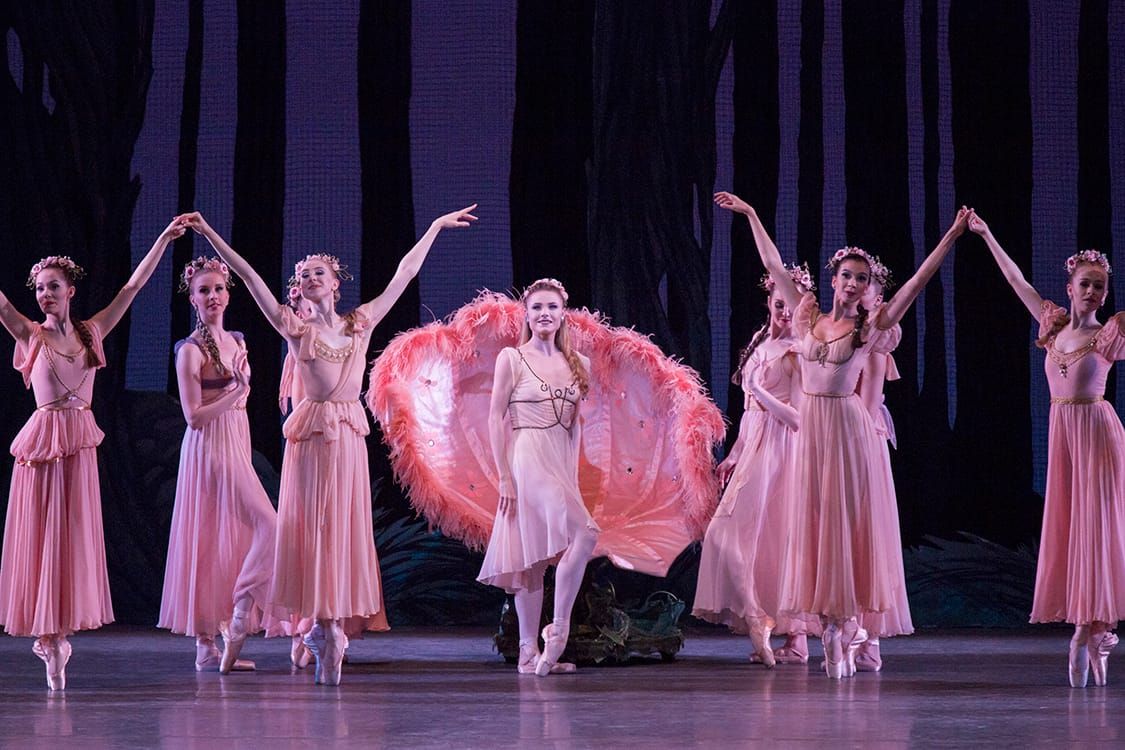
“A Midsummer Night’s Dream”
New York City Ballet
Lincoln Center, New York
May 29, 2019
George Balan-chine’s “A Midsummer Night’s Dream” is a perfect antidote for our troubled times. Shakespeare’s play may include tensions and quarrels, but by the end, harmony is achieved and love triumphs. In Balanchine’s hands Shakespeare’s narrative is given an added abundance of humor and beauty. For a few hours, at least, we can enter an enchanted world where every wrong is righted.
Wednesday evening’s New York City Ballet performance was aided by an excellent cast. As Oberon, Anthony Huxley was a last minute replacement for Gonzalo Garcia, although he is not new to the role. In fact, he danced it several times this past week with a different cast. Huxley is not an extroverted dancer and so can seem uncomfortable in acting roles. There is always something enigmatic about him, as if he holds a secret he is not eager to divulge. But what in other instances could be a liability, became an asset here. His Oberon was cool, even dispassionate, but there was an assumption of power in his reserve that gave added nuance to the role. It was shown in his small smile as he commanded the mischief he would make for Titania, and his sure but measured pleasure at setting things right. Puck may have been making drastic mistakes, but his master knew what he was doing, and in the end he got just what he wanted. As for dancing, Huxley’s major solo consists of a virtuosic display of varied beats, and he performed it with a pristine elegance that reinforced his characterization.
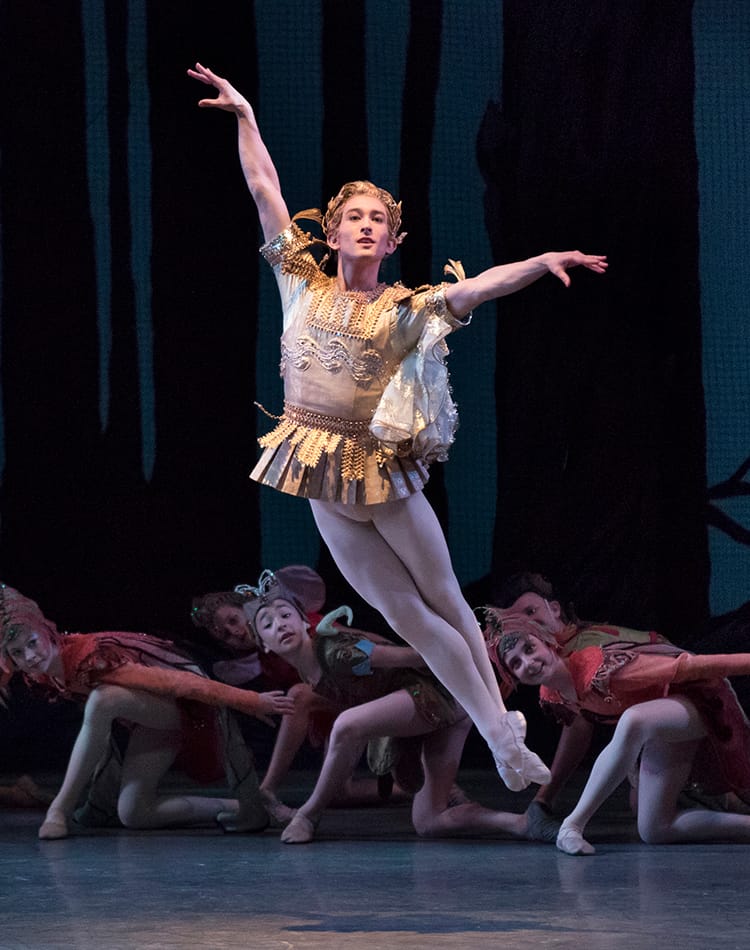
This may have been Huxley’s first pairing with Sara Mearns, who danced the role of Titania. Traditionally in this ballet, the role of Oberon is played by a shorter man and Titania by a taller woman, so Huxley and Mearns are ordinarily unlikely partners. Here they proved interesting adversaries with Mearns’ exuberant personality contrasting with Huxley’s quiet but authoritative presence. The couple’s interaction is limited to mime, and it was amusing to see Oberon’s sang froid dissolve into irritation as Titania refused his request for the changling boy. Oberon indicates his request by physically picking up the child and moving him from Titania’s side to his own, something he is forced to do several times as she continues to refuse his demand. How clever of Balanchine to use such a simple, repeated action to signify the couple’s argument. But then the ballet is full of such imaginative moments. For example, can there be anything more charming than the small butterflies and fairies (children from the School of American Ballet), who pile together unceremoniously to be lulled to sleep by Mendelsohn’s lullaby? It is one of many small elements that lend the ballet its magic.
Mearns was in her element in the duet with her Cavalier (Russell Janzen), imparting a luxuriousness all her own to the high extensions that are at the heart of the dance. She also showed a refined sense of humor in her encounter with Bottom (Peter Walker), whom Puck has turned into a donkey. Due to the potion Oberon has given her, Titania is besotted with this four-footed lover and attempts to beguile him with handfuls of grass. The scene could be played for laughs, but Mearns and Walker exaggerated nothing, which made it touching while preserving all its absurdity.
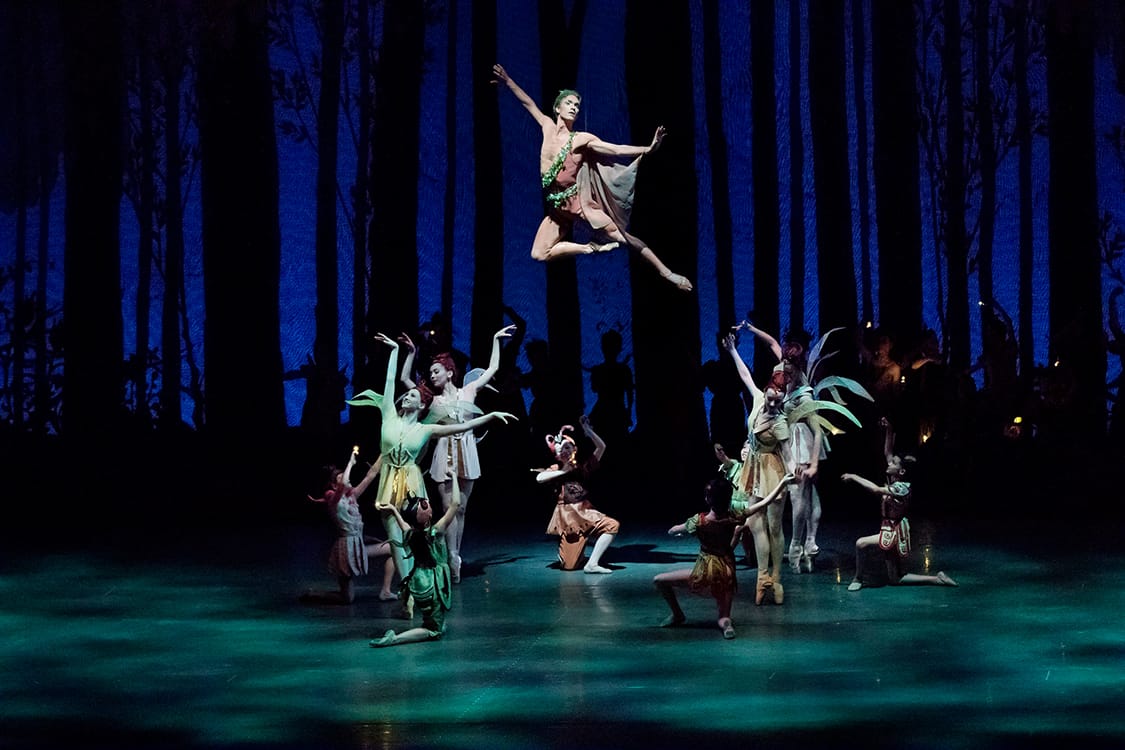
Harrison Ball’s Puck was increasingly frustrated, as he rushed about causing havoc where he was meant to solve problems. His dancing, in keeping with the character, was bright and clear. The two human couples, so at odds until Puck finally gets his instructions right and manages to straighten them out, were danced with wit by Erica Pereira and Lars Nelson, Lauren King and Daniel Applebaum. A surprise was Georgina Pazcoguin’s Hippolyta, Queen of the Amazons. We are so used to seeing her in character roles, there is a tendency to forget how strong a classical dancer she is. She whipped through her role’s multiple turns and leaps, making them look as easy as taking a walk across Lincoln Center plaza.
Act II of the ballet centers on the wedding of the couples, as well as of Theseus (Silas Farley) and Hippolyta. But the highlight in this act is a duet in the accompanying divertissement, here danced by Sterling Hyltin and Amar Ramasar. It’s going to take a while to forget Ramasar’s recent firing and subsequent reinstatement, but there is no denying he is a major talent and, as such, an asset to New York City Ballet. In contrast to the Oberon/Titania couple, this duet is usually performed by a small woman and a tall man. Hyltin’s delicacy and precision were heightened by Ramasar’s more open dynamism, and the dance, with its swooning romanticism, was quite beautiful. The weddings, though, are not the culmination of the ballet. In a final scene, Puck, surrounded by the denizens of the fairy kingdom, and with fairy lights dancing in the darkened forest behind him, rises into the heavens. It’s a final enchanting element to the ballet.
A word should be added about David Hays’ sets and Karinska’s costumes, which add immeasurably to the production’s sense of enchantment. And attention must be paid, too, to conductor Daniel Capps and the New York City Ballet Orchestra, as well as to the chorus of Musica Sacra, Kent Tritle, music director, who delivered Mendelssohn’s music with magic of their own.
copyright© 2019 by Gay Morris



