Balanchine Finally
"Square Dance," "La Valse," Cortège Hongrois"
New York City Ballet
David Koch Theater
New York, New York
October 5, 2017
After two weeks of Peter Martins' "Swan Lake", a gala showcase for another clutch of novelties in thrall to Fashion Week and a program of Wheeldon, Ratmansky and Justin Peck, the three choreographers who have revivified the New York City Ballet in this century, the company finally returned to its foundations with this mixed bill, back to bedrock, back to Balanchine. If the evening was not transcendent, there was still much to see, much to savor, to contemplate along the way.
At its premiere in 1957, "Square Dance" was something of a novelty, combining as it did, Vivaldi, Corelli, square dancing and classical ballet, with caller Elisha Keeler and the string orchestra on stage, in a vehicle for an indefatigable allegro dancer ("Square Dances" has one of the shortest adagios in the Balanchine canon) and her bandanna-sporting cavalier, Patricia Wilde and Nicholas Magallanes. Revived in 1976, Balanchine redressed the balance somewhat by adding a grave, inward gazing solo for the lead male. Nonetheless, "Square Dance" is still a vehicle for speed polished to diamond sharpness, lacerating when pushed too far. So it was fascinating to see Anthony Huxley and Megan Fairchild dance the ballet with a softer edge, a pearlescent glow. There seemed to be more time to see and to examine what one saw. When Fairchild dipped into a step which combined the posture of a seated lute player tuning her instrument with the stacked rectangular volumes and angled lines of legs torso and head, there was time enunciate, rather than just sense, the presence of a Renaissance figure in a Cubist construction. Only twice did one wish for a little more juice to electrify the glow. A couple of stag jumps which should soar parallel to the stage stayed close to the ground, the legs barely off the vertical axis. Similarly, a series of jetés across the stage which, egged on by the music, should bound like a flick knife opening and closing, had no snap at all. But that was overall a small price to pay to see Megan Fairchild more serene, more relaxed, more open, with more faith in herself than ever before. The company's eternal soubrette has grown up.
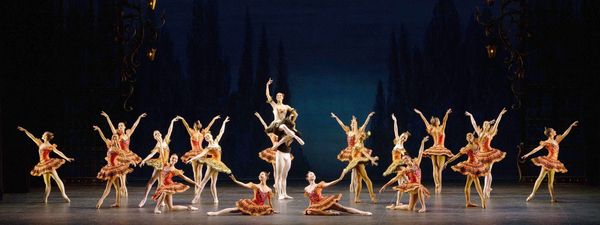
"Cortège Hongrois" is Balanchine's fourth ballet to the music of Glazunov's "Raymonda", and probably his least successful. Made as a farewell present for Melissa Hayden in 1973, its success has always depended on at least two of its leading performers; the ensemble sections have rarely registered with any force.
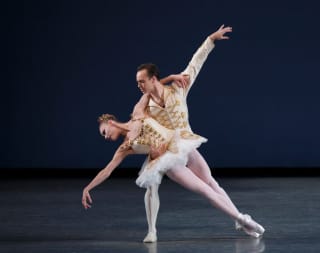
Here, all four leads put it over: Georgina Pazcoguin and Ask la Cour leading the czardas and Sara Mearns and Tyler Angle, the ballerina and her cavalier. Like "Square Dance", "Cortège Hongrois" combines ballet and folk rhythms and steps. Unlike the egalitarian "Square Dance" however, everyone in "Cortège" has an imperial pedigree, whether Russian or Austro-Hungarian. Until the finale, Pazcoguin looked as haughty and unsmiling, as sure of her terrain as any queen. Ask la Cour is tall enough and imposing enough to stake his claim simply by appearing on stage. Both are at ease with character dancing and dancing in character and both are professional enough not to be thrown by the very evident difference in height between them. Tyler Angle is known, rightly, as a splendid partner throughout the repertory. More surprising here was his ease with the pure unforgiving classical steps of his variations, not perhaps executed at the largest scale, but clearly, cleanly, without strain, and most importantly, musically.
One of the pleasures of watching Sara Mearns is wondering what she's going to do next; on stage she lives in the moment and seems to take every risk in the book.Not here, or at least not obviously, as befits a role steeped in Petipa. This was a gracious, generous, happy monarch, secure in her effects (the passés of her solo, utterly controlled, flowed like cream). Mearns was beaming during the curtain calls, and in spite of a costume whose bodice did everything but flatter her rib cage and whose skirt hung down over her thighs, shortening her legs. On the plus side, the czardas corps is now costumed in pale gold rather than cool white which warms and unifies the stage picture.
One of the great draws of "La Valse" has always been its costumes, among the most beautiful at City Ballet, the corps women in skirts of lavender or magenta to red orange, overlaid with black tulle with gray bodices and jewels ringing their necks. Everything, even the chandelier, is veiled in black. It's the perfect meeting place for a febrile melting pot of love, death, youth and vanity; Romanitic ballet and the New Look of the 1950's. But nothing happened. Of the three leads, only Justin Pecak as Death opale and hollow-eyed, registered, grabbing the girl in white (Sterling Hyltin) for her final dance as though avid for blood. One wondered if he had fangs. But otherwise, this performance was singularly bloodless. The air wasn't rancid. And the final churning circling of the corps, like a mill wheel pulverizing youth and innocence, hardly registered. Sometimes, restraint is not its own reward.
copyright © 2017 by Carol Pardo