Balanchine and Stravinsky at New York City Ballet
“Dances Concertantes,” “Monumentum pro Gesualdo,”
“Movements for Piano and Orchestra,” “Stravinsky Violin Concerto”
New York City Ballet
David Koch Theater
New York, New York
January 21, 2020
In his opening remarks for the 1972 Stravinsky Festival, George Balanchine commented that Stravinsky, like Delibes and Tchaikovsky, “made music for the body to dance to.” A steady pulse and strict adherence to time made Stravinsky a consummate dance composer, providing, as Balanchine said, “a floor for the dancer to walk on.” But that was just the beginning. Throughout his choreographic career, Balanchine found seemingly inexhaustible sources for invention in Stravinsky’s diverse works.
Four of Balanchine’s Stravinsky ballets made up the opening concert of New York City Ballet’s winter season Tuesday evening. All were choreographed in the 1960s and ‘70s. They demonstrated how Balanchine, who created his first Stravinsky ballet in 1928, continued to respond to Stravinsky’s music many years later. In fact, the variety of those responses was one of the most notable aspects of Tuesday’s performance. All the ballets on the program were plotless, and all but one was danced in practice clothes (so-called “black and white” ballets), yet each was markedly different.
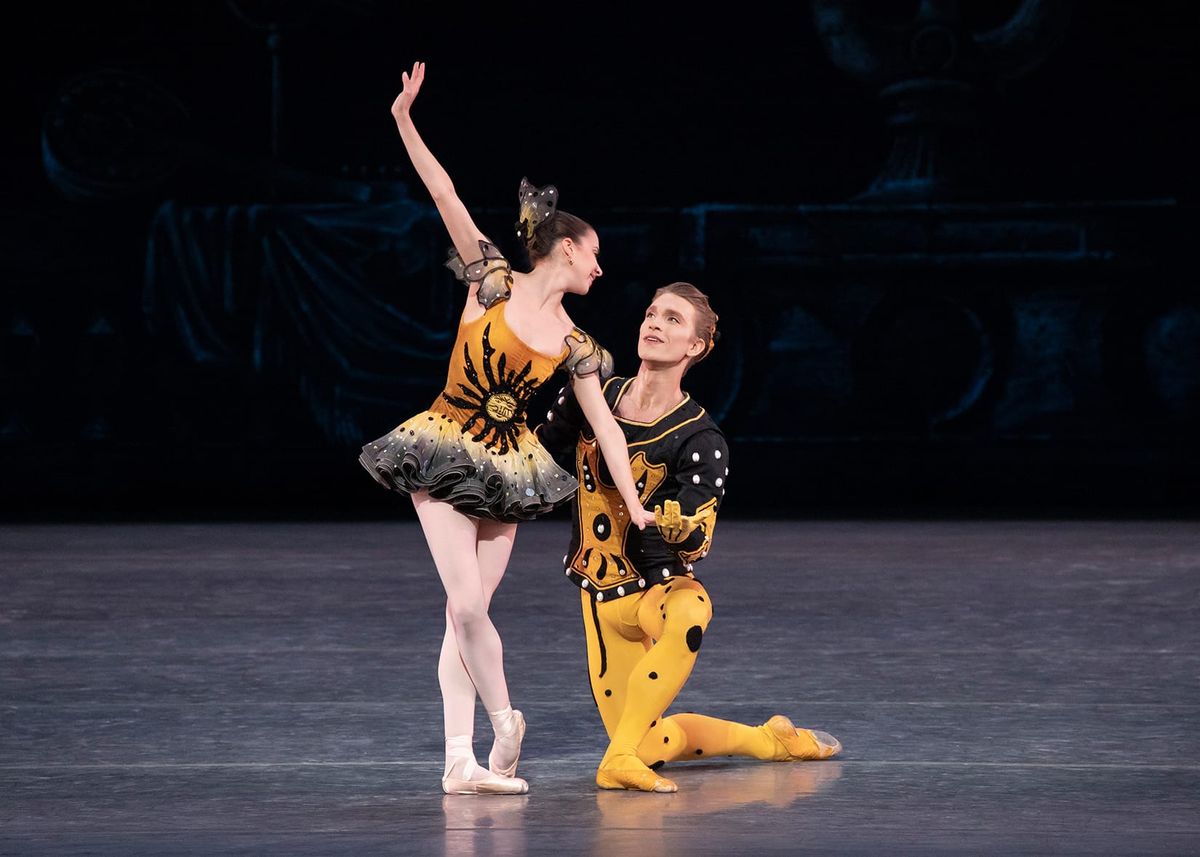
“Dances Concertantes,” the only work involving a set and costumes, was composed by Stravinsky in 1941 and was originally choreographed by Balanchine in 1944 for the Ballet Russe de Monte Carlo. Balanchine rechoreographed the ballet for the Stravinsky Festival, which NYCB created to honor Stravinsky the year after the composer’s death in 1971. The work begins with dances for four trios consisting of a man and two women. The first group is dressed in fabulous costumes of bright green, followed by blue, rose, and red. There is a central duet for a couple in yellow, in this case for Erica Pereira and Harrison Ball, and a finale to wrap it all up. Balanchine decided to use Eugene Berman’s original designs, which was an extremely good idea. It would be sad to think that these designs, so redolent of 1940s surrealist inflected style, were lost forever. Berman countered his brilliantly hued costumes with a gray, monochromatic set, which suggested that the audience is in a theater (a proscenium with opera house boxes on each side of the stage are depicted) and watching a performance in it. The whole ballet has an insouciance that recalls commedia dell’arte. Pereira, with her joyous smile, and Ball, with a touch of mischief about him, reinforced the work’s sense of witty playfulness. The choreography throughout is piquant, with a number of little jazzy movements and gestures, typical of Balanchine, coupled with more unusual steps like a deep plié, held for what seems hours, performed at several points by different male dancers.
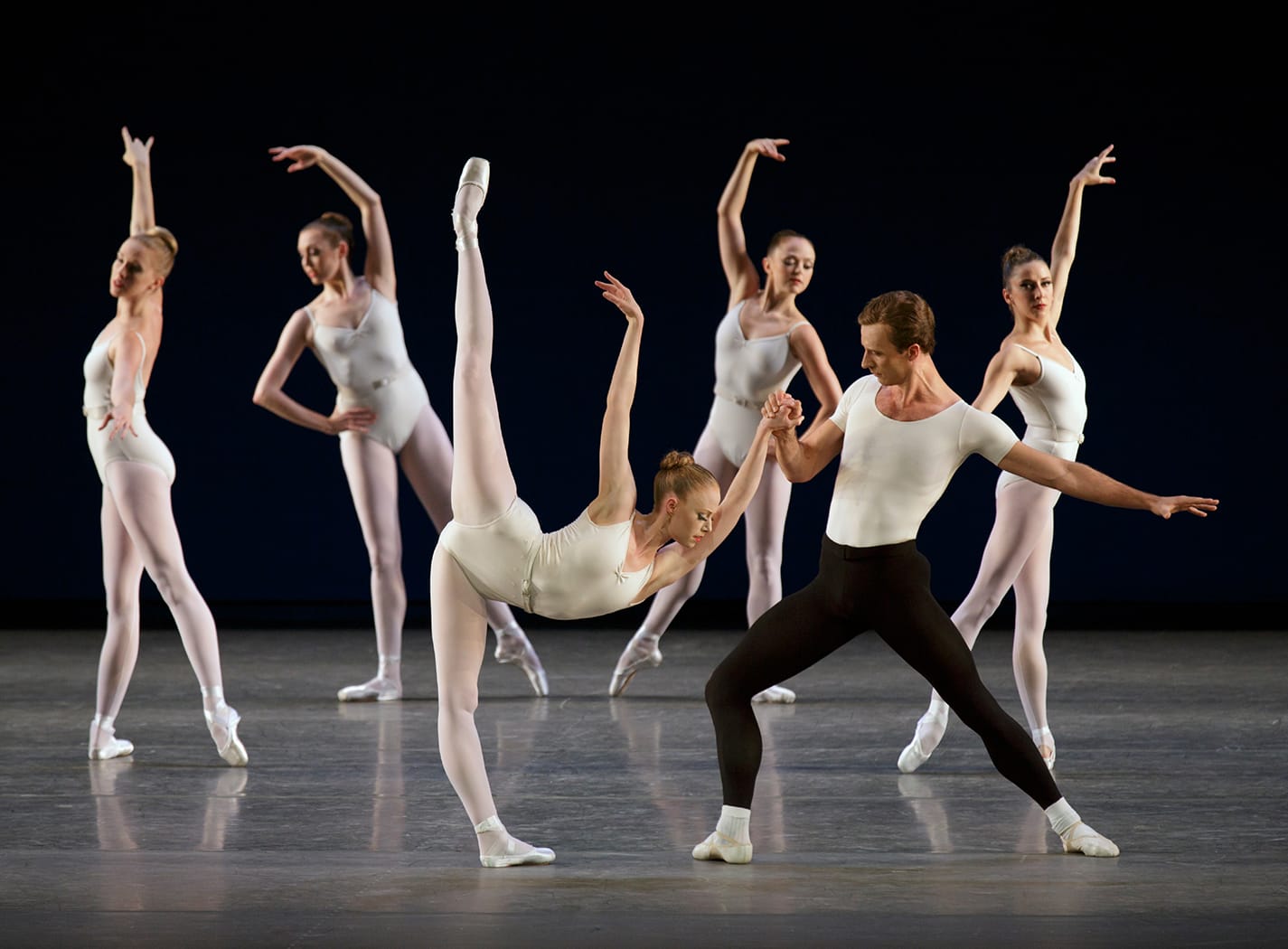
“Monumentum pro Gesualdo” and “Movements for Piano and Orchestra” are now usually performed together, although the former was choreographed in 1960, the latter in 1963. Teresa Reichlen and Ask la Cour were featured in both, backed in each instance by a corps de ballet. “Monumentum pro Gesualdo” was Stravinsky’s bow to the sixteenth century composer Don Carlo Gesualdo, and as might be expected, includes musical references to the Baroque. “Movements for Piano and Orchestra,” on the other hand, is a composition in mid-twentieth century, astringent, serial form. Both ballets are divided into sections, with the dancers walking in silence between each and reforming into new configurations to begin the next section. However, in all other elements, the two works are markedly different.
In “Monumentum” the arrangements of dancers are linear and formal, the movement itself rounded and curled, while in “Movements” the groupings are freer and the movement tends to be hard, spiked and percussive, with each step delivered like a knife thrust. Reichlen and la Cour, both tall dancers, brought great intelligence to the works. In “Monumentum” they showed a respectful tenderness toward each other, while in “Movements” la Cour stressed instances in which he crouched near the woman, like a predator, while Reichlen coldly showed her power by ignoring him.
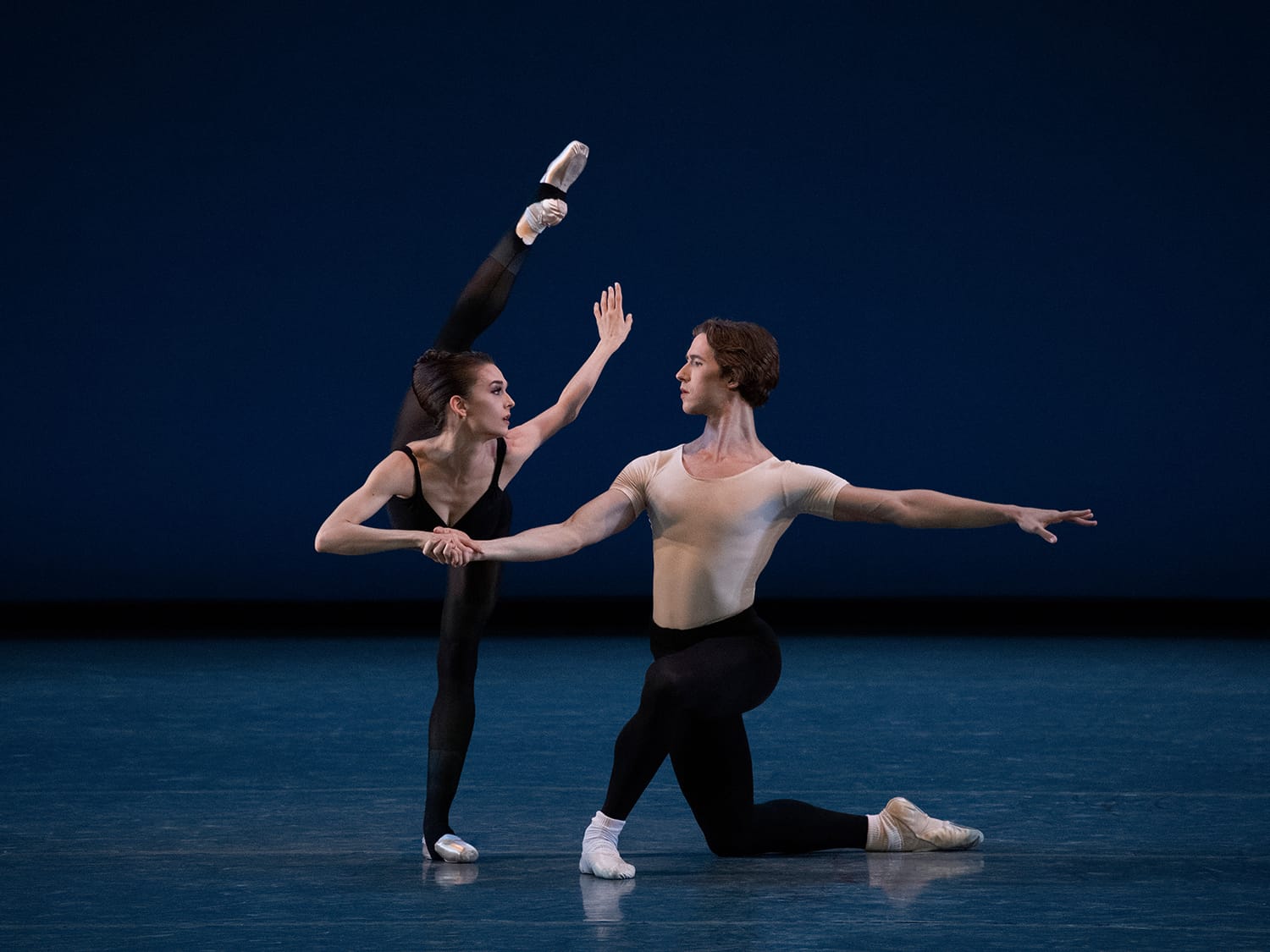
“Stravinsky Violin Concerto” is set for two couples: here Lauren Lovette partnered with Joseph Gordon, and Sara Mearns with Adrian Danchig-Waring. The opening section consists of four dances in which each of the two leading women dance with four men, while the two leading men dance with four women. The arrangement is then reversed (women dancing with women, men with men) to make another four dances. These are followed by duets for each of the couples, before a finale for the company. The first duet was danced by Mearns and Danchig-Waring like a friendly rivalry — who would be in charge? — with equality seeming to reign, until the end, when the man drops to the stage in defeat. The second duet is often performed by older dancers with the woman seeking independence but finding herself dependent on the man. The dance became a bit different with Lovette and Gordon, both of whom look young and rather innocent. They both appeared vulnerable, as if setting out on a journey full of the unknown for both of them. At the end of the dance, when the man holds the woman and gestures into the distance, as if to show her the future, it is most often a gesture that implies he knows the way. Here neither seemed sure of what the future might hold.
The finale of the work shifts mood, becoming a light-hearted romp, with everyone having fun. Lovette, with her gamine features and cheerful personality, looked totally at home in this segment. Gordon has grown in artistry over the last several years, and is technically impeccable, but so far, he doesn’t do fun. He inevitably looks serious and introspective. Perhaps a lighter heart will come with more experience and confidence. For now, seriousness of purpose and pristine execution will have to suffice.
copyright© 2020 by Gay Morris



