Back to Basics
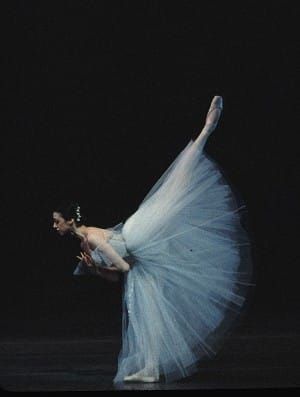
"Giselle"
American Ballet Theatre
Metropolitan Opera House
New York, NY
June 8, 2009
ABT's "Giselle" is their most traditional classical production; some might say "old-fashioned" but I say "timeless". There are no extraneous interpretive layers between the simple, tragic story and the audience, no unnecessary updating or exposition--fortunately it hasn't seemed necessary to explain exactly how Albrecht met Giselle or why Myrta really hates men. The opening night Giselle was Nina Ananiashvili, in one of her final performances. She is physically not a typical, wispy Giselle, but her commitment, imagination, and artistry triumphed. Yes, she has jumped higher in the past, and held positions longer, but art is about illusion, and the audience was there to cheer a performance, not measure an athlete. Her Giselle was gentle, loving, and lived only for her Albrecht. Even the showy hops on point, which generally are interrupted by applause, were danced with such effortless conviction that the audience stayed silent. Marcelo Gomes, her handsome Albrecht, used his natural generosity to portray a somewhat shallow but genuinely loving hero. Albrecht is, I think, the most interesting of the classical male roles, because it is open to so many different interpretations. Gomes wasn't a heartless flirt, just somewhat thoughtless. He could laugh gently at Giselle's superstitious conviction that the daisy would tell the truth about him, and made it clear that to him the story of the wilis and Giselle's fear was ridiculous. (That made his terror at finally seeing Myrta so much more real.)
The first act had other fine touches, though I missed Albrecht's sword at the beginning, when he makes it clear that he is really an aristocrat. Gennadi Saveliev was a rough hewn, brusque but sympathetic Hilarion who clearly thought that once Giselle knew the truth she would return to him. Bathilde, the warm and gracious Maria Bystrova, has toned down some of her more snooty mannerisms, and she no longer flicks Giselle away when she tried to thank her for the necklace. She also didn't just flounce out when she discovered Albrecht's treachery, but made it clear that her heart was broken too, and turned to the Prince of Courland for comfort.
The second act was dominated by Gillian Murphy's Myrta. Her opening bourees seemed to be danced on ball bearings, and her arms released thunderbolts. The contrast between her and the more reluctant Moyna and Zulma (Isalbella Boylston and Yuriko Kajiya) made her power all the more compelling. Ananiashvili and Gomes made their first pas de deux a dance between a man and some mist--it was so clear that he could only sense her and see the flowers that she could give him, and that the first time he actually saw her was when he was captured by the wilis; Gomes'combination of terror at the thought of Myrta and joy at the sight of Giselle was masterful. Murphy and Ananiashvili also made it clear that Myrta was commanding her to dance to draw Albrecht away from the safety of the cross, so the slow sadness of Ananiashvili was expressive as well as beautiful. Her more physical presence also worked, since she was the only wili with human emotions. Her dancing flowed gently, and she really did dance for Albrecht, rather than, as some do, waft from lithograph to lithograph. The cheering, standing audience did its best to thank her and her fellow dancers for a haunting and beautiful performance.
copyright © 2009 by Mary Cargill