Back in Business
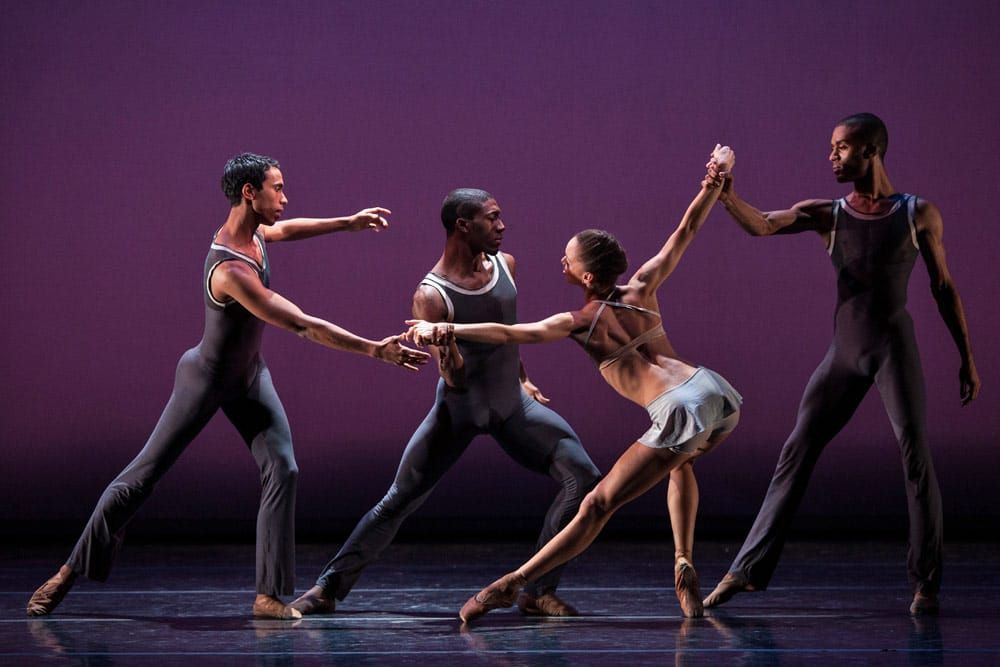
"Agon", "Black Swan Pas de Deux", "Far But Close", "Return"
Dance Theatre of Harlem
Rose Theater, Jazz at Lincoln Center
New York, New York
April 11, 2013
The Dance Theatre of Harlem hare returned to New York, after a nearly nine-year hiatus due to budget problems. Virginia Johnson, one of the original dancers, now leads the company and she has assembled an engaging group of 18 dancers. The larger works that the old company could perform (I especially remember their "Giselle" and Nijinska's magestic "Les Noces") are out of bounds now, but the New York repertoire was an ecclectic mix of old and new. The program opened with Balanchine's "Agon", an especially apt choice because DTH's founder, Arthur Mitchell, was in the original cast.
The DTH budget, unfortunately, doesn't allow for an orchestra, so "Agon" was danced to a recording, not identified in the program. A recording, with its set rhythms, tends to flatten performances, since there is no room for subtle changes, but it looked well-rehearsed and the shapes were clear. (It was set by Richard Tanner.) Samuel Wilson in the Sarabande had a fine, off-center approach, linking the movements to "The Four Temperament's" Phlegmatic--they were both done for Todd Bolender. Ashley Murphy sailed through the difficult balances of the Bransle Double, but she seemed a little too aware of the audience, not completely losing herself in the movement. The famous pas de deux, danced by Gabrielle Salvatto and Fredrick Davis, was also a bit too audience-directed, but Salvatto's long, elegant legs and Davis's dignified reticence were very effective. The dancers moved with an urgency and sweep, which, while not always neat, was lively and appealing.
The Black Swan pas de deux was also danced to a recording, a brash and loud one, which jogged along at a healthy clip. Chrystyn Fentroy and Da'von Doane weren't just jogging through it, though, they had a clear idea of the story. Fentroy, a fresh, young Odile, was having fun flirting with Siegfried, and he was beaming at the thought of finding his true love. The dancing was exhuberant and wildly applauded, though not always classically precise. Fentroy's fouettes were enlivened by occassional doubles with her arms outstretched; yes, it would probably have been more elegant to have toned down the flash and worked on placement (she ended up at the edge of the stage), but the Black Swan is about a go-for-broke attitude as well as technical niceties, and given the choice, attitude deserves to win.
All ballet companies are struggling to find new choreography, and the second half of the evening offered two new works, neither, unfortunately, very substantial. "Far But Close", John Alleyne's 2012 work, had live music (by Daniel Bernard Roumain, who played on the stage) and live narration, a poem by Daniel Beaty recited by Mr. Beaty and Nicole Lewis. The poem was an investigation of urban angst, a somewhat turgidly sentimental patter about a meeting on a subway, a girl who can't commit, and a guy who is sensitive at heart. There were two couples (Ashley Murphy with Da'von Doane and Stephanie Rae Williams with Jehbreal Jackson), meandering through some indistinct choreography. The dancers, though, gave it a heart-felt innocence, and despite its cliches, it had some moving moments. Murphy's impuslive lyricism and Jackson's loose-limbed rhythms were especially impressive.
Robert Garland's 1999 "Return" was a full-blooded crowd pleaser to recordings of songs by James Brown and Aretha Franklin. It was a mixture of boogying and point work, as the women strutted and wiggled while showing off their elegantly long lines, and the men bounded through what looked at times like a pop "Etudes". It left the audience deleriously happy, but it seemed a bit hollow to me--those dancers deserved more meat.
copyright © 2013 by Mary Cargill



