Angels on High
"Diversion of Angels", "Three Dubious Memories", "Spindrift"
Paul Taylor’s American Modern Dance
New York, New York
March 23, 2016
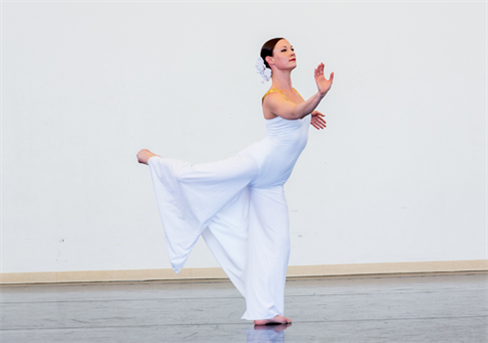
Paul Taylor's recent decision to sprinkle other choreo- graphers' works into his company has rewarded the audience with Martha Graham's 1948 "Diversion of Angels". Graham's exploration of love looked fine on the Taylor dancers –they do share a heritage. Laura Halzack and Michael Trusnovec were the more mature, serene couple. Halzack, tall and beautiful in white, projected a calm radiance and quiet resignation, though she had to fight an ultimately losing battle for that final majestic balance.
Trusnovec was at his commanding, committed best as the man torn between love and lust, combining strength with vulnerability as he seemed to be pulled apart. He can make the simplest gestures resonate, and just turning his head to the wings as Halzack disappeared evoked a world of regret, sorrow, and longing.
Parisa Khobdeh was the woman in red, whose flying leaps disturbed all the men. She danced with a fierce and wanton independence, dangerous but irresistible (in a ballet she would be spitting fouettes). I missed the shock of the contractions that Graham dancers give the series of stretched balances, like an inner snake licking her chops, but Khobdeh gave a powerful performance.
The couple in yellow, Eran Bugge and Michael Novak, provided a bit of relief and they sparkled through the skittering steps. The lifts were particularly effective, as Bugge seemed to float effortlessly up onto Novak's waiting shoulders, a physical metaphor for love and trust.
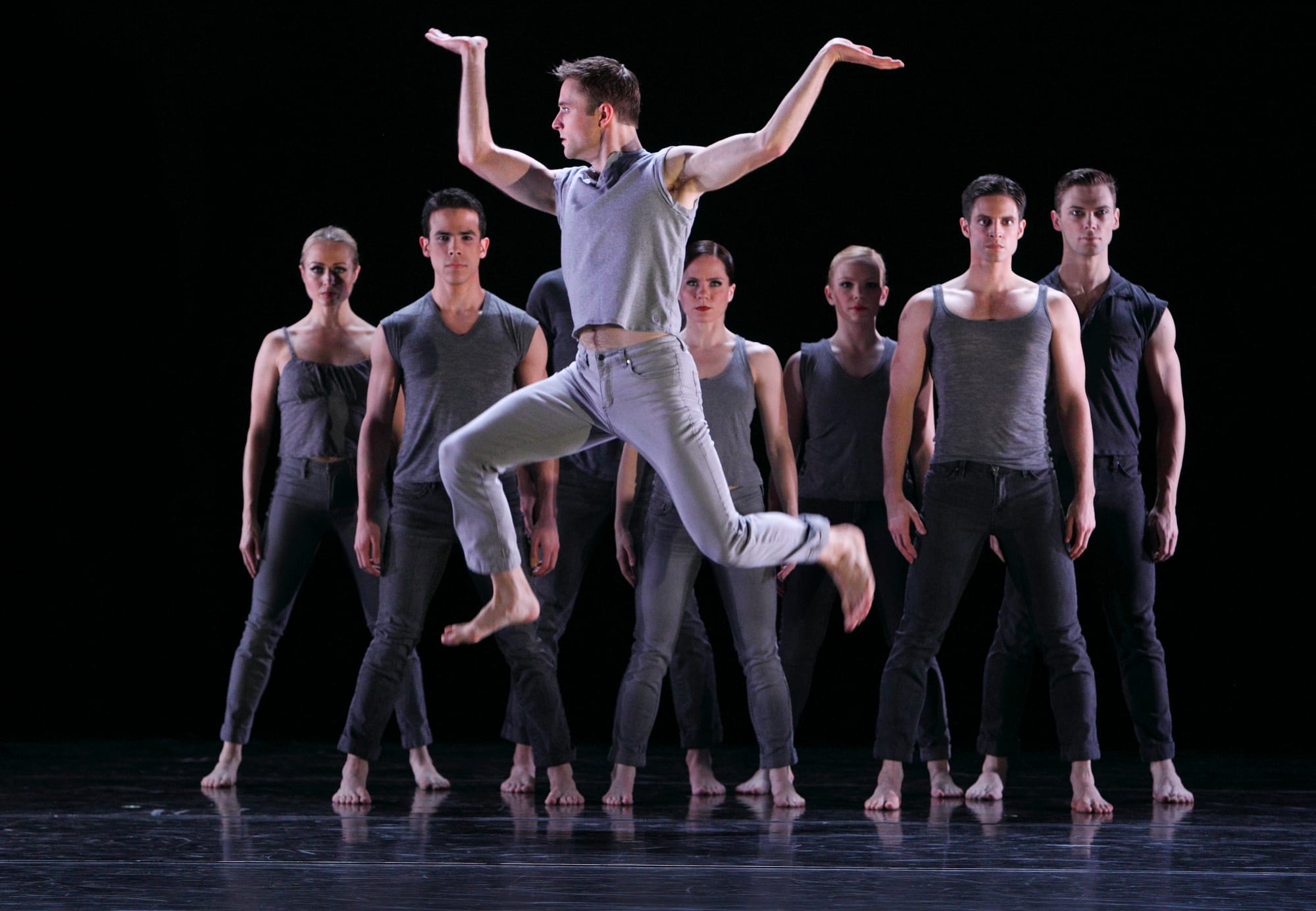
"Three Dubious Memories", Taylor's 2010 meditation on the Rashomon theme, seemed to be a look back, too, on typical Taylor moves, and was a well-crafted but somewhat uneasy mixture of dark and light. The opening was striking, with James Samson in grey jeans illuminated in a spotlight. He was identified as the Choirmaster, though he moved like a slightly grubby angelic guide.
The three memories (Eran Bugge in red, Robert Kleinendorst in green, and Sean Mahoney in blue) acted out the various scenarios; first Bugge and Kleinendorst had an idyllic rendezvous, broken up by Mahoney, then the men switched roles; this all involved a fair amount of stylized violence and what appeared to be a rape. The final memory, the most potent, had Kleinendorst and Mahoney as buddies in one of Taylor's male bonding jigs (musical and exhilarating), broken up by Bugge with some cartoon slugs, played for laughs. The mixture of violence and yucks didn't work, and no memory could play those kind of tricks.
The finale, however, as the three seemed to ascend into a grey-scale heaven presided over by the Choirmaster with eight little choristers threading through an eerie gloom showed remarkable patterns.
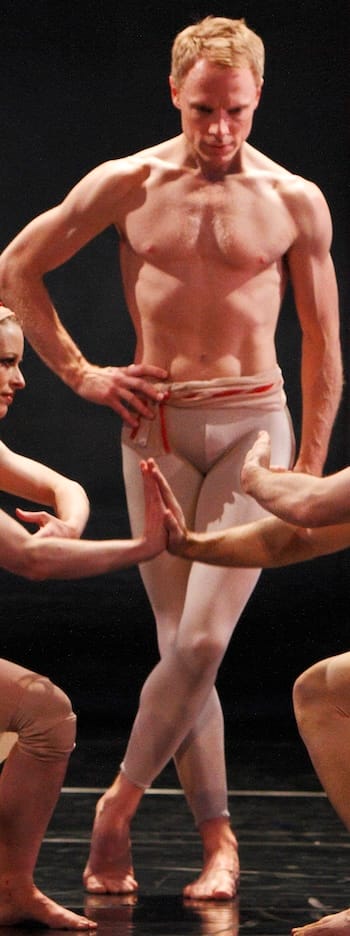
"Spindrift", Taylor's 1993 work to Arnold Schoenberg's "String Quartet Concerto" (based on a theme by Handel), as also set in a mist, with hints of a sea shore in the projections. (Spindrift is the spray from the crest of waves.) Trusnovec was a lone figure surrounded by a group of dancers in vaguely classical tunics, all initially facing outwards; this simple arrangement seemed to isolate him. The group broke into a cheerful dance, with occasional odd quirks; they looked like nymphs and shepherds who had discovered a cache of champagne and the slightly fractured Baroque moves looked like, well, Handel filtered through Schoenberg.
Trusnovec had a gentle, meditative solo which looked like a riff on Taylor's well-known Aureole solo (set to Handel), as he struck the familiar wide-armed, off-balance pose only to crumple up and crawl away. He did find a buddy in Kleinendorst, and they bonded over joyful jumps, though Trusnovec does end up alone, reaching outwards, an elegiac but not tragic ending, as he remained on the happy shore.
Copyright © 2016 by Mary Cargill



