Anchored Range, Off-Center
“Confetti,” “Valentine,” “Sea Shadow,” “Light Rain”
Arpino Dance Festival, Program 2
The Joyce Theater
New York, NY
October 7, 2025
If there was one overarching theme of the Arpino Dance Festival, particularly in the second program, it was the choreographer’s unapologetic commitment to experimentation and entertainment. That such a vision could materialize on the Joyce's intimate stage, and given the participating dancers' complex schedules and the festival's logistical demands, is a testament to Arpino Foundation’s leadership’s curatorial skill. The programming choices honored Gerald Arpino’s range while revealing the thread that connects his works: an irrepressible love of movement rooted in classical and modern ballet but always reaching for something more exuberant, more immediate and ultimately more alive.
The second program opened as the first had – with the dazzling “Confetti.” The ballet does not reveal more of itself on repeat viewing, remaining largely just an exciting curtain-raiser. As such it fared well enough, even if this night’s casting of dancers from Artistic Ventures in Dance, and their height differences, created some odd partnering moments during the couples’ partner swaps.
But where “Confetti” served as the appetizer, “Valentine” was the first of the main dishes. When the curtain went up for the second time to present the 1971 work, the evening shifted into a higher gear. Oh, the humor of Emily Speed and Fabrice Calmels! The premise here was supposed to be the battle of the sexes, but in a lighthearted way, and their first appearance alone - exhaustedly splayed on opposing chairs in boxing robes, radiating wicked tempers (as if they had just gone twelve rounds in the ring of matrimony, but were oh so ready for more) – set the comedic tone perfectly.
The work was accompanied by live music, a wonderful luxury at the Joyce. Kebra-Seyoun Charles expertly navigated the experimental percussion passages and vocalizations on the double bass, at times joined by the dancers themselves, and in many ways the dancers’ involvement with the musician made it a trio. Leg shakes and turns echoed and continued the musical phrasing in a dance that was part modern expression, part pantomimical comedy routine. Speed was sublimely difficult: she would demand attention, then sulk when combativeness didn’t yield results. At one point Calmels turned to the musician with a “just look at her go…” gesture, pointing at his partner’s theatrical exasperations. Then, he put her in a headstand time-out, which only ended with her rolling onto his back. It all had a happy ending though, with the couple embracing.
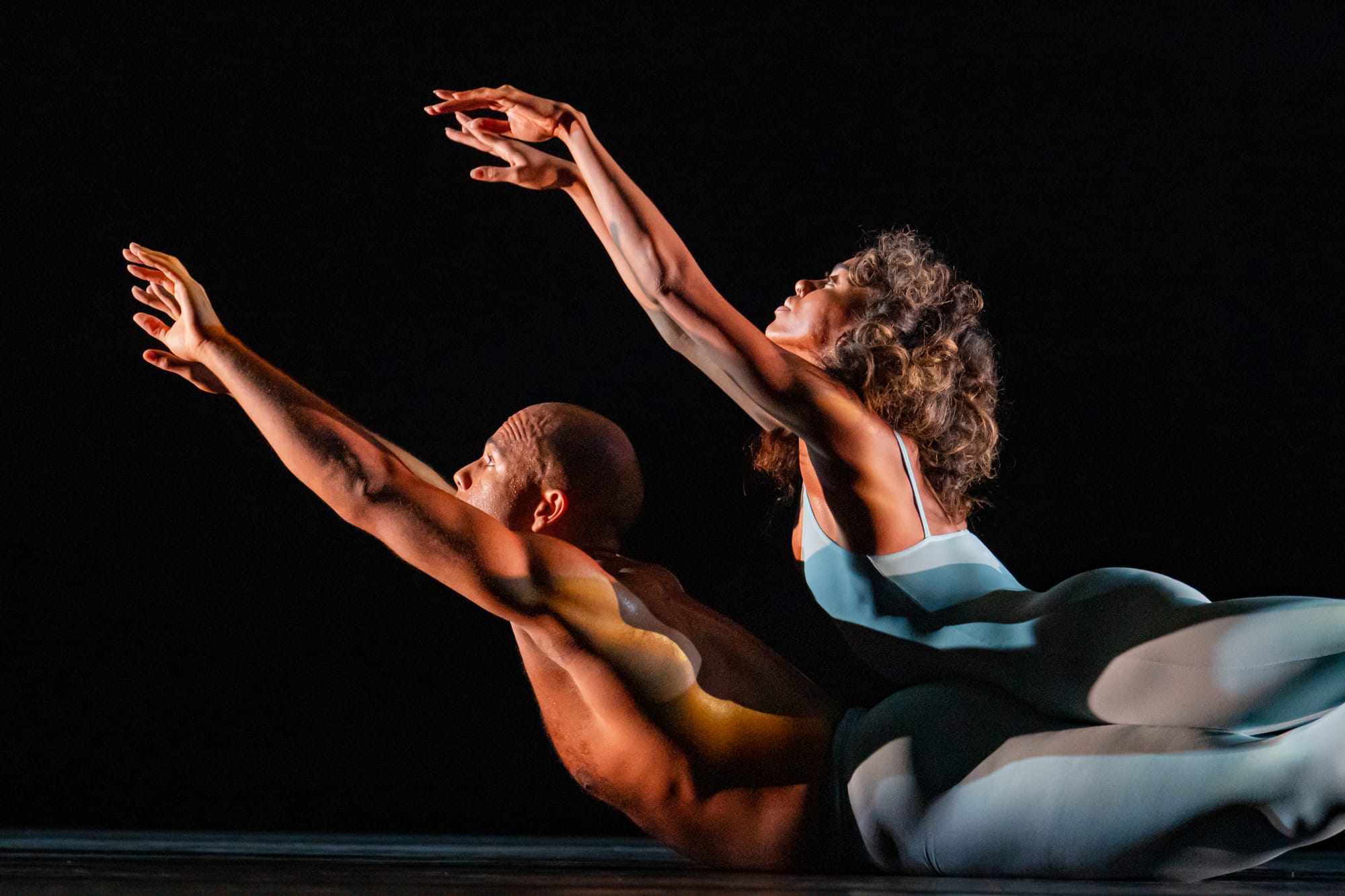
In a tonal shift toward the somber, after intermission "Sea Shadow" began with a man alone – beached, lost, perhaps shipwrecked. Intended to be an ode to Ondine – a man enamored with a sea creature – Kouadio Davis wandered the stage, discovering a seashell. He listened to it, and his movements immediately suggested a longing. Moments after he lay down on the floor, succumbing to a dream, Kamala Saara emerged from the back of the dimly lit stage, and the dance began in earnest.
Her interactions with Davis were not a seduction in a classic sense, as there was kindness and yearning, and lilting phrasing in their exchanges that signaled her allure was otherworldly. Ultimately, they ended up on the floor, rolling away together, presumably into the ocean – a dubious ending but for the sheer beauty of the dancers’ preceding exchanges. Choreographically, that’s what the ballet leaned on – great presence, line and aesthetic. There was little more there than many balances, lifts and embraces, and many body waves that sometimes too literally evoked ocean swells. If the ballet told a story, it did so in perhaps too many words. At least though, they were beautiful, even if they didn't quite coalesce into a compelling narrative.
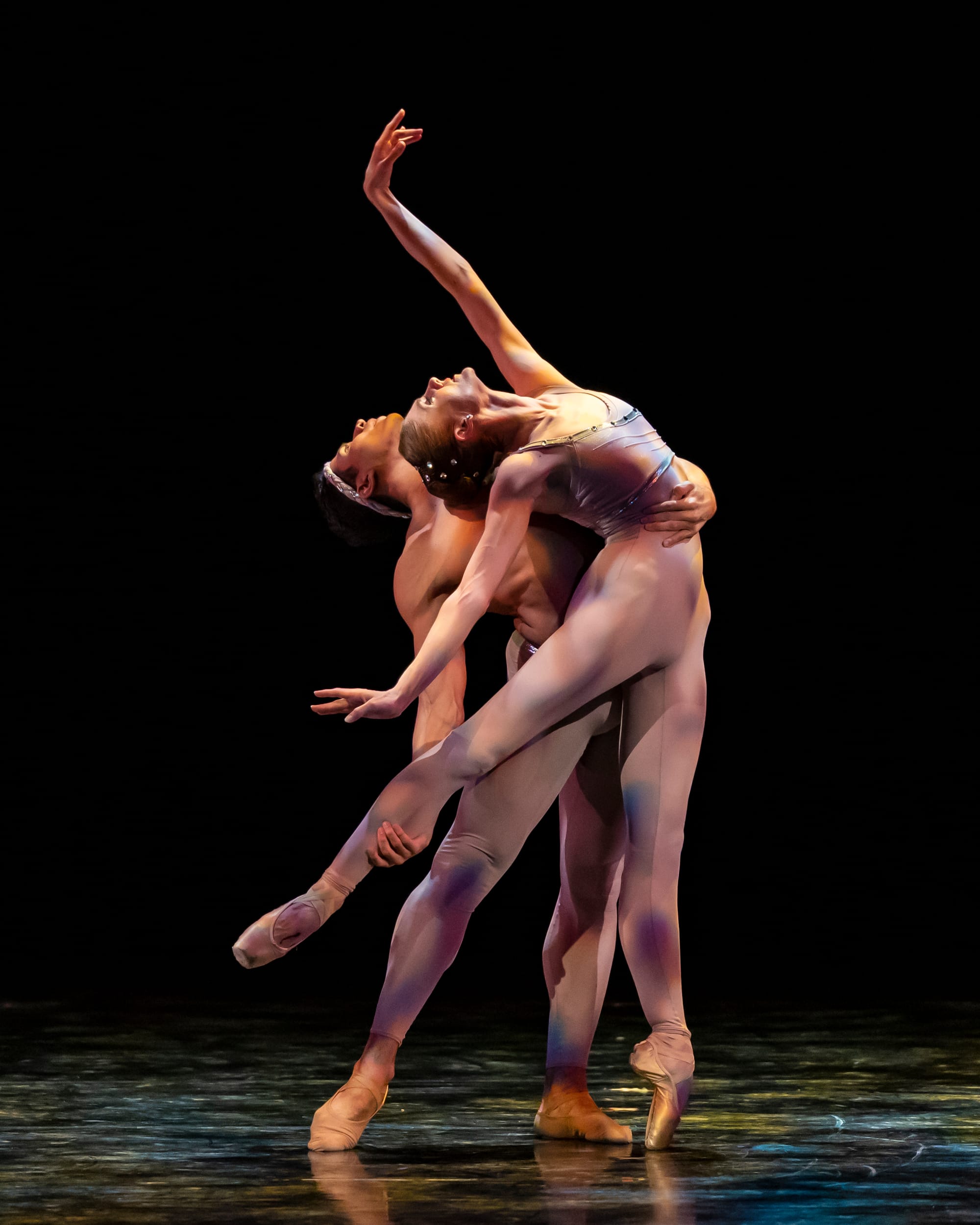
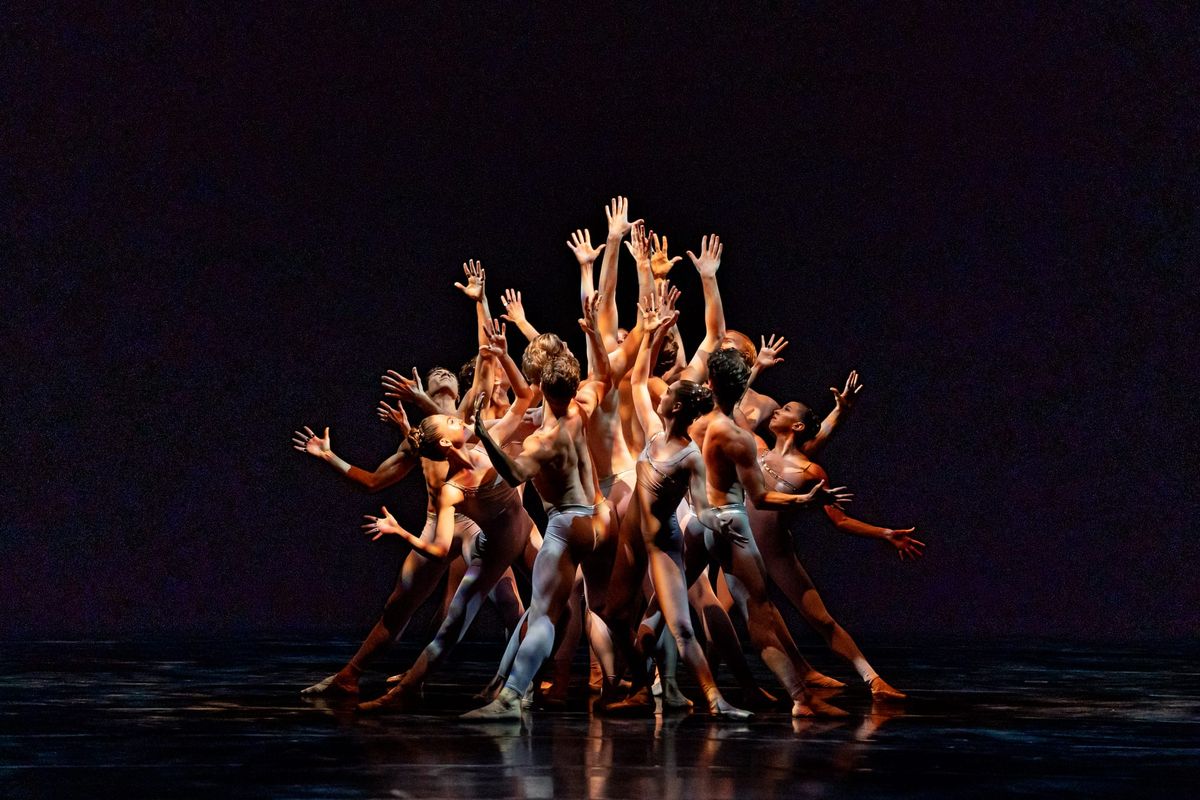
Fortunately, "Light Rain" was the perfect piece to wash away any lingering doubts and close the program on a high, and perhaps a little outrageous, note. Starting with a group of Ballet West dancers in a tight cluster, their small, jerky movements resembling either twitches to dodge raindrops or a fleeting struggle against self-restraint, this iconic work exploded with unrestrained exuberance. As a piece of choreography, it’s many things other than polite and modest – probably its best characteristic. One wants to imagine Arpino deciding to ignore how the work might be received and fully having fun with its composition while giving the dancers a chance to shine: it’s acrobatic yet delicate, at times comical and boldly in-your-face, but with an obvious playful edge. The dancers’ hands fluttered and hips swayed to a pulsating score, blending classical ballet’s elegance with a sensual, almost rebellious energy. All this, with an expert delivery from Ballet West, and particularly Katlyn Addison as the female lead full of allure, control and engagement.
With these and the other program’s three works, what can be said about Arpino and his choreography? Given the historical time and place of his creative opus, one might be tempted to try and compare him to George Balanchine and Jerome Robbins, or view his work in their context. And that would be inappropriate. Arpino was not a world-renowned, prodigious creator, nor one who hailed from the Imperial Ballet School in Russia or had an exciting Broadway background. That is precisely what makes his work interesting – he was a crafter amidst the greats, boldly paving the way for something new, completely unafraid to raise eyebrows. In that sense, he's a great representation of the Americana of dance that yielded so many great works (amid the many flops) from this country's truly impressive range of choreographers. And while Arpino may not have been a master architect, the Festival proves he was an excellent builder, and the house he constructed still stands, vibrant, full of life and quite inviting.
copyright © 2025 by Marianne Adams



