An Unquiet Mind
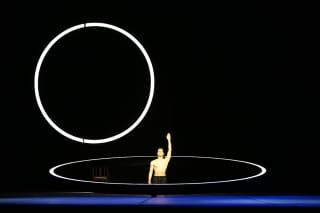
"Nijinsky"
The National Ballet of Canada
Four Seasons Centre for the Performing Arts
Toronto, Canada
November 22, 2017
Fresh from bringing John Neumeier's "Nijinsky" to Paris' Théâtre des Champs-Elysées in October, the National Ballet of Canada performed this ambitious work in their home theatre with renewed vigor. One can only imagine how powerful it must have been for the company to perform a ballet about this dance legend on the very stage where his "Le Sacre du Printemps" premiered in 1913. The entire performance was very strong and the dancers looked confident and well-rehearsed. Rather than a linear biographical narrative, Neumeier presents a melange of swirling vignettes that is part retrospective, reverie, and hallucination. The perspective is not that of an impartial observer; rather the ballet represents Vaslav Nijinsky's chaotic inner world with all its ambiguities, fantasies and trauma.
"Nijinsky" starts at the end of his professional career – his final performance in 1919 in an ostentatious hotel in St. Moritz. It is evident that he is already mentally ill at this point, as he enters the pristine ballroom swaddled in blankets. Psychologically, he appears child-like and regressed. Physically, however, he is at the peak of his dancing abilities. What follows is a brilliant solo with flashes of choreography from celebrated roles interspersed with seemingly improvised angular, avant-garde movements. As the dance star, Guillaume Côté, bursts onto the stage, he is in turn bravura and playful. Signs of his psychosis intersperse the moments of lucidity though. He is completely disconnected from his audience and responds to sights and sounds that are not there. Suddenly, he thinks he sees his mentor and impresario, Serge Diaghilev (Evan McKie). This sets off a series of recollections.
Act I reads as a whirlwind tour of the golden age of the Ballets Russes. Different dancers represent the various stage personas of Nijinsky from Harlequin in "Carnaval", to the Spirit of the Rose in "Spectre de la Rose", to the Faun in "L'Après-midi d'un faune". These figures are not presented sequentially. They weave in and out of each other, entering and exiting the scene idiosyncratically and often presented without contextual elements from the individual ballets. This segment may be a bit opaque to viewers who are not already familiar with these ballets. Even for those who are, it is disorienting to see familiar and often iconic choreography, like famous moments of "Les Sylphides", set to different music (in this case, the theme from Rimsky-Korsakov's "Schéhérazade"). This act provides ample opportunities to highlight the range of talent amongst the male dancers of the company. Naoya Ebe was sensual and androgynous as the Spirit of the Rose and Francesco Gabriele Frola was magnetic as the Golden Slave in "Schéhérazade" and the Faun.
The thread running through Act I is Nijinsky's complicated relationship with Diaghilev. Through this flurry of memories and snippets of dance, Diaghilev carries Nijinsky like a child. There is such closeness between these two men, but Neumeier draws particular attention to the inherent power differential between them and subsequent emotional abuse. The central pas de deux between them is one of the most effective and memorable pas de deux for two men in the NBoC repertoire, unsettling as it is. Linking hands, the lean sideways away from each other, but then Diaghilev lets go without warning, sending Nijinsky stumbling. There is desire and intimacy but no trust or reciprocity.
The turning point in the middle of the ballet is his flirtation with and impulsive marriage to Romola, which ultimately fractures his relationship to Diaghilev, and in turn, the Ballets Russes. As Romola, Heather Ogden pursues Nijinsky aggressively. In a pas de trois between her, Nijinsky, and the Faun, it becomes clear that she is infatuated with the eroticism he embodies on stage rather than the sensitive artist himself. Nijinsky finds himself lost – married to a woman he barely knows and alienated from his creative community.
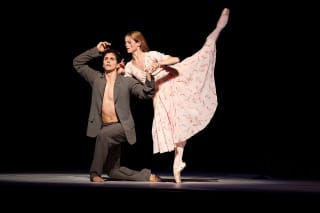
Act II begins with destruction. Diaghilev storms across the stage, knocking down panels that land with a heavy thud. The opulent score from "Schéhérazade" is replaced with Shoshtakovich's somber Sonata for Viola and Piano. The color of the previous act is washed out as the collapse of Nijinsky's world coincides with the horrors of the First World War. The corps, dressed in a version of army fatigues, are particularly strong here. Personal tragedies, such as the death of his brother, further contribute to Nijinsky's retreat from reality. A black and white-clad Petruschka symbolizing his struggle, bangs desperately on the wall downstage in front of the curtain. The pace here becomes meandering at times as corps from Act I, dressed in costume for"Schéhérazade" or simple classroom attire, come and go. They dance similar steps and it seems somewhat repetitive.
There is also the problem of Neumeier's treatment of psychiatric illness in Act II. Nijinsky was diagnosed with schizophrenia and the ballet tries to depict the gradual deterioration of his mental state. However, this is done with stereotypical gestures that do little more than present caricatures of "madness". Given the nuance in the rest of the ballet, the inclusion of maniacal laughter and over the top thrashing is disappointing.
Côté gave everything he had in this performance, carrying the ballet from start the finish. He imbued the role with pathos and realism. Technically speaking, the role requires great stamina and a fearless attack, which Côté most certainly delivered. Ogden's Romola was a layered character who tried her best to care for her ill husband while also succumbing to pulls towards infidelity. McKie was an imposing and disdainful Diaghilev, charming when he would get his way and frightening when he did not. Dylan Tedaldi gave a spirited performance as Nijinsky's brother, Stanislav.
Given the challenging subject matter and burden of depicting such well-known figures of the dance world, Neumeier's "Nijinsky" largely succeeds in bringing this tortured artist's history to life.
copyright © 2017 by Denise Sum